
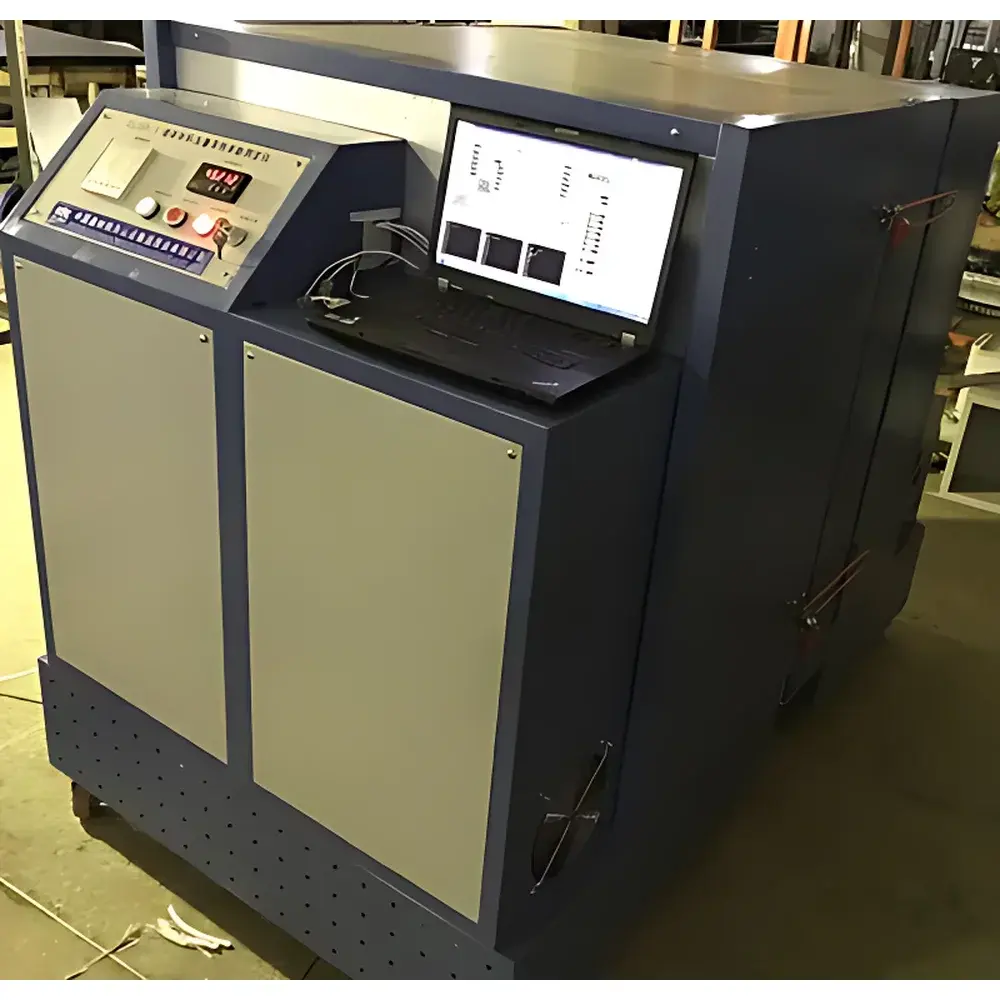
JB-16 Wall Material Equivalent Thermal Conductivity Analyzer
| Brand | Jiubin Instruments |
|---|---|
| Origin | Shanghai, China |
| Manufacturer Type | Authorized Distributor |
| Regional Classification | Domestic (PRC) |
| Model | JB-16 |
| Price Range | USD 7,000–14,000 |
| Measurement Principle | Laser Flash Method (ASTM E1461, ISO 22007-4 compliant) |
| Dimensions (L×W×H) | 3000 × 2200 × 1500 mm |
| Accuracy Class | 0.5 (per GB/T 7782–2008 & JJG 1044–2008) |
| Thermal Conductivity Test Range | 0.03–4.0 W/(m·K) |
| Repeatability | ≤ ±2.0% (at 23 °C, RH 50%, standard reference material NIST SRM 1453) |
Overview
The JB-16 Wall Material Equivalent Thermal Conductivity Analyzer is a high-stability, benchtop-scale thermal property measurement system engineered for precise determination of equivalent thermal conductivity (λeq) in heterogeneous, multi-layered building envelope materials—including autoclaved aerated concrete (AAC), expanded polystyrene (EPS) composites, mineral wool boards, gypsum-based panels, and sandwich wall systems. Unlike steady-state guarded-hot-plate instruments, the JB-16 employs the laser flash method (LFM), which delivers rapid, non-contact thermal diffusivity (α) measurements under transient heating conditions. By coupling measured α with known volumetric heat capacity (ρcp)—either pre-characterized or derived from complementary DSC data—the system calculates λeq = α × ρcp. This approach is particularly suited for low-conductivity, anisotropic, or moisture-sensitive specimens where conventional steady-state techniques require excessive equilibration time (>24 h) or risk edge-loss artifacts. The instrument complies with ASTM E1461 (Standard Test Method for Thermal Diffusivity of Solids), ISO 22007-4 (Plastics — Determination of Thermal Conductivity and Thermal Diffusivity — Part 4: Laser Flash Method), and Chinese national metrological verification regulation JJG 1044–2008.
Key Features
- Integrated high-energy Nd:YAG pulsed laser source (1.064 µm, 0.8–1.2 J pulse energy, 0.3–1.0 ms pulse width) with automated beam homogenization and shutter control
- Dual-channel InSb infrared detector array with liquid-nitrogen-cooled optics, enabling simultaneous front- and rear-surface temperature rise capture at 10 kHz sampling rate
- Modular sample chamber with vacuum-tight sealing (≤10−2 mbar base pressure), inert gas purge capability (N2/Ar), and programmable temperature control (−20 °C to +150 °C, ±0.5 °C stability)
- Automated sample positioning stage with micrometer-level Z-axis adjustment and real-time alignment feedback via integrated CCD visualizer
- Embedded calibration suite using NIST-traceable reference standards (e.g., NIST SRM 1453, Pyroceram 9606, and sapphire disks) for both diffusivity and emissivity correction
- Rugged steel-frame architecture with vibration-damped optical table integration and EMI-shielded electronics enclosure
Sample Compatibility & Compliance
The JB-16 accommodates disk-shaped specimens ranging from Ø10 mm to Ø25.4 mm and thicknesses between 0.5 mm and 10 mm. Custom holders support irregular geometries up to 100 × 100 mm planar area with optional edge-sealing gaskets. It is validated for use with porous, fibrous, and composite construction materials per GB/T 10294–2008 (Steady-State Thermal Resistance), GB/T 20473–2021 (Building Thermal Insulation Mortar), and JGJ/T 283–2012 (Testing Methods for Thermal Performance of Building Envelope). All firmware and calibration records conform to GLP documentation requirements, supporting audit readiness for ISO/IEC 17025-accredited laboratories. Raw thermal response data files are timestamped, digitally signed, and stored with full metadata (operator ID, ambient conditions, calibration history), satisfying traceability mandates under CNAS-CL01:2018.
Software & Data Management
The proprietary ThermalLab v4.2 software (Windows 10/11 64-bit) provides full instrument control, real-time thermal curve visualization, and ISO-compliant data reduction. Key modules include: (1) Pulse analysis engine applying Cowan’s two-layer model correction for finite-thickness effects; (2) Emissivity compensation wizard using iterative least-squares fitting against reference blackbody curves; (3) Batch processing workflow with customizable report templates (PDF/Excel) aligned with GB, ASTM, and EN formatting conventions; (4) Audit trail log recording all parameter changes, user logins, and calibration events with read-only export for FDA 21 CFR Part 11 compliance (electronic signature support available via optional PKI module). Data backups are auto-synced to network drives or encrypted cloud repositories with AES-256 encryption.
Applications
- Quality assurance of prefabricated insulation panels and structural insulated panels (SIPs) in green building certification workflows (LEED, China Green Building Label)
- R&D validation of phase-change material (PCM)-integrated drywall and thermal mass composites
- Thermal bridging quantification in multi-material junctions (e.g., concrete frame + EPS infill)
- Moisture-dependent λeq profiling across RH-controlled hygrothermal cycles (requires optional humidity chamber add-on)
- Regulatory submission support for CCC (China Compulsory Certification) and CE marking of building products
- Inter-laboratory round-robin testing under CMA (China Metrology Accreditation) proficiency schemes
FAQ
What standards does the JB-16 comply with for building material certification?
The system meets ASTM E1461, ISO 22007-4, GB/T 10294–2008, and JJG 1044–2008 for thermal diffusivity and equivalent conductivity determination.
Can the JB-16 measure anisotropic materials such as oriented fiberboards?
Yes—by rotating the specimen holder and performing orthogonal directional scans, the system supports in-plane vs. through-plane diffusivity differentiation.
Is sample preparation required to be strictly flat and parallel?
Surface parallelism within ±0.05 mm and roughness < Ra 0.8 µm is recommended; the software includes geometric error compensation algorithms for minor deviations.
Does the instrument support automated long-term stability monitoring?
Yes—built-in drift diagnostics run hourly self-checks on laser energy output, detector responsivity, and ambient temperature offset, logging trends for preventive maintenance scheduling.
How is calibration traceability documented for regulatory audits?
Each calibration event generates a PDF certificate with NIST SRM lot numbers, uncertainty budgets (k=2), technician signatures, and instrument serial linkage—exportable in CSV or XML for LIMS integration.



