
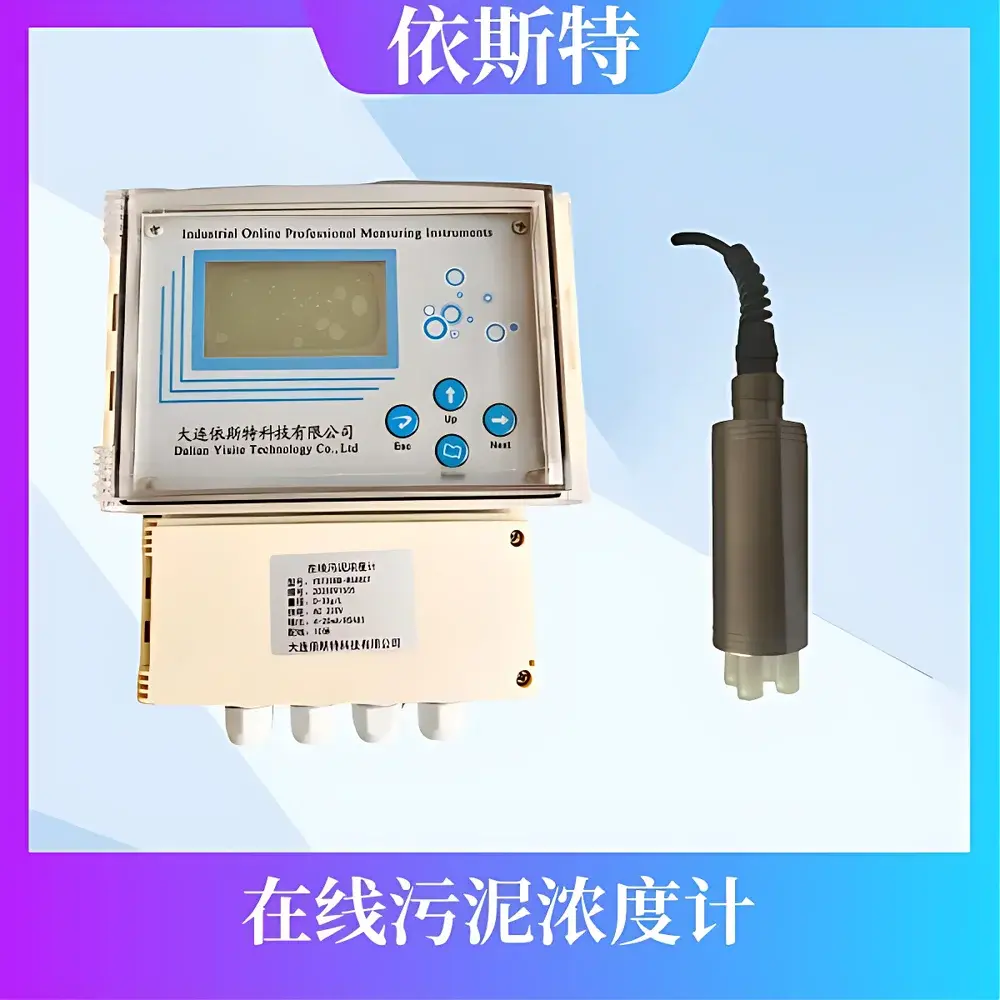
YST308B-MS880T Submersible Sludge Concentration Monitor
| Brand | YST (Dalian Yist Environmental Technology) |
|---|---|
| Origin | Liaoning, China |
| Model | YST308B-MS880T |
| Measurement Range | 0–20 g/L |
| Accuracy | ±1% FS |
| Resolution | 0.01 g/L |
| Operating Temperature | 0–60 °C |
| Relative Humidity | <85% RH |
| Enclosure Rating | IP65 (transmitter), IP68 (sensor) |
| Power Supply | 90–260 V AC or 12–24 V DC |
| Output Signals | 4–20 mA analog, RS485 digital (Modbus RTU) |
| Sensor Material | SUS316L stainless steel |
| Sampling Interval | Adjustable from 1 to 30 minutes |
| pH Tolerance | 2–12 |
| Optical Principle | Near-infrared (NIR) backscatter turbidimetry |
Overview
The YST308B-MS880T Submersible Sludge Concentration Monitor is an industrial-grade optical sensor engineered for continuous, real-time measurement of suspended solids concentration in aqueous environments—particularly activated sludge, return activated sludge (RAS), waste activated sludge (WAS), and high-turbidity process streams. It operates on the principle of near-infrared (NIR) backscatter turbidimetry, where an integrated NIR LED emits light into the medium, and a precisely aligned photodetector measures the intensity of scattered photons at a fixed angular geometry. This configuration minimizes interference from color, bubble entrainment, and particle size distribution shifts commonly observed in biological wastewater treatment systems. Unlike lab-based gravimetric or centrifugation methods, the YST308B-MS880T delivers in-situ, non-invasive quantification without sample extraction, reagent consumption, or flow cell clogging—enabling uninterrupted process insight across municipal WWTPs, pulp & paper effluent lines, mining tailings ponds, and food processing wastewater channels.
Key Features
- Submersible probe design with IP68-rated SUS316L stainless steel housing—resistant to corrosion in pH 2–12 environments, including aggressive industrial effluents and high-salinity brines.
- Integrated temperature compensation algorithm and dynamic turbidity correction logic mitigate drift caused by thermal expansion, refractive index variation, and background particulate noise.
- Dual-output interface: isolated 4–20 mA analog signal for direct PLC/DCS integration and Modbus RTU over RS485 for bidirectional communication, data logging, and remote configuration.
- Configurable sampling interval (1–30 minutes) supports adaptive monitoring strategies—from rapid feedback loops in clarifier control to long-term trend analysis in sludge blanket profiling.
- Self-diagnostic firmware continuously monitors sensor fouling status, cable integrity, optical path attenuation, and power stability—triggering event-based alerts via output signal modulation or Modbus register flags.
- Low-maintenance optical window geometry with minimal surface area reduces biofilm adhesion; optional ultrasonic cleaning module (accessory) available for extended deployment in viscous or fibrous media.
Sample Compatibility & Compliance
The YST308B-MS880T is validated for use in heterogeneous, non-homogeneous suspensions containing organic flocs, mineral precipitates, cellulose fibers, and colloidal iron oxides. Its NIR optical band (850 nm) exhibits reduced sensitivity to dissolved chromophores compared to visible-light turbidimeters, improving robustness in colored wastewaters (e.g., textile dye effluents, tannery discharge). While not certified to IEC 61508 (SIL) or ATEX/IECEx standards, the device complies with EMC Directive 2014/30/EU and Low Voltage Directive 2014/35/EU. Its analog and digital outputs conform to ISA-50.00.01 (analog signal integrity) and ISA-88 Part 1 (batch control data structures) guidelines. For GLP/GMP-aligned facilities, audit trails can be implemented via external SCADA historian systems capturing timestamped Modbus register reads—including diagnostic registers (e.g., fouling index, temperature deviation, signal-to-noise ratio).
Software & Data Management
The monitor does not include embedded GUI software but is fully interoperable with industry-standard platforms: Siemens Desigo CC, Honeywell Experion PKS, Emerson DeltaV, and open-source solutions such as Node-RED or Grafana via Modbus TCP gateway. Configuration is performed using a handheld terminal or PC-based utility supporting parameter write-through (e.g., zero calibration offset, damping factor, unit scaling). All measurements are timestamped with millisecond resolution and support linear scaling to user-defined engineering units (e.g., g/L, %TS, mg/L SS). Data retention relies on upstream historian systems; however, local non-volatile memory retains up to 72 hours of 1-minute interval readings for recovery during brief communication outages. Firmware updates are delivered via ASCII-based Modbus file transfer protocol (MBAP), requiring no physical access to the transmitter housing.
Applications
- Secondary clarifier optimization: Real-time sludge blanket level tracking enables predictive underflow pump control and prevents sludge bulking-induced effluent turbidity excursions.
- RAS/WAS flow balancing: Continuous concentration input improves mass-balance calculations in nutrient removal models (e.g., ASM1/ASM3), supporting dynamic DO setpoint adjustment in aerobic zones.
- Industrial pre-treatment compliance: Monitors settleable solids loading in equalization basins prior to downstream membrane bioreactors (MBRs) or tertiary filtration—reducing fouling risk and extending cartridge life.
- Mining tailings management: Deployed in thickener feed wells and overflow launders to maintain optimal underflow density and prevent cyclone overload or pipeline sedimentation.
- Food & beverage process water reuse: Tracks yeast, starch, and protein particulates in CIP rinse streams to validate cleaning efficacy and reduce freshwater consumption.
FAQ
What calibration procedures are required?
Factory calibration is traceable to NIST-certified suspended solids standards (kaolin or polystyrene latex suspensions). Field verification uses clean water zero and single-point span check with certified reference suspension (e.g., 10 g/L kaolin); full two-point calibration is optional and supported via Modbus register write.
Can the sensor operate in aerated basins?
Yes—the NIR optical path is insensitive to microbubble interference typical of fine-pore diffusers; however, gross air entrainment (>5% v/v) may require installation below the aerated zone or use of a stilling well.
Is temperature compensation automatic?
Yes—integrated Pt1000 RTD provides real-time thermal correction per ISO 7027:2016 Annex B methodology, eliminating manual coefficient entry.
How often does the optical window require cleaning?
Under typical municipal WWTP conditions, cleaning intervals range from 3–6 months; in high-fouling applications (e.g., pulp stock, dairy whey), quarterly inspection is recommended. The self-diagnostic fouling index provides quantitative indication prior to performance degradation.
Does the device meet regulatory reporting requirements for NPDES permits?
While the instrument itself is not EPA-certified for compliance-grade reporting, its measurement uncertainty (±1% FS) meets the data quality objectives specified in EPA Method 160.1 for suspended solids estimation when deployed per ASTM D3694-18 (sampling representativeness) and validated against grab samples at least quarterly.
Related Products







