
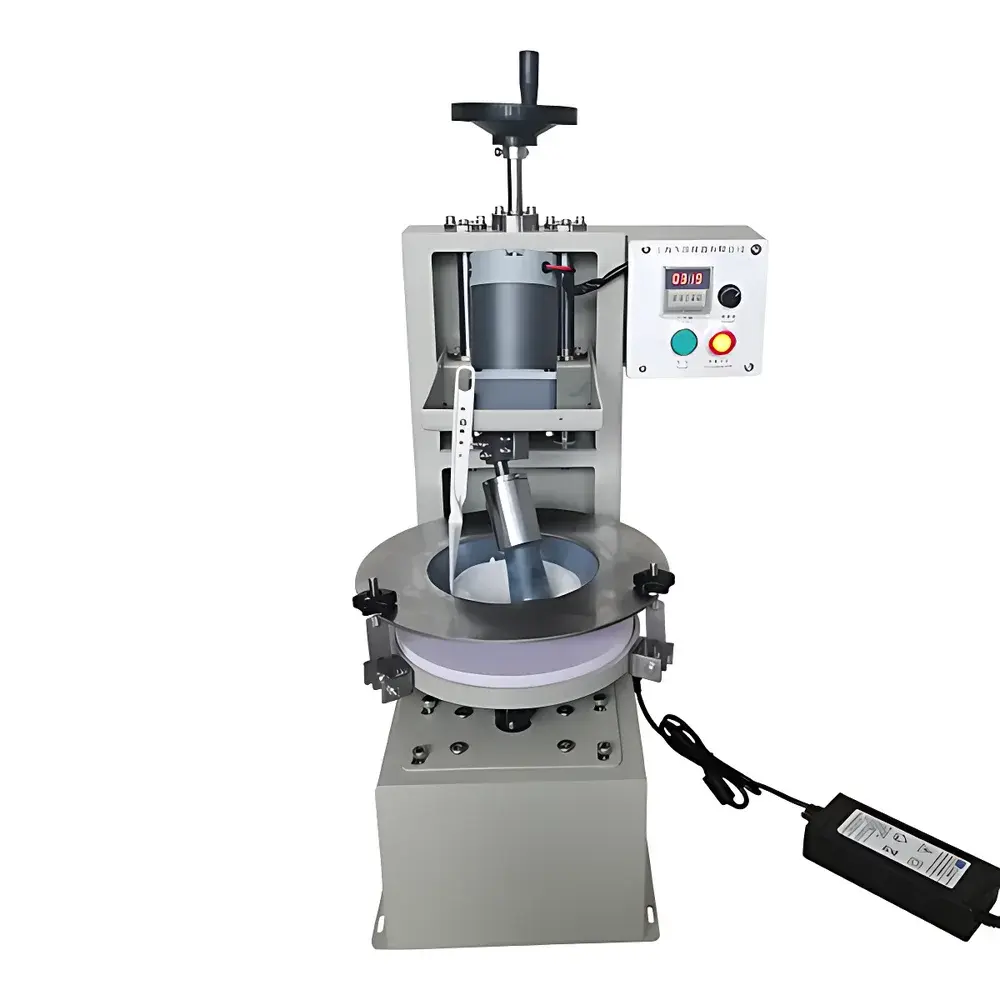
Jiubin JB-120 Single-Head Agate Mortar Grinder
| Brand | Jiubin |
|---|---|
| Origin | Shanghai, China |
| Model | JB-120 |
| Grinding Bowl Diameter | 120 mm |
| Pestle Speed | 100 rpm |
| Mortar Speed | 10 rpm |
| Pestle Power | 30 W |
| Mortar Power | 40 W |
| Bowl & Pestle Material | Natural Agate |
| Dimensions (L×W×H) | 240 × 240 × 500 mm |
| Weight | 12 kg |
| Voltage | AC 220 V |
| Programmable Timer | Yes |
| Application | Dry & Wet Grinding of Hard/Brittle Materials |
| Compliance | Designed for GLP-compliant sample preparation workflows |
Overview
The Jiubin JB-120 Single-Head Agate Mortar Grinder is a precision laboratory instrument engineered for controlled, low-contamination comminution of hard, brittle, and chemically sensitive materials. It operates on the principle of shear-assisted compression grinding—mimicking traditional manual mortar-and-pestle techniques—but with reproducible rotational kinetics: the agate pestle rotates at 100 rpm while the agate mortar rotates eccentrically at 10 rpm, generating consistent mechanical energy input across the sample bed. This dual-speed differential enables progressive particle size reduction without thermal degradation or metallic leaching—critical for applications requiring elemental purity (e.g., semiconductor feedstock, pharmaceutical actives, or reference standards). Unlike ball mills or jaw crushers, the JB-120 avoids impact-driven fragmentation; instead, it relies on surface-to-surface attrition within a sealed, inert agate chamber, yielding narrow particle size distributions and minimizing amorphization risk in crystalline materials.
Key Features
- Natural agate grinding components (mortar and pestle) certified for chemical inertness—free from Fe, Cr, Ni, and other transition metal contaminants that compromise trace elemental analysis (ICP-MS, XRF)
- Programmable digital timer (0–99 min) enabling precise control over grinding duration, directly correlating to final particle size distribution (PSD); validated sub-100 nm median diameters achievable under optimized wet-grinding protocols
- Low-power, high-torque drive system (30 W pestle + 40 W mortar) designed for sustained operation without thermal drift—maintains < ±1.5 °C ambient temperature rise during 60-min continuous cycles
- Compact footprint (240 × 240 × 500 mm) and modular design facilitate integration into ISO Class 5/7 cleanrooms or fume hood–constrained analytical labs
- Single-head configuration ensures operator safety via interlocked lid mechanism; automatic shutdown upon lid opening per IEC 61000-6-2 EMC and IEC 61000-6-4 emission standards
Sample Compatibility & Compliance
The JB-120 accommodates dry and solvent-based (e.g., ethanol, isopropanol, aqueous surfactant dispersions) grinding of materials with Mohs hardness ≤9, including diamond abrasives, silicon carbide, fused silica, pharmaceutical APIs (e.g., ibuprofen, paracetamol), iodine crystals, epoxy resin powders, and roasted coffee beans. Its agate construction complies with USP particulate matter testing requirements for parenteral-grade excipients and meets ASTM D2842–22 criteria for non-metallic abrasive grain size classification. For regulated environments, the instrument supports audit-ready documentation: grinding time logs are retained locally (non-volatile memory) and exportable via USB—aligning with FDA 21 CFR Part 11 data integrity expectations when paired with validated LIMS integration.
Software & Data Management
While the JB-120 operates via embedded microcontroller (no PC dependency), its timer firmware stores up to 20 user-defined grinding protocols—including speed profiles, dwell times, and pause intervals—with timestamped execution records. All parameters are accessible via front-panel LCD with backlight. Optional RS-232/USB interface (sold separately) enables remote parameter upload/download and synchronization with laboratory information management systems (LIMS) for full traceability. Data exports comply with CSV-UTF8 format, supporting automated QA/QC reporting in accordance with ISO/IEC 17025:2017 clause 7.5.2 (control of data).
Applications
- Preparation of ultrafine calibration standards for laser diffraction (Malvern Mastersizer) and dynamic light scattering (DLS) instrumentation
- Homogenization of brittle ceramic precursors prior to XRD phase quantification (Rietveld refinement)
- Size reduction of iodine microcrystals for radiopharmaceutical synthesis (GMP Annex 1-aligned workflows)
- Dispersion stabilization studies of nanoscale semiconductor powders (Si, GaAs) in colloidal suspensions
- Grinding of thermolabile APIs where cryomilling introduces moisture or nitrogen contamination risks
FAQ
Is the agate mortar and pestle supplied with certification of material origin and trace metal content?
Yes—each set includes a CoA specifying SiO₂ purity (>99.9%), heavy metal limits (Pb < 0.5 ppm, As < 0.1 ppm), and Mohs hardness (6.5–7.0), verified by third-party SEM-EDS and ICP-OES analysis.
Can the JB-120 be used under inert atmosphere (e.g., argon glovebox)?
The unit is compatible with glovebox integration; optional stainless-steel enclosure kit (JB-ENC-SS) provides IP54-rated sealing and electrical feedthroughs rated for <1% O₂ environments.
What maintenance is required to ensure long-term dimensional stability of the agate components?
Agate surfaces require periodic inspection under 10× magnification for microfractures; cleaning must use deionized water and lint-free cellulose wipes—no ultrasonication or acidic solvents. Recommended recalibration every 500 operating hours using NIST-traceable glass microspheres (10–50 µm).
Does the instrument meet electromagnetic compatibility requirements for use near NMR or electron microscopy suites?
Yes—the JB-120 conforms to CISPR 11 Group 1 Class B emissions limits and exhibits < 25 mV/m radiated field strength at 3 m distance, verified per EN 61326-1:2013.
How is particle size distribution verified post-grinding?
We recommend orthogonal validation: laser diffraction (dry dispersion mode) for D10/D50/D90 reporting, supplemented by TEM imaging for morphology assessment and BET surface area analysis for specific surface correlation.



