
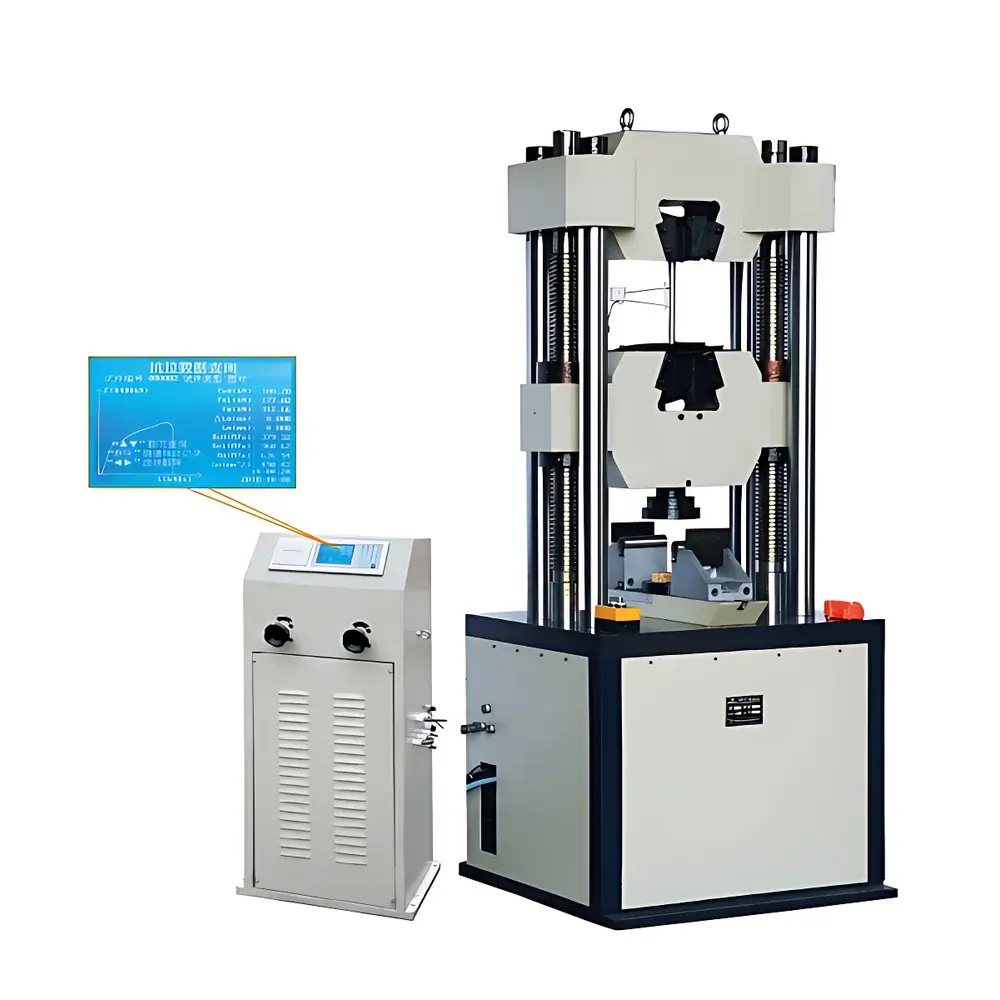
JB/WE-1000D Hydraulic Universal Testing Machine by Jiubin Instruments
| Brand | Jiubin Instruments |
|---|---|
| Origin | Shanghai, China |
| Model | JB/WE-1000D |
| Type | Hydraulic Universal Testing Machine |
| Max Test Force | 1000 kN |
| Force Measurement Range | 50–1000 kN |
| Force Accuracy | ≤ ±1% of reading |
| Force Resolution | 0.01 kN |
| Tensile Space | 750 mm |
| Compression Space | 380 mm |
| Piston Stroke | 150 mm |
| Round Specimen Grip Range | Φ13–Φ40 mm |
| Flat Specimen Grip Thickness | 0–15 mm |
| Flat Specimen Grip Width | 75 mm |
| Compression Platen Diameter | φ160 mm |
| Bend Span (Two-Point) | 450 mm |
| Bend Support Roll Width | 140 mm |
| Bend Support Roll Diameter | Φ40 mm |
| Piston Speed | 50 mm/min |
| Clamping Method | Hydraulic |
| Overall Dimensions (L×W×H) | 900×710×2200 mm |
| Control Cabinet Dimensions (L×W×H) | 1000×700×1400 mm |
Overview
The JB/WE-1000D Hydraulic Universal Testing Machine is a robust, oil-cylinder-underneath configured mechanical testing system engineered for high-capacity static mechanical property evaluation of metallic and non-metallic materials. Designed in accordance with fundamental principles of axial force application under controlled displacement or load control, the machine operates via a servo-controlled hydraulic actuation system that delivers stable, repeatable force output across its full 1000 kN capacity. Its low-profile architecture—featuring a bottom-mounted main cylinder—minimizes overall height while maintaining structural rigidity, making it especially suitable for field deployment in construction sites, prefabrication yards, and quality control laboratories where ceiling clearance or transport logistics are constrained. The system complies with core mechanical testing standards including ASTM E4 (Standard Practices for Force Verification of Testing Machines), ASTM E8/E8M (Tension Testing of Metallic Materials), ASTM C39 (Compressive Strength of Cylindrical Concrete Specimens), and ISO 6892-1 (Metallic Materials – Tensile Testing – Part 1: Method of Test at Room Temperature).
Key Features
- Hydraulic actuation with dual-range force measurement (50–1000 kN), ensuring high linearity and repeatability across both low-load verification and high-capacity structural testing.
- Integrated digital force transducer (calibrated pressure sensor from Ningbo Zhenhai) with real-time LCD display of load–time curves, peak load, yield point detection for materials exhibiting distinct yielding behavior (e.g., carbon steels, aluminum alloys).
- Direct input interface for specimen identification number and cross-sectional area—enabling automatic calculation and on-screen display of tensile strength (Rm), yield strength (ReH, Rp0.2), and elongation at break (A50 or A80) per ISO 6892-1 or ASTM E8 conventions.
- Hydraulically actuated wedge-type grips ensure uniform clamping pressure distribution and minimize slippage during high-force tensile tests on round (Φ13–Φ40 mm) and flat (0–15 mm thick × 75 mm wide) specimens.
- Dedicated compression platen (φ160 mm) and bend fixture (450 mm support span, Φ40 mm rollers, 140 mm roller width) allow standardized evaluation of concrete cubes, cement mortars, ceramic tiles, and structural components per ASTM C39, EN 12390-3, and GB/T 232.
- Self-contained control cabinet includes embedded microprocessor-based controller, thermal mini-printer for immediate hardcopy output of test reports, and non-volatile memory for local storage of up to 500 test records.
Sample Compatibility & Compliance
The JB/WE-1000D accommodates a broad spectrum of standard and custom specimens without requiring external adapters. It supports routine testing of hot-rolled steel bars (HRB400, HRB500), welded wire mesh, prestressed strands, structural timber elements, polymer composites, and hardened concrete cylinders (150 mm × 300 mm). All standard fixtures—including dual-range round grips (Φ13–Φ26 mm and Φ26–Φ40 mm), flat grip set (0–15 mm), compression platen, and three-point bend assembly—are manufactured to dimensional tolerances specified in ISO 7500-1 (static calibration of force-proving instruments) and verified traceable to national metrological standards. The machine’s force indication error (≤ ±1% of reading) and resolution (0.01 kN) meet Class 1 accuracy requirements per ISO 7500-1 and are suitable for GLP-compliant material certification workflows.
Software & Data Management
While the base configuration relies on embedded firmware with LCD interface and thermal printer output, optional PC-based software (Jiubin TestLink v3.x) enables extended functionality: synchronized data logging at 10 Hz, customizable report templates compliant with ISO/IEC 17025 documentation requirements, audit trail generation (user ID, timestamp, parameter changes), and export to CSV, PDF, or XML formats. The software supports 21 CFR Part 11–compatible electronic signatures when deployed in regulated environments, and maintains version-controlled calibration history aligned with internal QA protocols. Raw load–displacement data is stored with metadata (specimen ID, operator, date/time, environmental conditions) to facilitate root-cause analysis and long-term trend monitoring.
Applications
- Mechanical verification of reinforcing steel (rebar) per ASTM A615/A615M and GB/T 1499.2.
- Compressive strength assessment of concrete cores and molded cylinders in accordance with ASTM C39, EN 12390-3, and JGJ/T 23.
- Quality assurance testing of anchor bolts, lifting shackles, and structural fasteners under static tensile loading.
- Bending performance evaluation of roofing sheets, metal decking, and cold-formed steel sections (ASTM C794, EN 14782).
- Routine mechanical screening of geosynthetic reinforcement grids and polymer-based civil engineering materials.
- Factory acceptance testing (FAT) of precast concrete elements prior to site delivery.
FAQ
What is the maximum allowable piston speed during testing?
The nominal piston travel speed is fixed at 50 mm/min under full-load conditions; this value is optimized for stability and force fidelity in high-capacity hydraulic systems and conforms to standard displacement rates defined in ASTM E8 and ISO 6892-1 for quasi-static testing.
Is third-party calibration certification available?
Yes—Jiubin provides optional factory calibration certificates traceable to CNAS-accredited laboratories (China National Accreditation Service), including as-found/as-left data, uncertainty budgets, and compliance statements against ISO/IEC 17025.
Can the machine be integrated into a central LIMS environment?
Via optional RS-232 or Ethernet interface and TestLink API, raw test data and summary metrics can be exported programmatically to LIMS platforms supporting HL7, ASTM E1384, or custom RESTful ingestion protocols.
Does the system support closed-loop strain control?
No—the JB/WE-1000D operates in open-loop load control mode only; for closed-loop strain or displacement control, consider the servo-hydraulic JB/WE-1000S variant equipped with extensometer interface and advanced motion controller.
What maintenance intervals are recommended for hydraulic oil and filter replacement?
Jiubin recommends hydraulic oil replacement every 2,000 operating hours or biannually (whichever occurs first), and filter cartridge replacement every 500 hours or quarterly, using ISO VG 46 anti-wear hydraulic fluid meeting DIN 51524 Part 2 specifications.



