
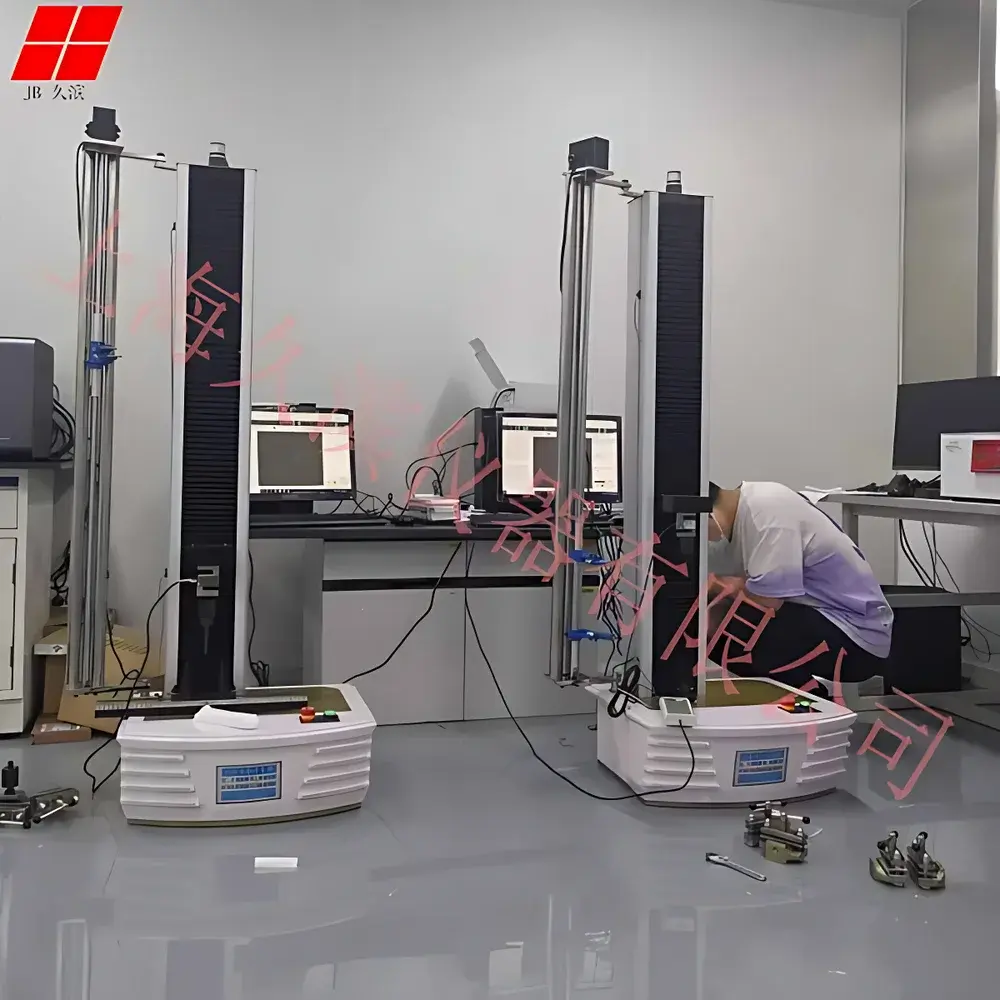
Jiubin JB-119 Digital Display Tensile Testing Machine for Flexible Foam
| Brand | Jiubin |
|---|---|
| Origin | Shanghai, China |
| Model | JB-119 |
| Instrument Type | Electronic Tensile Testing Machine |
| Max Test Force | Customizable (Standard Configuration: 100 N) |
| Force Range | 2–100% FS (2–100 N) |
| Force Accuracy | ±1% FS |
| Minimum Force Resolution | 0.1 N |
| Crosshead Speed | 1–500 mm/min (Infinitely Variable) |
| Displacement Accuracy | ±1% |
| Stroke | 600 mm |
| Speed Control Accuracy | ±1% |
| Display | LCD (Real-time Force, Displacement, Peak Load, Status, Speed) |
| Protection | Dual-stage (Mechanical + Software) Overload & Limit Protection |
| Power Supply | 220 V, 50 Hz |
| Weight | ~120 kg |
| Dimensions (W×D×H) | ~420 × 400 × 1580 mm |
| Compliance | GB/T 6344-2008, GB/T 1040.1-2018, GB/T 16825-2008, ISO 7500-1:2006, GB/T 16491-2008 |
Overview
The Jiubin JB-119 Digital Display Tensile Testing Machine for Flexible Foam is a precision-engineered single-axis electromechanical testing system designed specifically for mechanical characterization of low-modulus polymeric foams. It operates on the principle of controlled displacement-driven loading, where a motorized crosshead applies uniaxial tensile, compressive, or cyclic loads to specimens while continuously measuring force and displacement via high-stability load cell and linear encoder feedback. The system adheres to fundamental metrological requirements defined in ISO 7500-1:2006 and GB/T 16825-2008 for static testing machines, ensuring traceable force measurement accuracy within ±1% of full scale. Its structural architecture—featuring rigid C-frame construction, precision-ground lead screws, and anti-backlash drive mechanisms—minimizes parasitic deflection and ensures high reproducibility across repeated tests on compliant materials such as polyurethane (PU), ethylene-vinyl acetate (EVA), and expanded polyethylene (EPE) foams.
Key Features
- Automatic force calibration routine compliant with GB/T 16491-2008, enabling on-site verification without external reference standards
- Real-time synchronized acquisition of load and displacement data at configurable sampling rates, supporting dynamic curve visualization during test execution
- Intuitive Chinese-language LCD interface with menu-driven navigation—designed for operational efficiency in QC laboratories with mixed technical proficiency levels
- Multi-function capability: equipped with standardized mounting interfaces to accommodate interchangeable fixtures for tensile, compression, tear, peel, and flexural testing per ASTM D3574 and ISO 1798
- Programmable test protocols including preload application, constant-rate extension, break detection, and automatic return-to-start upon specimen failure
- Dual-layer safety architecture: hardware-based mechanical limit switches integrated with software-enforced travel boundaries prevent over-travel and protect both operator and transducer integrity
- Integrated overload protection circuitry that halts motion and alerts the user when applied force exceeds 110% of selected range, preserving load cell linearity and longevity
Sample Compatibility & Compliance
The JB-119 is optimized for soft cellular polymers with nominal densities between 15–120 kg/m³ and tensile strengths ranging from 0.02–0.5 MPa. It supports standard specimen geometries per GB/T 6344-2008 (dumbbell-shaped Type I, II, or III) and GB/T 1040.1-2018 (Type V for thin foams). All mechanical and electrical design elements conform to GB/T 2611-2007 for general requirements of testing machines, including surface finish, labeling, and environmental operating conditions (10–35 °C, ≤80% RH non-condensing). While not certified to ISO/IEC 17025 or FDA 21 CFR Part 11 out-of-the-box, the instrument’s deterministic control logic and audit-ready parameter logging (via optional RS232/USB export) provide foundational support for GLP-compliant documentation workflows in regulated R&D and quality assurance environments.
Software & Data Management
The embedded firmware enables local storage of up to 100 test records directly on the device, each containing timestamped force-displacement arrays, peak values, elongation at break, and modulus calculations (e.g., secant modulus at 10% strain). Data export is supported via USB flash drive in CSV format for post-processing in third-party analysis tools such as MATLAB, OriginLab, or Excel. Optional PC-based software (sold separately) adds advanced features including multi-curve overlay, statistical batch reporting (mean ± SD, CV%), pass/fail thresholding against specification limits, and PDF report generation with embedded calibration certificates. All digital outputs retain metadata such as operator ID, test date, environmental conditions (if externally logged), and instrument serial number—facilitating traceability under internal QA procedures.
Applications
This system serves as a core tool in foam formulation development, incoming raw material inspection, and finished product release testing. Typical use cases include: quantifying tensile strength and elongation at break of automotive seat cushioning foams; evaluating compression set resistance of packaging-grade EPE after thermal cycling; verifying consistency of medical-grade PU foam wound dressings per ISO 10993-10 biocompatibility pre-screening protocols; monitoring batch-to-batch variability in mattress core density gradients; and validating aging effects on flame-retardant additives through accelerated UV/ozone exposure followed by mechanical retesting. Its adaptability to auxiliary fixtures also extends utility to adhesion strength assessment of laminated foam composites used in HVAC insulation systems.
FAQ
What foam thickness ranges can be reliably tested on the JB-119?
Specimens from 5 mm to 50 mm thick are accommodated using standard grips; thinner samples (<5 mm) require optional pneumatic or serrated face grips to prevent slippage.
Is the machine compatible with international test standards beyond Chinese GB standards?
Yes—its force resolution (0.1 N), speed control fidelity (±1%), and stroke length meet minimum requirements for ISO 1798, ASTM D3574, and JIS K6400 series methods when configured with appropriate fixtures and calibration.
Can test data be exported in formats suitable for LIMS integration?
Raw CSV exports contain structured columns (Time[s], Force[N], Displacement[mm]) and can be parsed by most laboratory information management systems via custom ingestion scripts or middleware adapters.
Does the system support closed-loop strain control?
No—the JB-119 operates in displacement-control mode only; true closed-loop strain control requires an extensometer feedback loop, which is not included in the base configuration.
What maintenance intervals are recommended for long-term accuracy retention?
Annual verification of force calibration and displacement linearity is advised; lead screw lubrication and grip jaw inspection should occur every 6 months under continuous operation.



