
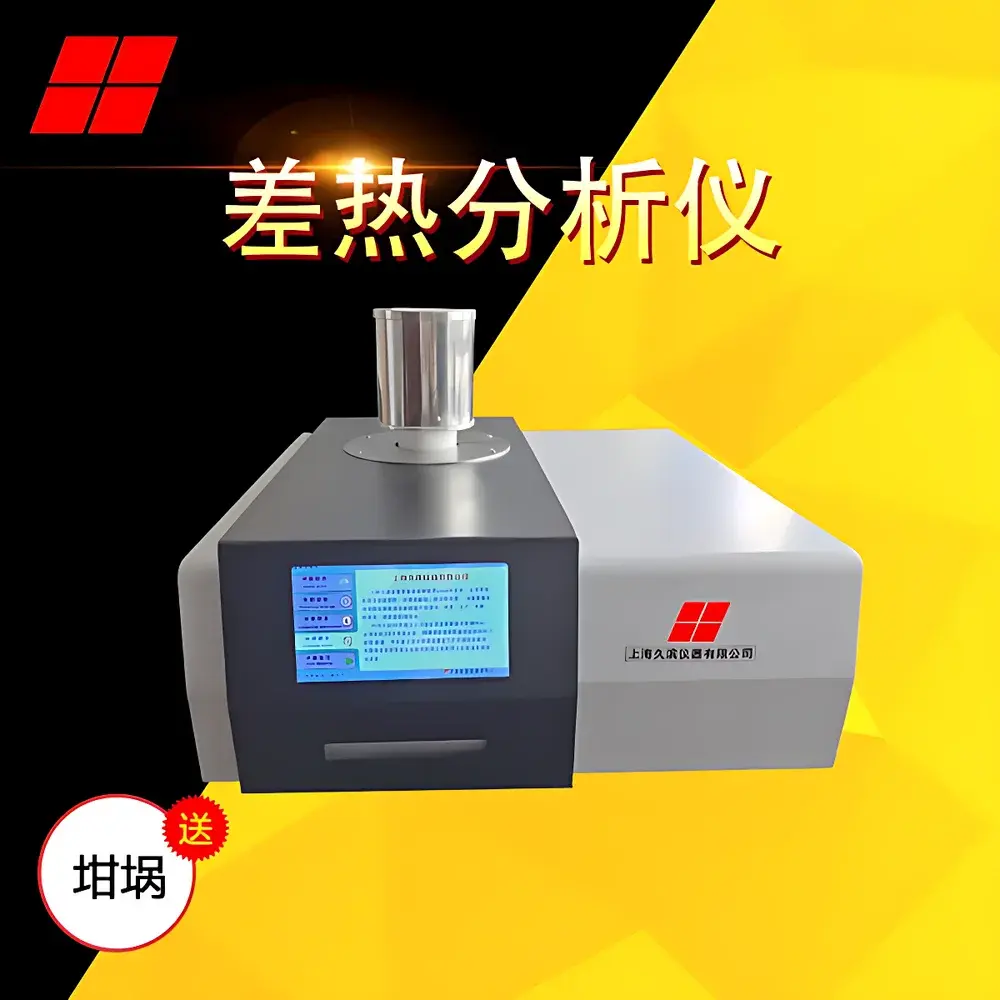
Jiubin JB-DTA-1150 Differential Thermal Analyzer
| Brand | Jiubin |
|---|---|
| Origin | Shanghai, China |
| Model | JB-DTA-1150 |
| Temperature Range | Ambient to 1150 °C |
| Temperature Accuracy | ±0.1 °C |
| Heating/Cooling Rate | 1–80 °C/min |
| DTA Signal Range | 0 to ±2000 μV |
| DTA Sensitivity | 0.01 μV |
| Temperature Resolution | 0.1 °C |
| Temperature Repeatability | ±0.1 °C |
| Furnace Type | Top-opening dual-wound Fe-Cr-Al heating element (1 kW) |
| Atmosphere Control | Automated internal gas switching |
| Interface | Standard USB |
| Display | 7-inch 24-bit color LCD touchscreen |
| Calibration | Built-in reference materials with one-click temperature calibration |
| Baseline Adjustment | Adjustable slope and intercept |
| Power Supply | AC 220 V, 50 Hz |
Overview
The Jiubin JB-DTA-1150 Differential Thermal Analyzer (DTA) is a precision laboratory instrument engineered for quantitative thermal event detection under controlled temperature programs. It operates on the fundamental principle of differential thermometry: simultaneously monitoring the temperature difference (ΔT) between a sample and an inert reference material as both are subjected to identical, programmable heating, cooling, or isothermal profiles. This ΔT signal—recorded in microvolts (μV)—directly reflects endothermic or exothermic processes occurring within the sample, including solid–solid phase transitions, melting, crystallization, polymorphic transformations, dehydration, decomposition, oxidation, reduction, and glass transitions. Unlike differential scanning calorimetry (DSC), which measures heat flow, DTA provides high-sensitivity detection of thermal events based on temperature differentials—making it particularly suitable for qualitative and semi-quantitative analysis of thermal stability, reaction onset, and multi-step decomposition behavior in inorganic compounds, ceramics, pharmaceuticals, polymers, and metallurgical powders.
Key Features
- High-stability furnace architecture: Top-opening furnace with dual-wound Fe-Cr-Al heating elements (1 kW total power), designed to minimize electromagnetic interference and ensure uniform axial temperature distribution across an extended isothermal zone.
- Precision temperature control: ARM Cortex-M3 microcontroller-based thermal regulation system enables reproducible ramp rates from 1 to 80 °C/min, isothermal holds with user-defined duration, and active air-cooling for rapid descent—each fully programmable via intuitive touchscreen interface.
- Enhanced signal fidelity: Nickel-chromium alloy thermocouples provide stable, corrosion-resistant sensing up to 1150 °C; analog front-end delivers 0.01 μV resolution over ±2000 μV full-scale DTA output range.
- User-centric operation: 7-inch 24-bit color LCD touchscreen with responsive GUI supports real-time curve visualization, parameter entry, baseline correction (slope/intercept adjustment), and one-click calibration using certified reference standards (e.g., α-Al2O3, Sn, Zn).
- Robust data infrastructure: USB 2.0 interface enables direct connection to Windows-based PCs; includes proprietary acquisition and analysis software compliant with basic GLP documentation requirements—including timestamped raw data logging, operator ID tagging, and audit-ready export formats (CSV, TXT, PDF).
Sample Compatibility & Compliance
The JB-DTA-1150 accommodates standard ceramic or alumina crucibles (typically 50–100 μL capacity) and supports ambient-to-1150 °C operation under static air, nitrogen, argon, or oxygen atmospheres. Internal solenoid-valve-based gas routing allows automated atmosphere switching during a single run—critical for studying oxidation kinetics or inert-phase stabilization. While not certified to ISO 11357 or ASTM E794, the instrument’s temperature accuracy (±0.1 °C), repeatability (±0.1 °C), and traceable calibration protocol align with routine QC/QA workflows in R&D labs, materials synthesis facilities, and academic thermal analysis centers. Its design facilitates adherence to internal SOPs referencing USP , ISO 11357-1, or national metrological verification guidelines for thermal instrumentation.
Software & Data Management
The bundled Windows application provides synchronized acquisition of DTA voltage, furnace temperature, and time stamps at configurable sampling intervals (default: 0.1 s). Raw datasets include metadata (operator, date/time, method name, calibration status), enabling traceability in regulated environments. Curve processing tools include baseline subtraction, peak integration (onset, peak, endset temperatures; area), derivative (dT/dt) calculation, and multi-curve overlay. Export functions support CSV for third-party statistical analysis (e.g., OriginLab, MATLAB), PDF for reporting, and image capture for presentations. The software logs all parameter modifications and calibration actions—meeting foundational expectations for audit trails under GLP and basic GMP-aligned documentation practices.
Applications
- Identification and characterization of polymorphic transitions in active pharmaceutical ingredients (APIs)
- Thermal stability assessment of battery cathode materials (e.g., LiCoO2, NMC) under inert and oxidative conditions
- Decomposition kinetics of metal-organic frameworks (MOFs) and hybrid perovskites
- Phase diagram validation for ceramic systems (e.g., alumina–zirconia composites)
- Quality control of refractory raw materials and sintered components
- Educational demonstration of eutectic behavior, congruent/incongruent melting, and solid-state reactivity
FAQ
What is the maximum recommended sample mass for optimal DTA sensitivity?
For most inorganic and ceramic samples, 5–20 mg is optimal; larger masses may reduce resolution of overlapping transitions due to thermal lag.
Can the JB-DTA-1150 be used under vacuum?
No—the furnace is not vacuum-rated; it supports only positive-pressure gas atmospheres (N2, Ar, O2, air) via integrated solenoid valves.
Is the instrument compatible with FDA 21 CFR Part 11 requirements?
The current software does not include electronic signatures, role-based access control, or full audit-trail encryption; however, raw data files contain immutable timestamps and operator tags suitable for supplementary validation in non-Part 11 environments.
How often should temperature calibration be performed?
We recommend calibration before each analytical campaign involving critical onset temperature measurements, or at minimum daily when operating continuously above 800 °C.
Does the system support custom heating rate profiles (e.g., multi-segment ramps)?
Yes—the method editor allows up to 10 independent segments with distinct ramp rates, hold times, and target temperatures.



