
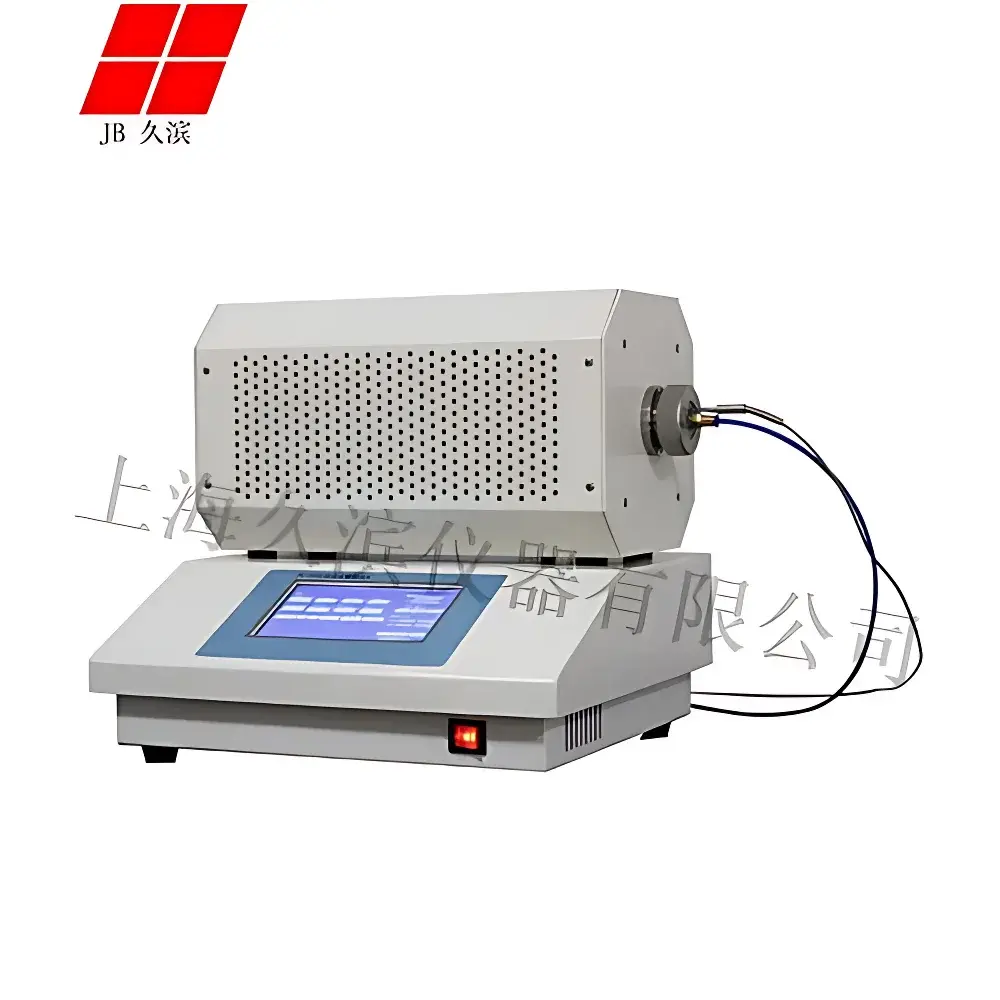
Jiubin JB-3500F Polyethylene Carbon Black Content Analyzer
| Brand | Jiubin |
|---|---|
| Model | JB-3500F |
| Origin | Shanghai, China |
| Manufacturer Type | Authorized Distributor |
| Regional Classification | Domestic (PRC) |
| Pricing | Upon Request |
Overview
The Jiubin JB-3500F Polyethylene Carbon Black Content Analyzer is a dedicated thermal gravimetric instrument engineered for the precise quantification of carbon black loading in polyethylene (PE), polypropylene (PP), ethylene–propylene copolymers, and other thermoplastic matrices. It operates on the principle of controlled pyrolysis under inert atmosphere (typically nitrogen), followed by oxidative ashing to isolate and determine residual carbon black mass as a weight percentage of the original sample. This two-stage thermogravimetric method complies with internationally recognized standards including ASTM D1601 (Standard Test Method for Carbon Black Content of Polyethylene Compounds), ISO 6964 (Plastics — Polyethylene compounds — Determination of carbon black content), and GB/T 13021 (Chinese national standard for carbon black content in polyolefins). The system delivers high reproducibility (< ±0.2 wt% RSD for repeat measurements on homogeneous PE masterbatches) and supports routine QC/QA workflows in polymer compounding, cable sheathing, pipe extrusion, and automotive plastic component manufacturing.
Key Features
- Programmable dual-zone furnace with independent temperature control for pyrolysis (up to 600 °C) and oxidation (up to 800 °C), ensuring complete volatilization of polymer matrix and selective retention of carbon black.
- Digital microbalance with 0.01 mg resolution and internal calibration, integrated into a sealed, draft-free weighing chamber to minimize environmental drift.
- Automated gas switching system (N₂ → air/O₂) with mass flow controllers and pressure monitoring, enabling seamless transition between inert decomposition and oxidative burn-off phases.
- Robust stainless-steel reaction crucibles compatible with repeated high-temperature cycles and resistant to carbon residue buildup.
- Touchscreen HMI with preloaded ASTM/ISO/GB methods, real-time TGA curve visualization, and automatic calculation of carbon black content (wt%), ash residue, and volatile loss.
- Modular design supporting optional upgrades: RS-232/USB data export, LIMS-compatible CSV output, and GLP-compliant audit trail logging (with user login, method versioning, and timestamped result archiving).
Sample Compatibility & Compliance
The JB-3500F accommodates solid granules, pellets, thin films (≤2 mm thickness), and compression-molded plaques. Sample mass range: 10–100 mg (optimized at 30–50 mg for PE compounds). It is validated for use with carbon black loadings from 1.5 wt% to 35 wt%, covering standard black masterbatches, conductive composites, UV-stabilized pipes, and flame-retardant cable jackets. All operational protocols align with ISO/IEC 17025 requirements for testing laboratories, and method execution satisfies FDA 21 CFR Part 11 data integrity expectations when paired with optional electronic signature and audit trail modules. Routine verification includes NIST-traceable reference materials (e.g., certified PE + carbon black standards) and daily balance calibration checks.
Software & Data Management
The embedded firmware supports method storage (≥100 user-defined profiles), real-time derivative thermogram (DTG) display, and automatic endpoint detection based on mass stabilization criteria (e.g., <0.1 mg/min over 2 min). Raw data (time, temperature, mass, gas flow) are exportable in ASCII format for post-processing in Excel or third-party TGA analysis software. Optional PC-based software provides enhanced reporting: customizable certificate-of-analysis templates, statistical process control (SPC) charts for batch trending, and integration with enterprise quality management systems (QMS) via ODBC or REST API. All data files include embedded metadata: operator ID, instrument serial number, calibration status, and environmental ambient conditions.
Applications
- Quality control of carbon black masterbatches prior to extrusion or injection molding.
- Verification of pigment dispersion uniformity in PE geomembranes and agricultural films.
- Regulatory compliance testing for automotive interior trim (SAE J2236), underground utility ducts (ASTM F2160), and potable water pipe compounds (NSF/ANSI 61).
- R&D screening of novel conductive fillers (e.g., graphene hybrids) against conventional carbon black benchmarks.
- Failure analysis of premature cracking in black HDPE gas distribution pipes linked to insufficient carbon black UV stabilization.
- Supplier qualification audits requiring documented traceability from raw material receipt to final compound certification.
FAQ
What standards does the JB-3500F comply with for carbon black analysis?
ASTM D1601, ISO 6964, GB/T 13021, and DIN 53521. Method validation reports and uncertainty budgets are available upon request.
Can the instrument analyze non-polyolefin polymers such as PVC or PET?
No — the JB-3500F is specifically optimized for polyolefins. PVC dehydrochlorination and PET thermal degradation interfere with carbon black quantification; alternative methods (e.g., solvent extraction per ASTM D3849) are recommended.
Is operator training included with purchase?
Yes — standard delivery includes a 1-day on-site installation, operational training, and method transfer support for up to two users.
How often does the system require recalibration?
The microbalance requires daily zero calibration; full span calibration is recommended every 30 days or after 100 test cycles, using certified weights traceable to NIST.
Does the analyzer support 21 CFR Part 11 compliance?
Yes — with optional software module enabling electronic signatures, role-based access control, and immutable audit trails meeting FDA regulatory expectations for GMP environments.



