
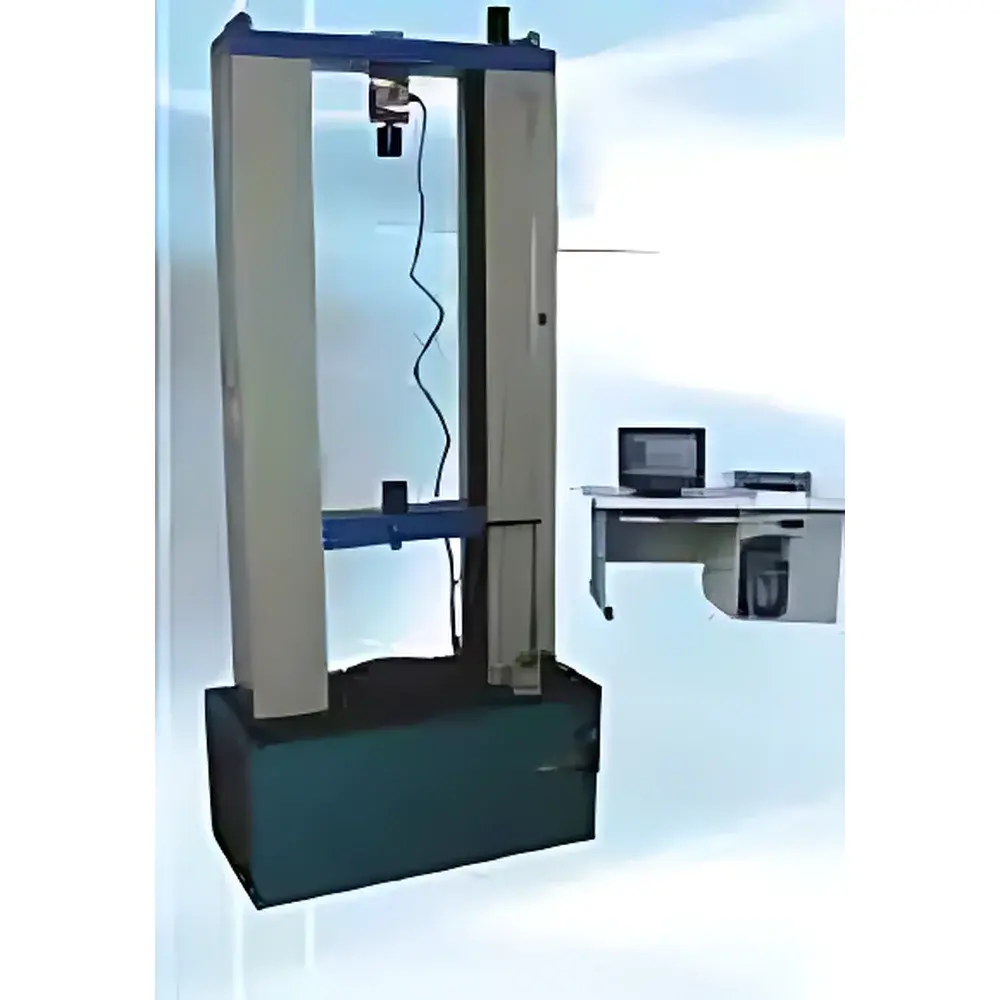
Jiubin JB-119A Universal Testing Machine
| Brand | Jiubin (JByq) |
|---|---|
| Origin | Taiwan |
| Model | JB-119A |
| Load Capacity | 0–5 kN (user-selectable) |
| Force Sensing | High-precision load cell (U.S.-made) |
| Force Accuracy | ±0.5% of full scale |
| Effective Test Width | 380 mm |
| Max. Tensile Travel | 1000 mm |
| Drive System | Servo motor (Japan-made) + AC motor (Taiwan-made) |
| Mechanical Transmission | Precision ball screw (Taiwan-made) + High-strength zero-backlash screw (Korea-made) |
| Test Speed Range | 0.001–500 mm/min (infinitely variable) |
| Displacement Accuracy | ±0.005% |
| Resolution | 1/200,000 |
| Safety Features | Upper/lower mechanical limits, emergency stop button |
| Display | Dual-mode — PC-based GUI + embedded microcomputer display |
| Power Supply | 220 V / 380 V, 50 Hz |
| Net Weight | 1180 kg |
| Dimensions (W×D×H) | 1280 × 950 × 1800 mm |
| Unit Options | g, kg, N, kN, lb, lbf |
Overview
The Jiubin JB-119A Universal Testing Machine is an electromechanically integrated static mechanical testing system engineered for precision measurement of tensile, compressive, flexural (three-point bending), shear, peel, and tear properties of metallic, polymeric, elastomeric, textile, composite, and electrical insulation materials. It operates on the fundamental principle of controlled displacement-driven force measurement: a servo-controlled actuator applies calibrated motion to a test specimen clamped between upper and lower fixtures, while a high-fidelity load cell—traceable to U.S. NIST standards—continuously records axial force response. Simultaneously, an optical or linear encoder-based displacement transducer captures positional data with sub-micron resolution. This dual-signal acquisition architecture enables real-time generation of stress–strain, load–displacement, and modulus curves compliant with ASTM E8/E9/E21, ISO 6892-1, ISO 178, and ISO 14129 test protocols.
Key Features
- Modular load frame architecture with reinforced steel base and rigid column assembly, ensuring minimal deflection under maximum rated load (5 kN).
- Dual-drive configuration: Japanese servo motor for high-resolution low-speed control (0.001 mm/min) and Taiwan-sourced AC motor for rapid positioning and high-speed testing (up to 500 mm/min).
- Hybrid transmission system combining Taiwan-manufactured precision ground ball screws (lead accuracy ≤ 0.005 mm/300 mm) and Korea-sourced preloaded zero-backlash lead screws for consistent torque transfer and long-term repeatability.
- Embedded microcontroller interface synchronized with Windows-based software via USB 2.0 or RS-232, supporting simultaneous real-time display, data logging, and hardware status monitoring.
- Comprehensive safety suite including dual mechanical limit switches, redundant emergency stop circuitry (EN 60204-1 compliant), and automatic load-cell over-range protection.
- High-resolution signal conditioning electronics with 200,000-count A/D conversion, enabling detection of force changes as low as 0.0025% FS and displacement increments down to 0.1 µm.
Sample Compatibility & Compliance
The JB-119A accommodates specimens ranging from thin polymer films (≥ 0.05 mm thickness) to structural metal coupons (≤ 30 mm cross-section), provided appropriate fixture sets are installed. Standard configurations include wedge-action tensile grips, compression platens, three-point bend fixtures, and shear adapters—all machined from hardened tool steel (HRC 58–62) and certified for dimensional stability per ISO 9001:2015 manufacturing controls. All test methods executed on this platform support traceable calibration against ISO/IEC 17025-accredited reference standards. The system meets mechanical safety requirements of CE Machinery Directive 2006/42/EC and electromagnetic compatibility per EN 61326-1. Optional configurations support GLP-compliant audit trails when paired with validated software modules compliant with FDA 21 CFR Part 11 Annex 11 requirements.
Software & Data Management
The included Windows-native testing software provides full IEC 61508-aligned control logic, supporting programmable multi-step test profiles (e.g., preload → ramp → hold → return), automatic yield point detection per ASTM E111, and tangent/ secant modulus calculation. Raw data streams are stored in .csv and proprietary .jbt binary formats with embedded metadata (operator ID, timestamp, environmental conditions, calibration certificate ID). Reporting templates conform to ISO 5893 and ASTM D638/D790/D1435 formatting conventions. Audit logs record all user actions—including parameter edits, calibration events, and report exports—with SHA-256 hashing for integrity verification. Network deployment supports centralized database archiving via SQL Server or Oracle backends, enabling enterprise-level QA/QC traceability across multiple lab sites.
Applications
- Tensile characterization of automotive fasteners, brake pads, rubber bushings, and thermoplastic interior trim per SAE J211 and ISO 37.
- Compression testing of foam seating components, gasket materials, and battery module spacers per ASTM D3574 and UL 94.
- Three-point flexural evaluation of composite body panels, carbon fiber chassis elements, and injection-molded structural brackets per ISO 178 and ASTM D790.
- Peel and shear strength validation of adhesive-bonded joints in EV battery enclosures and sensor housings per ASTM D1876 and ISO 4577.
- Quality assurance screening of wire insulation jackets, cable sheathing, and connector housings per UL 1581 and IEC 60811.
FAQ
What load cell calibration standards does the JB-119A support?
The system accepts third-party calibration certificates traceable to NIST, PTB, or NPL, and supports internal verification using Class M1 deadweight standards per ISO 7500-1.
Can the machine perform cyclic loading tests?
No—the JB-119A is designed exclusively for static monotonic testing; fatigue or dynamic cycling requires upgrade to the JB-2000 series with electrodynamic actuation.
Is the software compatible with LIMS integration?
Yes—via HL7 v2.5 or ASTM E1482-compliant XML export, enabling bidirectional data exchange with major laboratory information management systems.
What is the recommended maintenance interval for the ball screw assembly?
Lubrication and backlash verification should be performed every 500 operational hours or semiannually, whichever occurs first, using ISO VG 68 synthetic gear oil.
Does the system meet ISO 17025 requirements for accredited testing labs?
When operated with documented procedures, trained personnel, and annual third-party metrological verification, the JB-119A satisfies Clause 6.4 (Equipment) and Clause 6.5 (Measurement Traceability) of ISO/IEC 17025:2017.



