
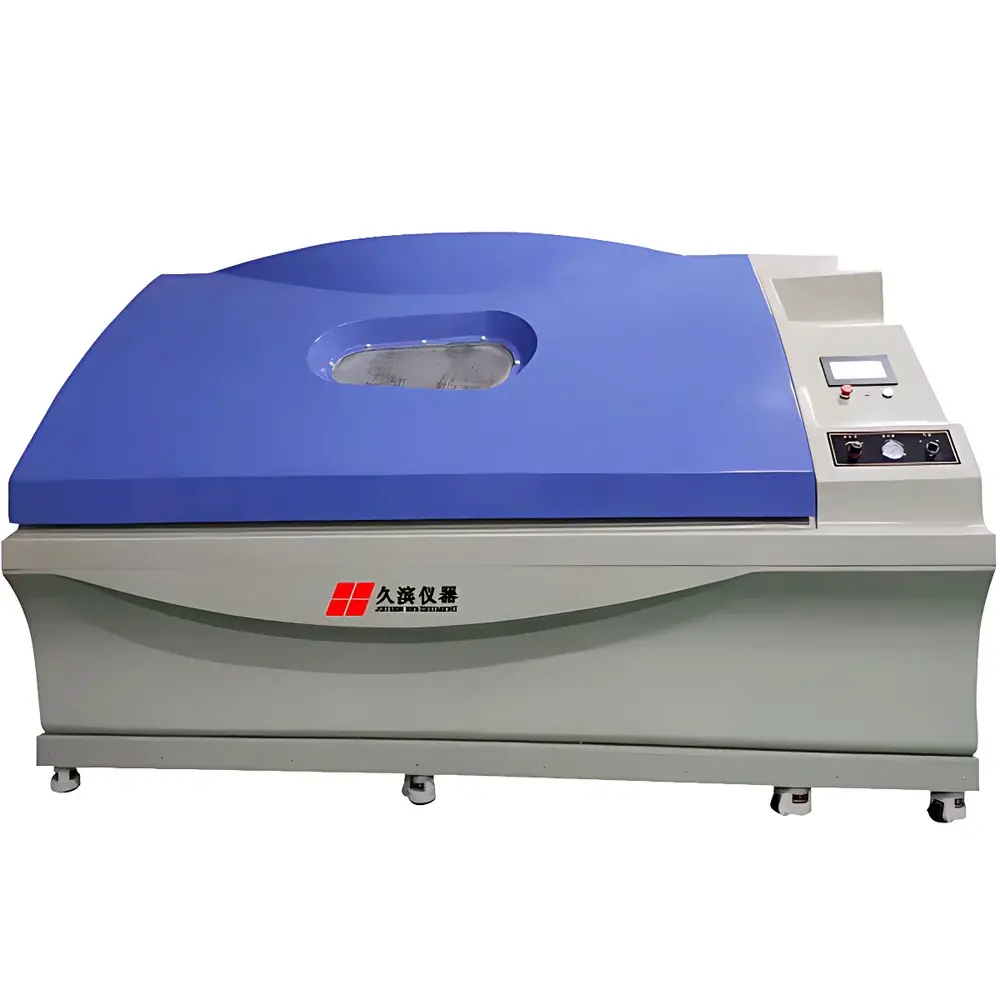
Jiubin JB-280D Fiberglass-Reinforced Plastic (FRP) Dry-Burn Salt Spray Corrosion Test Chamber
| Brand | Jiubin |
|---|---|
| Model | JB-280D |
| Origin | Shanghai, China |
| Chamber Dimensions (W×D×H) | 1200 × 1000 × 600 mm |
| External Dimensions (W×D×H) | 2000 × 1300 × 1350 mm |
| Temperature Range | +5°C to 55°C |
| Salt Spray Deposition Rate | 1–2 mL/h per 80 cm² |
| Spray Modes | Continuous or Intermittent (selectable) |
| Temperature Uniformity | ≤ ±2°C |
| Temperature Fluctuation | ≤ ±0.5°C |
| Timer Range | 1–9999 s/min/h (adjustable) |
| Power Supply | 220 V AC, 50 Hz, 4.5 kW |
| Construction Material | Molded FRP (fiberglass-reinforced plastic) |
| Nozzle Type | Crystallization-resistant quartz glass nozzle |
| Humidity Control | Saturated air chamber with automatic water replenishment system |
| Safety Features | Leakage current protection, over-temperature cutoff, pressure tank de-fogging system |
Overview
The Jiubin JB-280D Fiberglass-Reinforced Plastic (FRP) Dry-Burn Salt Spray Corrosion Test Chamber is an engineered environmental test system designed to evaluate the corrosion resistance of metallic and coated materials under controlled saline atmospheric conditions. It operates on the principle of accelerated electrochemical corrosion simulation via atomized sodium chloride (NaCl) solution mist, generated through compressed air-driven nebulization in a saturated humid environment. Unlike conventional stainless-steel chambers, this model utilizes a one-piece molded FRP enclosure—resistant to acid, alkali, high temperature, and mechanical impact—ensuring long-term structural integrity and chemical inertness during extended exposure cycles. The chamber supports both continuous and programmable intermittent spray modes, enabling compliance with standardized salt fog testing protocols including ASTM B117, ISO 9227, JIS Z2243, and GB/T 2423.17. Its dry-burn heating architecture eliminates water bath contamination risks while delivering rapid thermal response and stable temperature maintenance across the working volume (1200 × 1000 × 600 mm).
Key Features
- Monolithic FRP chamber construction: Seamless, corrosion-resistant molding prevents delamination, cracking, or electrolytic degradation—even at elevated temperatures up to 55°C.
- Cone-shaped lid (120° apex angle): Prevents direct condensate drip onto test specimens, preserving test validity and minimizing measurement artifacts.
- Quartz glass nozzles: Smooth-bore, non-crystallizing design ensures consistent droplet size distribution and long-term operational reliability without clogging.
- Dual-mode spray control: Adjustable inlet pressure regulation and vertical nozzle positioning allow precise tuning of salt deposition rate (1–2 mL/h/80 cm²), traceable via calibrated graduated collection funnel.
- Integrated saturation chamber: Maintains >95% RH pre-spray air conditioning, critical for reproducible NaCl aerosol generation per ISO 9227 Annex A.
- Intelligent PID temperature controller: Imported digital regulator with ±0.5°C fluctuation tolerance and ≤2°C uniformity across the workspace.
- Multi-layer safety architecture: Includes earth leakage protection, over-temperature cut-off, automatic pressure tank de-fogging, and sealed water-trap gasketing between lid and body.
Sample Compatibility & Compliance
The JB-280D accommodates a broad range of substrate-coating systems, including zinc-, nickel-, copper-, silver-, and chromium-plated ferrous and stainless steel components; passivated aluminum alloys; organic coatings (epoxy, polyurethane, powder coat); conversion films (chromate, phosphate); and corrosion inhibitors (volatile rust preventives, vapor-phase inhibitors). Its FRP interior avoids galvanic coupling with test samples and eliminates metallic ion leaching that could interfere with corrosion morphology analysis. The chamber meets essential requirements for GLP-compliant corrosion testing laboratories: traceable calibration paths for temperature, deposition rate, and timer functions; audit-ready operational logs (when integrated with optional data logger); and physical design alignment with ISO/IEC 17025 clause 6.4.1 (environmental condition control). While not intrinsically FDA 21 CFR Part 11 compliant, its analog control architecture supports external validation for regulated industries requiring documented test repeatability.
Software & Data Management
The JB-280D employs a standalone microprocessor-based temperature and timer controller with LED display—designed for robustness and minimal maintenance in industrial lab environments. Though natively hardware-controlled, the unit features analog signal outputs (0–10 V / 4–20 mA) compatible with third-party SCADA or LIMS integration for time-stamped logging of chamber temperature, cycle duration, and spray activation status. Optional RS-485 Modbus RTU interface enables remote monitoring and centralized fleet management in multi-chamber test facilities. All operational parameters—including setpoint, actual temperature, elapsed time, and spray mode—are retained after power interruption, ensuring continuity of long-duration tests (up to 9999 hours). Calibration certificates for temperature sensors and deposition rate verification tools are provided upon request, supporting ISO/IEC 17025 internal audit documentation.
Applications
This chamber serves as a core qualification tool in quality assurance workflows for automotive fasteners (bolts, springs, brake calipers), aerospace hydraulic fittings, marine-grade hardware, medical device housings, printed circuit board conformal coatings, and architectural metal cladding systems. It supports cyclic corrosion testing (CCT) when paired with external humidity and drying modules (e.g., for ASTM D5894 or VDA 621-415 protocols). In R&D labs, it facilitates comparative screening of new plating chemistries, sealants, and anti-corrosion nanocomposites. Its FRP build also makes it suitable for testing aggressive media beyond NaCl—such as CuCl₂-accelerated solutions (per ISO 9227 Acetic Acid Salt Spray, AASS) or mixed-gas environments when retrofitted with auxiliary gas manifolds.
FAQ
What standards does the JB-280D comply with?
It is configured to meet the core operational requirements of ASTM B117, ISO 9227, JIS Z2243, and GB/T 2423.17 for neutral salt spray (NSS) testing. Optional accessories enable adaptation to AASS and CASS variants.
Can the chamber be used for cyclic corrosion testing (CCT)?
Yes—though the base unit performs single-mode NSS, its modular design allows integration with external humidity chambers, dry-off ovens, and gas dosing systems to execute multi-phase CCT sequences.
Why is FRP preferred over stainless steel for salt spray chambers?
FRP eliminates galvanic corrosion risk, resists HCl and H₂SO₄ byproducts formed during testing, and maintains dimensional stability under thermal cycling—critical for long-term repeatability in accredited labs.
How is salt spray deposition rate verified and adjusted?
A calibrated 80 cm² funnel collects mist over 16–24 h; volume is measured via the built-in graduated sight tube. Rate is fine-tuned using the air pressure regulator and nozzle height adjustment mechanism.
Is automatic water replenishment available for the saturation tower?
Yes—the system includes both manual fill ports and an auto-refill solenoid valve linked to a float-level sensor in the pressurized saturation chamber.



