
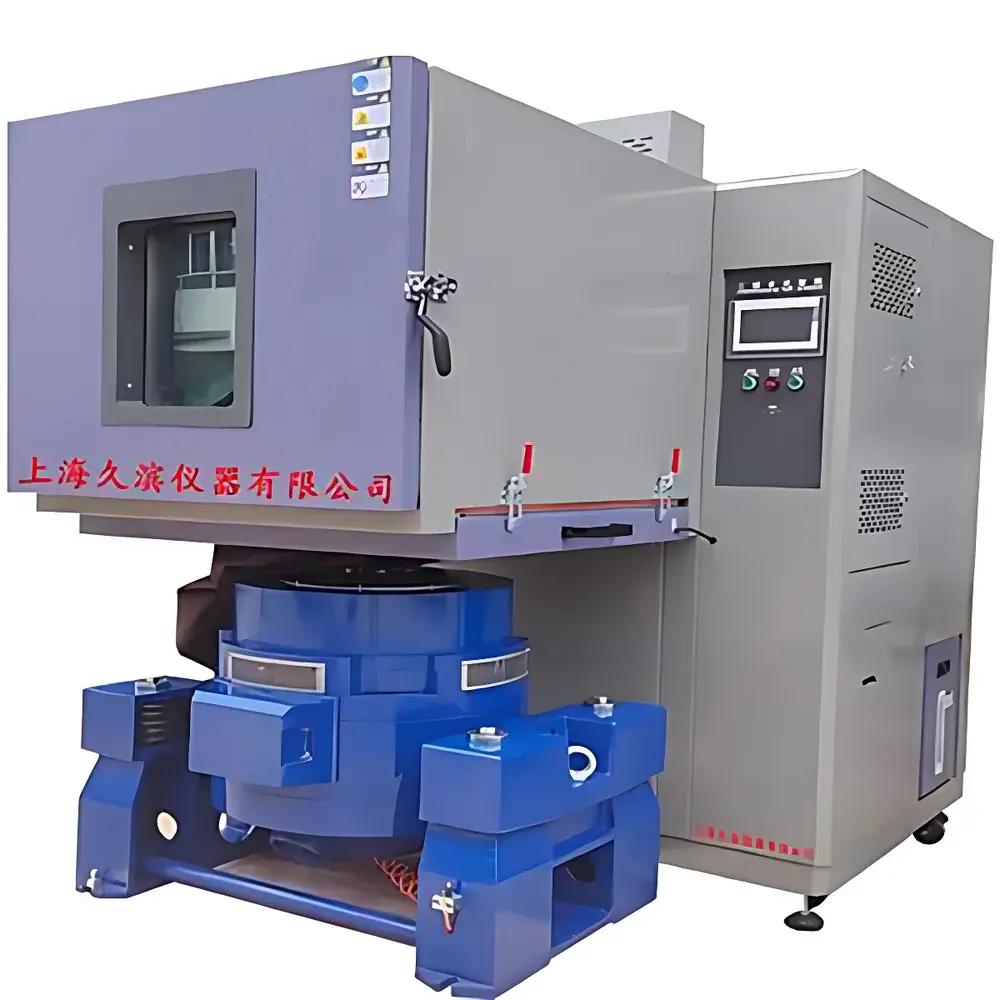
Jiubin JB Combined Temperature-Humidity-Vibration Environmental Test Chamber
| Brand | Jiubin |
|---|---|
| Model | JB |
| Origin | Shanghai, China |
| Type | Domestic |
| Temperature Range | -70°C to +180°C |
| Humidity Range | 20–95% RH |
| Temperature Change Rate | ≥2°C/min (from -55°C to +85°C, loaded, average) |
| Temperature Uniformity (unloaded) | ≤2°C |
| Temperature Fluctuation (unloaded) | ≤±0.5°C (ambient to +85°C), ≤±1°C (≤-40°C) |
| Temperature Deviation (unloaded) | ≤±2°C |
| Humidity Accuracy | ±3% RH (>75% RH), ±5% RH (≤75% RH) |
| Internal Chamber Dimensions | 1000 × 1000 × 1000 mm (D×W×H) |
| Effective Volume | 1 m³ |
| Load Capacity | 60 kg |
| Heat Load Capacity | 1000 W |
| Cooling Method | Water-Cooled Mechanical Compression Refrigeration |
| Humidification Method | Steam Humidification |
| Vibration Interface | Integrated electrodynamic shaker coupling (standard 50 mm stroke, 1000 kgf peak force, frequency range 5–2000 Hz — compatible with external vibration controllers per ISO 10816 & ASTM D4728) |
Overview
The Jiubin JB Combined Temperature-Humidity-Vibration Environmental Test Chamber is an integrated reliability validation platform engineered for simultaneous application of thermal, hygric, and dynamic mechanical stress on test specimens. It operates on the principle of multi-stress synergy—precisely synchronizing programmable temperature/humidity profiles with controlled sinusoidal or random vibration inputs via a mechanically coupled electrodynamic shaker system. This architecture enables accelerated life testing, failure mode identification, and environmental robustness verification under conditions replicating real-world operational extremes encountered in aerospace avionics, automotive ECUs, defense electronics, and high-reliability industrial control systems. Unlike sequential single-stress testing, the JB chamber supports true concurrent stress application—ensuring that thermally induced material expansion, moisture absorption, and resonant mechanical loading interact as they would in field deployment. Its chamber design complies with ISO 16750-4 (road vehicles), MIL-STD-810H Method 514.7 (vibration), and IEC 60068-2 series for combined environmental testing.
Key Features
- Triple-stress integration: Independent yet synchronized control of temperature (-70°C to +180°C), relative humidity (20–95% RH), and vibration (5–2000 Hz, configurable waveform and profile)
- High-fidelity thermal performance: Water-cooled dual-stage compression refrigeration system with steam-based humidification ensures stable RH control across wide temperature bands, including low-temperature dehumidification capability
- Precision chamber uniformity: ≤2°C temperature uniformity (unloaded) and ≤±0.5°C fluctuation (at mid-range temperatures) verified per IEC 60068-3-5
- Robust mechanical interface: Standardized flange-mounted shaker coupling with 50 mm stroke and 1000 kgf peak force; compatible with third-party vibration controllers (e.g., LDS, Vibration Research, m+p) via IEEE-488 or Ethernet/IP protocols
- Structural integrity: 1 m³ stainless-steel inner chamber (1000 × 1000 × 1000 mm) with reinforced insulation, leak-tested door seal, and internal load capacity of 60 kg at up to 1000 W heat dissipation
- Compliance-ready architecture: Built-in data logging with timestamped sensor outputs (PT100, capacitive RH, accelerometer), supporting audit trails required for GLP/GMP and ISO/IEC 17025-accredited laboratories
Sample Compatibility & Compliance
The JB chamber accommodates full-system assemblies (e.g., flight control units, battery packs, radar modules) as well as subcomponents such as PCBs, sensors, connectors, and polymer housings. Its 1 m³ workspace allows mounting on standard slip tables or custom fixtures with direct accelerometer feedback paths. The system meets the physical and procedural requirements of multiple international standards—including GB/T 2423.102–2008 (combined high/low temperature + vibration), GB/T 2423.35–1986 and GB/T 2423.36–1986 (heat-dissipating/non-dissipating specimen protocols), ASTM D4728 (vibration durability of packaged goods), and ISO 16750-4 Annex C (combined thermal cycling and road-induced vibration). All thermal and humidity calibrations are traceable to NIM (National Institute of Metrology, China) standards, and chamber validation reports include uncertainty budgets per ISO/IEC 17025 Clause 6.4.
Software & Data Management
The chamber is operated via a Windows-based control suite featuring dual-mode operation: standalone profile sequencing and SCADA-integrated remote monitoring. Users define multi-segment temperature-humidity ramps and overlay time-synchronized vibration spectra (sine sweep, random PSD, shock pulses) using intuitive drag-and-drop editors. Real-time telemetry includes chamber air temperature, dew point, RH%, shaker armature acceleration (g-rms), displacement (mm p-p), and coil temperature. All raw data streams are logged at ≥10 Hz with embedded metadata (operator ID, test ID, calibration expiry dates) and exported in CSV, MATLAB .mat, or UFF58 formats. Audit trail functionality satisfies FDA 21 CFR Part 11 requirements—including electronic signatures, user-level access controls, and immutable log archiving. Optional OPC UA server enables integration into MES or PLM platforms (e.g., Siemens Opcenter, PTC Windchill).
Applications
- Aerospace: Qualification of satellite payload electronics under launch vibration + thermal vacuum transition simulation (via dry nitrogen purge option)
- Automotive: Validation of ADAS camera modules against thermal shock (-40°C ↔ +85°C, 10 min ramp) while subjected to engine-bay-frequency random vibration (10–200 Hz)
- Energy Storage: Cycle-life assessment of lithium-ion battery enclosures under humidity cycling (30↔90% RH at 45°C) combined with road-spectrum vibration to evaluate seal integrity and electrolyte migration
- Medical Devices: Biocompatibility and functional stability testing of implantable pulse generators per ISO 14708-1, including condensation resistance during rapid cooldown phases
- Industrial IoT: Reliability screening of edge computing gateways deployed in offshore oil platforms—simulating salt-laden humidity, wide thermal swings, and structural resonance from pump harmonics
FAQ
Does the JB chamber support real-time vibration spectrum adjustment during temperature ramping?
Yes—the control system permits dynamic modulation of vibration amplitude, frequency bounds, and PSD shape while executing temperature/humidity profiles, with synchronization resolution of ±100 ms.
Can the chamber be validated per ISO 17025 for accredited testing labs?
Yes—factory-installed Class A PT100 sensors, NIST-traceable hygrometers, and calibrated accelerometers enable full uncertainty analysis; optional IQ/OQ/PQ documentation packages are available.
Is remote monitoring and alarm notification supported?
Yes—Ethernet-connected units support SNMP traps, SMTP email alerts, and MQTT publishing for integration into centralized facility monitoring systems.
What vibration controller brands are natively compatible?
The chamber provides analog voltage (±10 V) and digital (IEEE-488, EtherCAT) interfaces compatible with LDS, m+p International, Vibration Research, and Crystal Instruments controllers.
How is condensation managed during rapid cooldown under high-RH conditions?
The system employs active dew-point control logic and optional hot-gas bypass to suppress condensation formation on test specimens and chamber walls during transitions below dew point.
Related Products



