
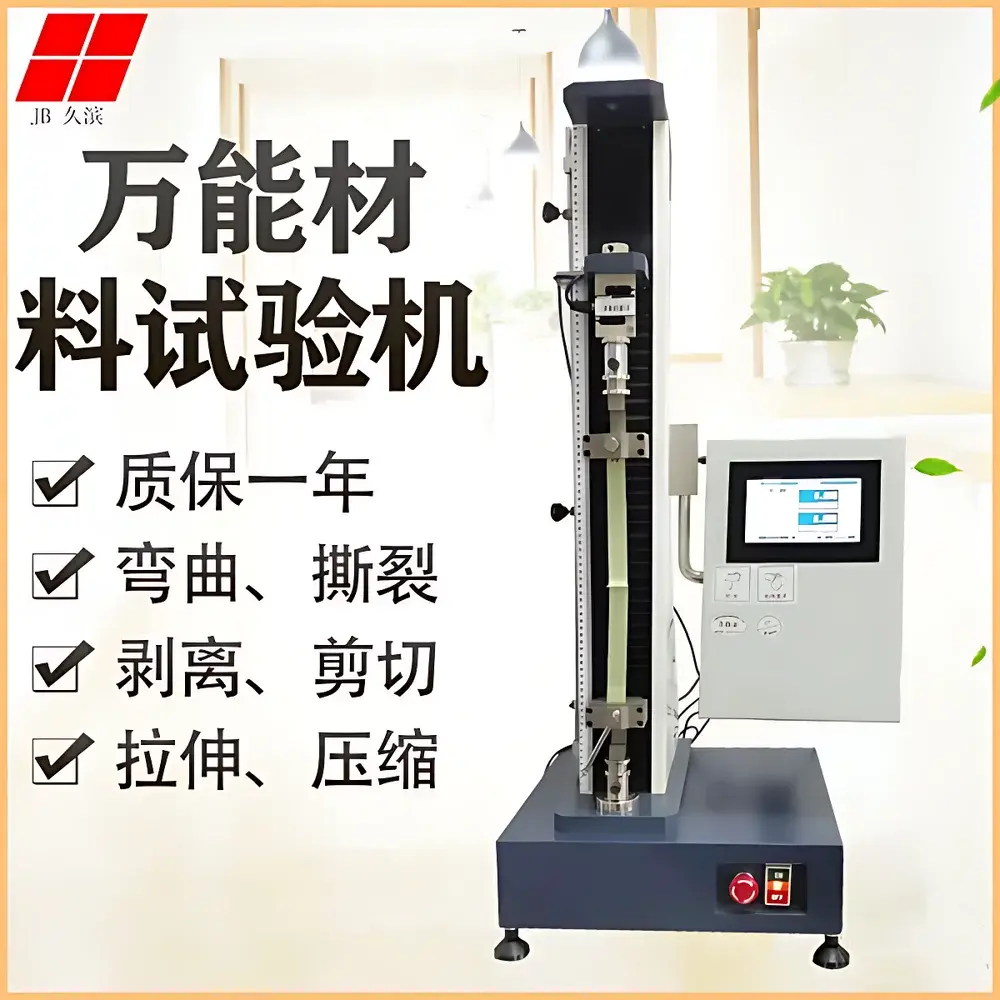
JB-126A Universal Electronic Tensile Testing Machine
| Brand | Jiubin Instruments |
|---|---|
| Origin | Shanghai, China |
| Model | JB-126A |
| Type | Electromechanical Universal Testing Machine |
| Category | Physical Property Testing Instrument |
| Application Focus | Elastomers & Thin Polymer Films |
Overview
The JB-126A Universal Electronic Tensile Testing Machine is an electromechanical force-displacement measurement system engineered for high-reproducibility mechanical characterization of polymeric materials—specifically optimized for rubber compounds and thin plastic films. It operates on the fundamental principle of controlled uniaxial tensile loading, where a motor-driven crosshead applies precisely regulated displacement to a specimen clamped between pneumatic or mechanical grips, while a calibrated load cell (typically ±0.5% full-scale accuracy) continuously records axial force. Displacement resolution is maintained at ≤0.1 µm via high-resolution encoder feedback, enabling reliable determination of stress–strain behavior, modulus (Young’s, secant, tangent), yield point, elongation at break, and tensile strength per ISO 37, ASTM D412, ASTM D882, and GB/T 1040. Designed for laboratory and quality control environments, the JB-126A conforms to structural and operational requirements defined in ISO 7500-1 (static calibration of testing machines) and supports traceable calibration through NIST-traceable reference standards.
Key Features
- Electromechanical actuation with servo-controlled AC motor and precision ball-screw transmission, ensuring smooth, low-noise operation and long-term mechanical stability.
- Adjustable crosshead speed range from 0.001 mm/min to 500 mm/min, programmable in multi-step profiles to accommodate quasi-static creep tests, strain-rate-dependent modulus evaluation, and rapid failure assessment.
- Dual-mode gripping systems: pneumatic film grips (for sub-100 µm thickness films) and wedge-action rubber grips (for vulcanized elastomer strips up to 25 mm wide), both featuring self-aligning geometry to minimize bending moments.
- Integrated digital load cell with overload protection (150% FS), temperature-compensated analog-to-digital conversion, and real-time filtering to suppress mechanical noise during low-force measurements (e.g., <1 N for ultra-thin PET or PE films).
- Rigid C-frame architecture with reinforced aluminum alloy housing and hardened steel guide columns, delivering frame stiffness >150 kN/mm to minimize deflection-induced measurement error under peak loads.
- Front-panel LCD interface with tactile navigation keys and USB host port for firmware updates; optional Ethernet or RS-232 connectivity for remote command execution via SCPI-like protocol.
Sample Compatibility & Compliance
The JB-126A accommodates standard dumbbell- and strip-shaped specimens per ISO 37 (rubber), ASTM D412 (vulcanized rubber), and ASTM D882 (thin plastic films). Specimen widths from 2 mm to 25 mm and thicknesses from 0.02 mm (e.g., BOPP lamination film) to 6 mm (e.g., cured EPDM gasket stock) are supported using interchangeable grip inserts. All test configurations comply with GLP documentation requirements: test logs include timestamped operator ID, environmental conditions (optional humidity/temperature sensor input), specimen dimensions, gauge length, and calibration certificate IDs. The system meets essential safety requirements per IEC 61000-6-2 (EMC immunity) and IEC 61000-6-4 (EMC emission), and its mechanical design aligns with ISO 12100 for risk assessment of testing equipment.
Software & Data Management
The JB-126A is supplied with proprietary PC-based testing software compliant with FDA 21 CFR Part 11 for electronic records and signatures. Software features include customizable test templates (tensile, peel, tear, cyclic loading), real-time curve overlay, automatic calculation of ISO/ASTM-defined parameters, and export to CSV, PDF, and XML formats. Audit trails record all user actions—including method edits, data deletions, and calibration events—with immutable timestamps and operator authentication. Raw force-displacement data is stored in binary format with metadata headers (sample ID, test date, machine serial number, calibration epoch), supporting retrospective analysis and third-party integration via OPC UA or RESTful API (available as licensed module). Data integrity is enforced through SHA-256 hashing of archived test files.
Applications
- Quality assurance of elastomeric components: O-rings, seals, conveyor belts, and automotive bushings—measuring tensile strength retention after thermal aging per ISO 188.
- Development of biodegradable packaging films: evaluating elongation at break and puncture resistance of PLA, PHA, and starch-based laminates under controlled RH conditions.
- Regulatory submission support for medical device packaging: generating ASTM F88 seal strength data for Tyvek®-polyethylene pouches used in sterile barrier systems.
- Academic research in polymer physics: characterizing strain-induced crystallization in natural rubber and hysteresis behavior in thermoplastic elastomers across variable strain rates.
- Supplier qualification testing: verifying conformance of incoming raw materials (e.g., SBR, NBR, LDPE film stock) against internal specifications and industry benchmarks such as ISO 1043 or ASTM D1248.
FAQ
What standards does the JB-126A support out-of-the-box?
It includes preconfigured test methods for ISO 37, ASTM D412, ASTM D882, GB/T 1040.1, and ISO 527-3—each validated against certified reference materials.
Can the system perform cyclic fatigue testing?
Yes—software supports up to 999,999 cycles with programmable load/displacement amplitude, dwell time, and waveform shape (sine, triangle, trapezoidal).
Is third-party calibration certification available?
Jiubin Instruments provides factory calibration certificates traceable to CNAS-accredited laboratories; optional on-site calibration by ISO/IEC 17025-certified service providers is supported.
How is specimen alignment verified before testing?
The system incorporates a digital alignment verification routine that measures lateral deviation of the upper grip relative to the lower grip using integrated optical sensors, reporting misalignment in micrometers.
Does the software meet audit requirements for pharmaceutical QC labs?
Yes—the Part 11-compliant version includes role-based access control, electronic signatures, and tamper-evident audit logs required for GMP-regulated environments.



