
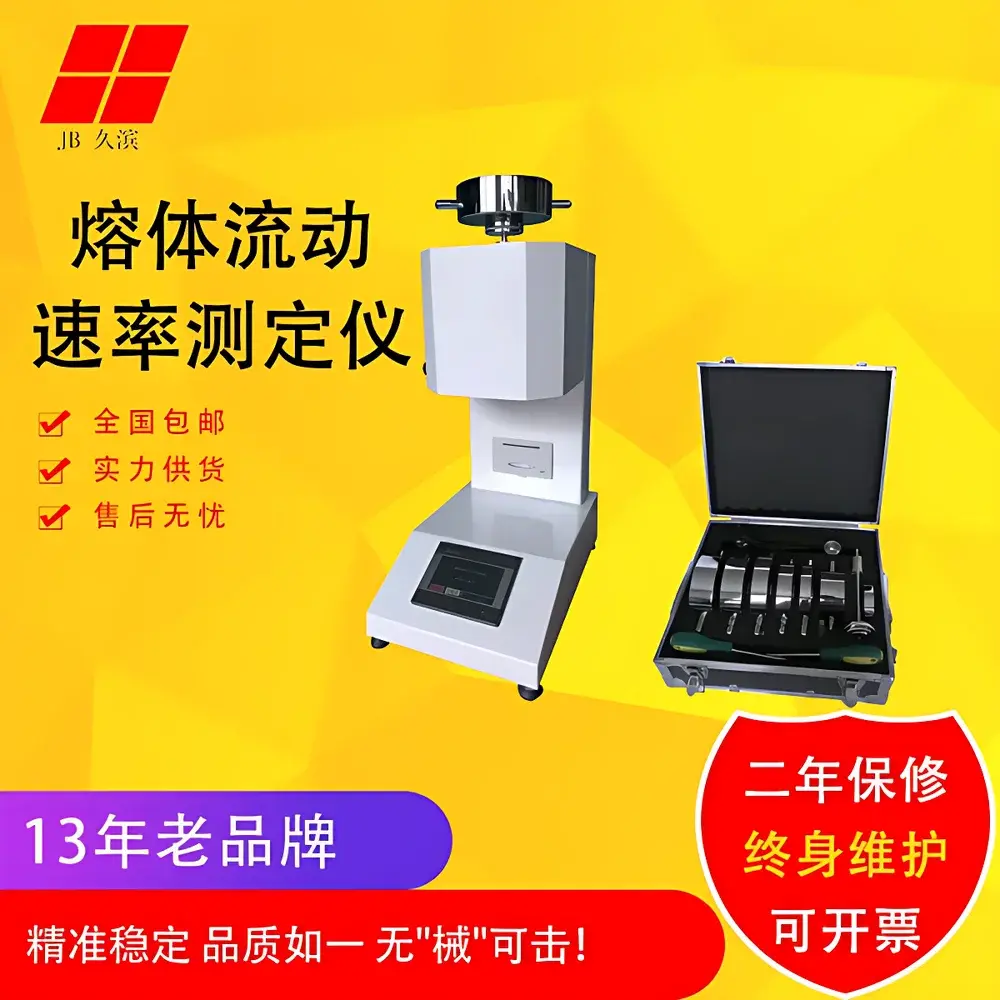
Jiubin JB-400H Melt Flow Indexer for Nonwoven Fabric Used in Medical Face Masks
| Brand | Jiubin |
|---|---|
| Model | JB-400H |
| Origin | Shanghai, China |
| Die Diameter | Φ2.095 ± 0.005 mm |
| Die Length | 8.000 ± 0.025 mm |
| Barrel Diameter | Φ9.550 ± 0.007 mm |
| Barrel Length | 152 ± 0.1 mm |
| Piston Head Diameter | 9.474 ± 0.007 mm |
| Piston Head Length | 6.350 ± 0.100 mm |
| Standard Test Loads (8 levels) | 0.325 kg to 21.600 kg (3.187 N to 211.82 N |
| Temperature Range | Ambient to 450 °C |
| Temperature Stability | ±0.2 °C |
| Control System | PLC-based |
| Human-Machine Interface | 5-inch color touch screen |
| Display | LCD |
| Report Output | Thermal printer support |
| Melt Cutting Modes | Manual / Time-controlled / Automatic |
| Test Method | Gravimetric (MFR) |
| Dimensions (L×W×H) | 250 × 350 × 510 mm |
Overview
The Jiubin JB-400H Melt Flow Indexer is a precision thermal-mechanical instrument engineered for the quantitative determination of melt mass-flow rate (MFR) of thermoplastic polymers—specifically polypropylene (PP) and polyethylene (PE) nonwoven fabrics used in medical face mask production. It operates on the principle of extrusion rheometry under standardized gravitational loading, in strict accordance with ISO 1133-1:2011 and ASTM D1238 (Condition E and G). The device measures the mass of polymer extrudate forced through a calibrated capillary die under controlled temperature and defined load over a fixed time interval, yielding MFR values expressed in g/10 min. Its design prioritizes repeatability, thermal uniformity, and mechanical traceability—critical for QC laboratories validating raw material consistency prior to spunbond or meltblown process integration.
Key Features
- High-precision machined capillary assembly: Die diameter Φ2.095 ± 0.005 mm and length 8.000 ± 0.025 mm meet ISO 1133 Annex A tolerances for standard MFR testing.
- Thermally stabilized barrel system: 152 mm long, Φ9.550 ± 0.007 mm barrel with embedded Pt100 sensor and PID-controlled heating zone ensures ±0.2 °C stability across 190–230 °C (standard PP test range) and up to 450 °C for engineering resins.
- Eight-level calibrated weight set: Covers loads from 3.187 N (0.325 kg) to 211.82 N (21.600 kg), certified to ≤±0.5% relative error per ISO 1133-2:2013 Annex B.
- PLC-based control architecture: Ensures deterministic timing for extrusion duration, cut initiation, and data logging—eliminating microcontroller drift common in low-cost microprocessor systems.
- Triple-mode melt cutting: Supports manual cut (for operator verification), time-controlled cut (programmable intervals), and automatic cut triggered by real-time mass accumulation algorithm.
- Integrated gravimetric workflow: Includes tare calibration routine, digital mass input via touchscreen, and automatic MFR calculation using ISO 1133 Equation (1).
Sample Compatibility & Compliance
The JB-400H is validated for use with isotactic polypropylene (iPP), high-density polyethylene (HDPE), and copolymer blends commonly employed in surgical mask and respirator nonwoven layers. It supports both single-point MFR determination and multi-load flow curve generation (e.g., for apparent viscosity estimation). All mechanical dimensions comply with ISO 1133-1:2011 Figure 1 specifications. Temperature calibration is traceable to NIST-traceable reference thermometers. The instrument satisfies requirements for GLP-compliant environments when operated with documented SOPs, equipment logbooks, and annual verification against certified reference materials (e.g., NIST SRM 2893 for PP).
Software & Data Management
While the JB-400H operates via embedded PLC logic and local HMI, its thermal and timing parameters are fully configurable and auditable. The 5-inch color touchscreen logs test ID, date/time stamp, temperature setpoint, applied load, cut time, sample mass, and calculated MFR—exportable as CSV via USB port. Print reports include instrument ID, calibration due date, operator ID field, and pass/fail status against user-defined specification limits. For regulated environments, optional RS-232 or Ethernet modules enable integration into LIMS platforms supporting 21 CFR Part 11-compliant electronic records (audit trail, electronic signature, data integrity controls).
Applications
- Quality assurance of PP granules and masterbatches prior to nonwoven fabric extrusion.
- In-process monitoring of melt index shifts during polymer degradation studies (e.g., peroxide-induced chain scission).
- Batch-to-batch consistency verification for FDA-listed medical device manufacturers (21 CFR 820.80).
- Raw material qualification per ISO 13485:2016 clause 7.4.2 (purchasing controls).
- Supporting technical documentation for CE marking submissions under MDR Annex II (technical file requirement for material characterization).
FAQ
What standards does the JB-400H comply with?
It conforms to ISO 1133-1:2011 (gravimetric method), ASTM D1238 (Condition E for PP at 230 °C/2.16 kg), and GB/T 3682.1–2018 (Chinese national standard equivalent).
Can it measure MFR for ultra-high-molecular-weight polyethylene (UHMWPE)?
No—UHMWPE cannot be tested via capillary extrusion per ISO 1133 due to zero melt flow; alternative methods such as gel permeation chromatography (GPC) are required.
Is calibration certificate included with shipment?
A factory calibration report covering die geometry, temperature uniformity, and load verification is provided; third-party ISO/IEC 17025 calibration is available upon request.
How often should the die and barrel be cleaned?
After each test series, using brass brushes and high-purity xylene or chloroform; full disassembly and dimensional recheck recommended every 200 tests or quarterly, whichever occurs first.
Does the instrument support MVR (melt volume-rate) measurement?
No—the JB-400H implements gravimetric MFR only; volumetric measurement requires piston displacement transducers and is not part of this model’s configuration.



