
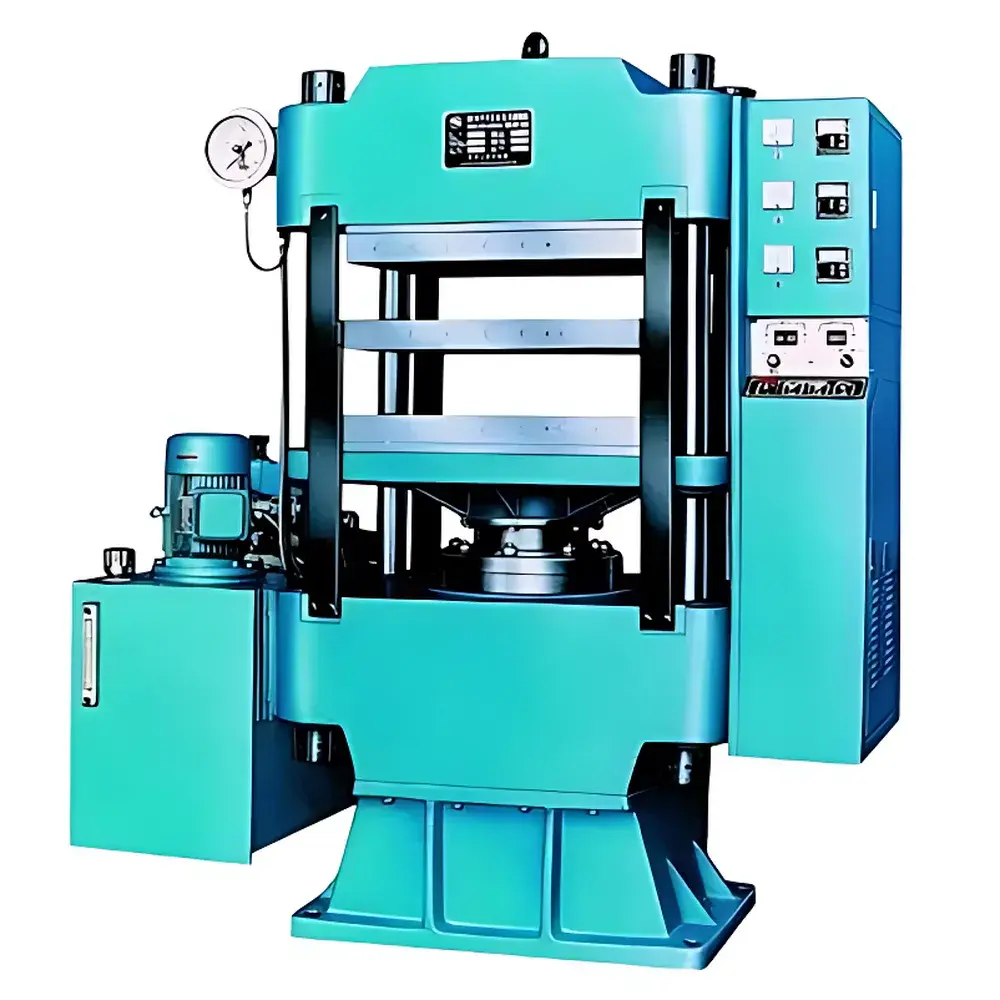
Jiubin Instruments JB-25T Four-Column Electrically Heated平板 Vulcanizing Press
| Brand | Jiubin Instruments |
|---|---|
| Origin | Shanghai, China |
| Manufacturer Type | Authorized Distributor |
| Country of Origin | China |
| Model | JB-25T |
| Price Range | USD 4,200 – 7,000 |
| Nominal Clamping Force | 250 kN |
| Platen Dimensions | 350 × 350 mm |
| Platen Spacing | 125 mm |
| Number of Working Layers | 2 |
| Hydraulic Pressure | 16 MPa |
| Max. Heating Temperature | 300 °C |
| Platen Surface Pressure | 2.04 MPa |
| Plunger Stroke | 250 mm |
| Heating Method | Electric (PID-controlled) |
| Control System | PLC-based with HMI interface |
| Motor Power | 14.4 kW |
| Overall Dimensions (L×W×H) | 1300 × 800 × 1500 mm |
| Net Weight | 1150 kg |
Overview
The Jiubin Instruments JB-25T Four-Column Electrically Heated Vulcanizing Press is a precision-engineered industrial press designed for controlled thermal curing and compression molding of elastomeric and thermoplastic compounds. Operating on the principle of isothermal compression under regulated hydraulic force and uniform electric heating, the JB-25T delivers repeatable crosslinking conditions essential for rubber compound development, quality assurance testing, and small-batch production of vulcanized components. Its dual-pump hydraulic architecture—integrating a high-flow low-pressure pump for rapid platen closure and a low-flow high-pressure pump for precise pressure holding—enables both energy-efficient warm-up cycles and stable dwell-phase pressure maintenance. The press conforms to fundamental mechanical design standards for industrial vulcanization equipment, including ISO 14001-aligned manufacturing practices and CE-compliant electrical safety architecture (EN 60204-1), supporting integration into GLP-compliant laboratory workflows and ISO 9001-certified production environments.
Key Features
- Four-column rigid frame construction with preloaded tie bars ensures minimal deflection (<0.05 mm under full 250 kN load), preserving parallelism between upper and lower platens across repeated duty cycles.
- PID-regulated electric heating system (TED-2301 digital temperature controller) maintains thermal stability within ±1.5 °C across the full 350 × 350 mm platen surface, verified per ASTM D5289 Annex A3 protocols for vulcanization equipment calibration.
- Intelligent auto-pressure compensation circuitry actively monitors and adjusts hydraulic pressure during cure dwell time to counteract polymer viscosity decay and thermal expansion effects—critical for achieving consistent scorch time (ts1/ts2) and optimum cure time (t90) reproducibility.
- PLC-based control unit with touch-enabled HMI supports programmable multi-step cure profiles (up to 9 segments), real-time parameter logging (temperature, pressure, time), and export-ready CSV data output via USB or RS-485 interface.
- Dual-gear-pump hydraulic configuration reduces average power consumption by ~22% compared to single-pump equivalents during pre-heating phase, as validated under IEC 61800-3 energy efficiency benchmarks.
Sample Compatibility & Compliance
The JB-25T accommodates standard ASTM D5289, ISO 6502, and GB/T 16584 test specimens—including disc-shaped (Ø16 mm × 2 mm), ring-shaped, and custom-machined geometries—within its 350 × 350 mm heated area and 125 mm open-height envelope. It supports both unidirectional compression (single-layer) and simultaneous dual-layer processing, enabling comparative vulcanization trials without equipment reconfiguration. All electrical subsystems comply with EN 61000-6-2 (immunity) and EN 61000-6-4 (emission) standards. The control firmware implements audit-trail-capable event logging (start/stop times, setpoint changes, fault codes), satisfying basic traceability requirements for internal QA documentation and preliminary FDA 21 CFR Part 11 readiness (when paired with validated user access controls and electronic signature protocols).
Software & Data Management
The integrated PLC controller records time-stamped process variables at configurable intervals (100 ms to 5 s resolution) and stores up to 1,000 complete cure cycles locally. Data export is supported in native CSV format for direct import into statistical analysis platforms (e.g., JMP, Minitab) or LIMS systems. Optional Ethernet/IP or Modbus TCP gateway modules enable remote monitoring and centralized fleet management in multi-press facilities. Firmware updates are performed via secure USB authentication, with version rollback capability and SHA-256 integrity verification to ensure system reliability and regulatory continuity.
Applications
- Rubber formulation development and optimization (NR, SBR, EPDM, FKM, silicone)
- Cure kinetics profiling per ASTM D5289 and ISO 6502 for RPA and MDR correlation studies
- Quality control of incoming raw materials and batch-to-batch consistency verification
- Small-lot production of gaskets, seals, insulators, and molded technical parts
- Thermoset plastic compression molding (phenolic, melamine, urea-formaldehyde)
- Academic research in polymer rheology, network formation kinetics, and filler dispersion effects
FAQ
What is the maximum recommended operating temperature for continuous use?
The JB-25T is rated for sustained operation at ≤280 °C; 300 °C is specified as absolute maximum for short-duration validation runs only.
Does the press support ASTM D5289-compliant oscillating disk rheometer (ODR) mode?
No—the JB-25T is a static compression press and does not incorporate oscillatory shear actuation. It is intended for conventional cure-state monitoring via hardness, torque, or physical property sampling post-cure.
Can the PLC program be password-protected to restrict operator-level modifications?
Yes—three-tier access control (Operator, Technician, Administrator) is embedded, with configurable password policies and session timeout enforcement.
Is third-party calibration certification available from Jiubin Instruments?
Factory calibration reports (traceable to CNAS-accredited reference standards) are provided with each unit; on-site NIST-traceable recalibration services are offered globally through authorized service partners.
What maintenance intervals are recommended for hydraulic oil and filter replacement?
Hydraulic oil (ISO VG 46 anti-wear mineral oil) and return-line filter should be replaced every 2,000 operating hours or annually—whichever occurs first—per ISO 4406:2017 cleanliness code requirements.






