
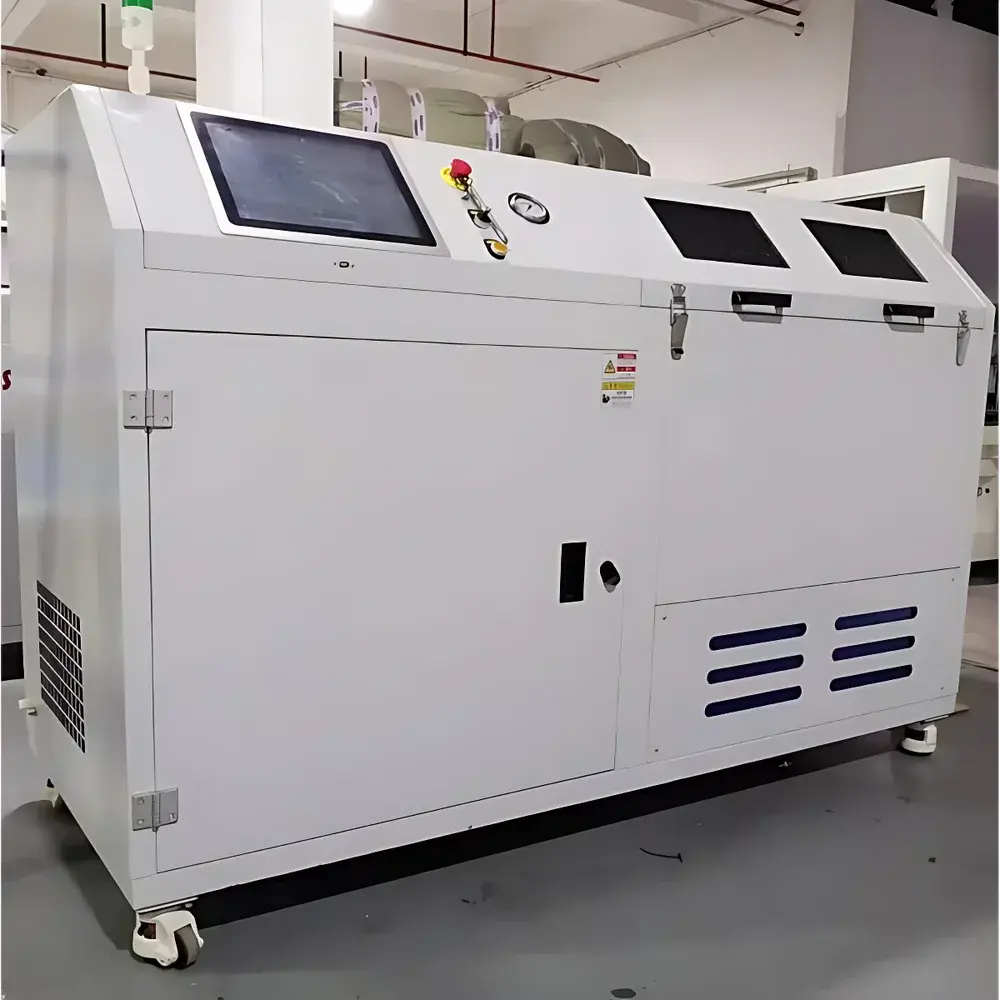
JB-JM8 Hydraulic Pulse Fatigue Test System
| Brand | Jiubin Instruments |
|---|---|
| Origin | Shanghai, China |
| Model | JB-JM8 |
| Pulse Pressure Range | 0–300 MPa (selectable) |
| Pulse Frequency | 0–4 Hz |
| Power Supply | 3-phase 380 V, 50 Hz |
| Total Power | 30 kW |
| Test Media | Hydraulic oil, water, antifreeze |
| Test Stations | 1–8 (configurable) |
| Mounting | Internal |
| Waveform Options | Sine, trapezoidal |
| Test Modes | Pulse fatigue, hold-pressure |
| Control System | Industrial PC-based |
| Pressure Ramp Rate | 0–300 MPa/s (adjustable) |
| Compliance | GB 5568–2005, ISO 4081:2005, SAE J1401–94, SAE J1610–2001, SAE J2050–2001, GM 6250–1995.02, GM 6278M–1997, DIN 73411-1-2:1996, TL 680:1999, TL 52361:1999, GME standards |
Overview
The JB-JM8 Hydraulic Pulse Fatigue Test System is an industrial-grade, programmable pressure cycling platform engineered for high-reliability hydraulic pulse endurance evaluation of fluid-carrying components. It operates on the principle of servo-controlled hydraulic actuation, generating precisely defined pressure waveforms—including sine and trapezoidal profiles—within sealed test specimens. By subjecting components such as automotive A/C hoses, brake lines, heat exchangers (radiators, condensers, evaporators), oil coolers, and hydraulic conduits to repeated pressure excursions between user-defined upper and lower limits, the system simulates real-world service-induced fatigue mechanisms including interfacial delamination, seal extrusion, and microcrack propagation. Temperature-regulated test media (hydraulic oil, water, or ethylene glycol-based antifreeze) circulate through the specimen at controlled flow rates while synchronized pressure modulation replicates dynamic loading conditions encountered in vehicular, aerospace, and industrial thermal management systems. The system executes fully automated test sequences—including pre-conditioning, cyclic pulsing, post-cycle hold-pressure verification, and leakage detection—enabling unattended operation with real-time fault recognition and safety-interrupt protocols.
Key Features
- Multi-range programmable pulse pressure capability: configurable up to 300 MPa with fine-grained resolution across 0–25 MPa, 0–100 MPa, 0–150 MPa, and 0–300 MPa ranges
- Adjustable frequency control from 0.01 Hz to 4.0 Hz, supporting both low-frequency durability validation and high-cycle accelerated life testing
- Industrial PC-based control architecture with deterministic real-time OS, enabling precise waveform synthesis, data logging at ≥1 kHz sampling rate, and closed-loop pressure feedback compensation
- Configurable test station count: 1 to 8 independent channels with individual pressure transducers, temperature sensors, and leak-detection logic per channel
- Programmable ramp rate control: linear pressure rise/fall profiles adjustable from 0.1 MPa/s to 300 MPa/s, critical for evaluating transient stress response and material viscoelastic hysteresis
- Integrated safety interlocks: redundant pressure relief valves, over-temperature cutoffs, burst disc monitoring, and automatic emergency depressurization upon anomaly detection
- Internal mounting configuration optimized for compact footprint and minimized hydraulic path compliance, ensuring waveform fidelity and phase accuracy
Sample Compatibility & Compliance
The JB-JM8 accommodates rigid and flexible tubular assemblies—including steel, aluminum, copper, reinforced polymer, and braided composite hoses—with nominal diameters ranging from 4 mm to 50 mm and wall thicknesses up to 8 mm. Fixturing supports standardized SAE, ISO, and DIN interface geometries (e.g., O-ring face seal, JIC 37° flare, ORFS). All test procedures are structured to meet mandatory regulatory and industry-specific requirements, including but not limited to GB 5568–2005 (Chinese national standard for hose pulse resistance), ISO 4081:2005 (rubber and plastics hoses – hydraulic pulse testing), SAE J1401–94 and J1610–2001 (automotive refrigerant and fuel line validation), GM 6250–1995.02 and GM 6278M–1997 (General Motors component durability specifications), and DIN 73411-1-2:1996 (pressure pulsation testing of cooling system components). The system’s control firmware and data archive structure support audit-ready documentation compliant with GLP and GMP frameworks, including electronic signature capability and 21 CFR Part 11–compatible audit trails when integrated with validated LIMS environments.
Software & Data Management
The JB-JM8 runs on a dedicated Windows-based HMI application built with deterministic I/O drivers and embedded SQL database backend. Test definition includes full parametric specification of waveform type, amplitude envelope, dwell times, cycle counts, ramp profiles, and pass/fail criteria (e.g., maximum allowable pressure decay during hold phase, volumetric leakage threshold < 0.5 mL/min). Real-time visualization displays synchronized pressure vs. time traces, temperature trends, and status flags for each active channel. Raw sensor data (pressure, temperature, flow, valve position) is logged in IEEE 754-compliant binary format with nanosecond-resolution timestamps, exportable to CSV, HDF5, or MATLAB .mat for post-test statistical analysis (Weibull, SN-curve derivation, fatigue life prediction). All test reports include metadata traceability—operator ID, calibration certificate IDs, environmental chamber readings, and instrument firmware revision—ensuring full data integrity per ISO/IEC 17025:2017 clause 7.7.
Applications
This system serves as a core validation tool across multiple engineering domains requiring quantitative assessment of pressure-cycle reliability. In automotive R&D labs, it validates HVAC refrigerant hoses against thermal shock + pulsation coupling per SAE J2050. Tier-1 suppliers use it for DOE-driven optimization of crimp joint integrity under combined torsion-pulse loads. Aerospace manufacturers employ it for qualification of titanium hydraulic manifolds per MIL-STD-1553B-compatible test protocols. Refrigeration equipment OEMs apply it to verify brazed joint longevity in commercial condenser coils subjected to daily thermal cycling. Additionally, it supports regulatory submissions for PED 2014/68/EU Annex I conformity assessments and ASME B31.1/B31.3 piping component certification where fatigue life modeling requires empirical boundary condition inputs.
FAQ
What types of fluids can be used as test media?
Hydraulic oil (ISO VG 32–68), deionized water, and aqueous ethylene glycol solutions (up to 60% concentration) are supported; compatibility with other media requires prior chemical compatibility verification.
Is the system capable of simultaneous multi-channel testing with independent pressure profiles?
Yes—each of the 1–8 configurable stations operates with fully decoupled pressure control, enabling mixed-part testing (e.g., brake hose + radiator core) under distinct waveform parameters.
How is leakage detected during or after pulse cycling?
Leakage is inferred via real-time pressure decay analysis during hold phases and confirmed by volumetric displacement measurement using calibrated piston displacement transducers with ±0.1 mL resolution.
Does the system provide calibration traceability to national metrology institutes?
All pressure transducers ship with NIST-traceable calibration certificates (valid for 12 months); optional annual recalibration services include on-site verification per ISO/IEC 17025 accredited providers.
Can test programs be exported and reused across different JB-JM8 units?
Yes—test definitions are stored as XML-based configuration files with embedded version control; cross-platform compatibility is ensured across all firmware revisions ≥v3.2.0.
Related Products



