
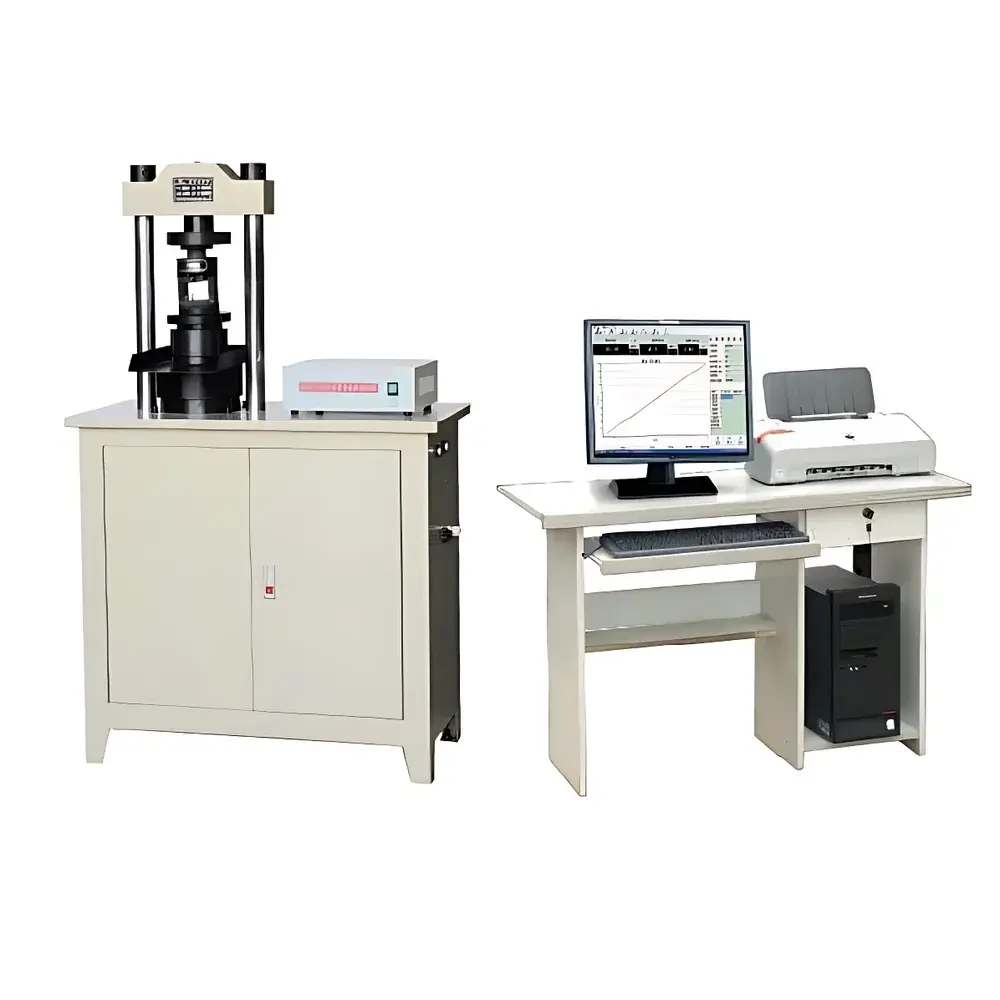
JB/YAW-300B Automatic Compression Testing Machine by Jiubin Instruments
| Brand | Jiubin Instruments |
|---|---|
| Origin | Shanghai, China |
| Model | JB/YAW-300B |
| Max. Test Load | 300 kN |
| Load Measurement Range | 4–100% FS |
| Load Accuracy | ±1% of reading |
| Load Resolution | 0.01 kN |
| Loading Rate | 0.3–10 kN/s |
| Loading Rate Accuracy | ±5% |
| Hydraulic Pump Rated Pressure | 25 MPa |
| Pump Flow Rate | 1.52 L/min |
| Platen Diameter | φ155 mm |
| Max. Platen Spacing | 260 mm |
| Piston Diameter | φ130 mm |
| Piston Stroke | 60 mm |
| Motor Power | 0.75 kW (3-phase) |
| Dimensions (W×D×H) | 870×450×1400 mm |
| Weight | 450 kg |
Overview
The JB/YAW-300B Automatic Compression Testing Machine is an electromechanical-hydraulic universal testing system engineered for high-reliability compressive strength evaluation of construction materials including concrete cubes, cement mortar prisms, fired bricks, natural stone specimens, and precast concrete elements. Designed in accordance with core mechanical testing principles—force-controlled closed-loop actuation via servo-regulated hydraulic pressure—the system delivers repeatable, traceable, and standards-compliant compression tests under both constant-rate-of-load (CRL) and constant-rate-of-stress (CRS) control modes. Its architecture integrates a rigid C-frame load frame, precision-machined platens, and a calibrated hydraulic actuation system, enabling stable force application across the full 300 kN capacity range while maintaining structural integrity during high-cycle or long-duration loading protocols.
Key Features
- Force-closed-loop control architecture ensures dynamic compensation for system compliance and load drift during sustained compression sequences.
- Programmable loading profiles support ASTM C39/C109/C140, ISO 7500-1 Class 1, and GB/T 2611–2007 compliant test execution—including ramp-hold-ramp, stepwise incremental, and creep-controlled protocols.
- Digital load cell with 0.01 kN resolution and ≤±1% indication error over 4–100% full scale (FS), verified per ISO 376 Annex B calibration procedures.
- Hydraulic power unit features a 25 MPa rated pressure pump with 1.52 L/min flow rate, optimized for smooth low-speed loading (0.3 kN/s) and rapid high-force ramping (up to 10 kN/s) within ±5% rate tolerance.
- Integrated industrial control unit with embedded real-time OS coordinates data acquisition at ≥100 Hz sampling rate, synchronized with position feedback from piston displacement transducers.
- Rigid monolithic frame (450 kg mass) minimizes vibration coupling and resonance effects during high-force testing, enhancing measurement stability for brittle material fracture analysis.
Sample Compatibility & Compliance
The JB/YAW-300B accommodates standard civil engineering specimens up to 155 mm in diameter and 260 mm in height—including 100 mm and 150 mm concrete cubes, 40×40×160 mm mortar beams (for compressive face testing), solid clay bricks (240×115×53 mm), and granite/marble core samples. Platens are hardened and ground to ≤0.02 mm flatness tolerance (per ISO 7500-1) and feature replaceable wear-resistant inserts. The system meets essential requirements of ISO 16840 (compression testing machines), EN 12390-4 (concrete strength testing), and GB/T 3159–2008 (hydraulic universal testing machines). While not inherently 21 CFR Part 11 compliant, audit-trail-ready data export functionality supports GLP/GMP-aligned laboratory documentation workflows when paired with validated Excel report templates.
Software & Data Management
The bundled PC-based control software (Windows 10/11 compatible) provides intuitive test configuration, real-time curve visualization (load vs. time, load vs. displacement), and automated calculation of compressive strength (MPa), modulus of elasticity (where applicable), and failure energy absorption. All raw channel data (load, displacement, time) are stored in binary .dat format with timestamped metadata. Users may define custom report layouts—including specimen ID, operator name, environmental conditions (optional manual entry), and pass/fail thresholds—and export finalized reports directly to editable Microsoft Excel (.xlsx) files. Calibration certificates, system verification logs, and user-defined test method libraries are managed within a hierarchical project folder structure supporting multi-user access control.
Applications
- Quality assurance testing of ready-mix concrete batches per ASTM C39 and EN 12390-3.
- Compressive performance validation of masonry units (ASTM C67, ISO 6707-1) and autoclaved aerated concrete (AAC) blocks.
- Research-grade mechanical characterization of geopolymer binders, recycled aggregate concretes, and fiber-reinforced cementitious composites.
- Educational laboratory use in civil engineering curricula for stress–strain curve derivation and ductility index assessment.
- Third-party certification lab execution of accredited tests under CNAS (China National Accreditation Service) or equivalent ILAC-MRA signatory schemes.
FAQ
What standards does the JB/YAW-300B comply with for calibration and verification?
It adheres to ISO 7500-1:2018 for static calibration of compression testing machines and supports verification against reference load cells traceable to NIM (National Institute of Metrology, China) or other BIPM-affiliated NMIs.
Can the system perform flexural or tensile tests?
No—it is purpose-built for uniaxial compression only. Tensile or bending configurations require separate universal testing machines with appropriate fixtures and load train geometry.
Is remote diagnostics or firmware update capability supported?
Firmware updates are performed locally via USB interface; remote desktop-assisted troubleshooting is available upon request through authorized service channels.
What maintenance intervals are recommended for the hydraulic system?
Hydraulic oil replacement every 1,500 operating hours or biannually (whichever occurs first); filter cartridge replacement every 500 hours; annual verification of pump pressure relief valve setpoint and load cell linearity.
Does the system include built-in data backup or cloud synchronization?
Data storage is local to the host PC; network-attached storage (NAS) or institutional cloud repositories may be integrated via standard Windows file-sharing protocols—no proprietary cloud service is embedded.



