
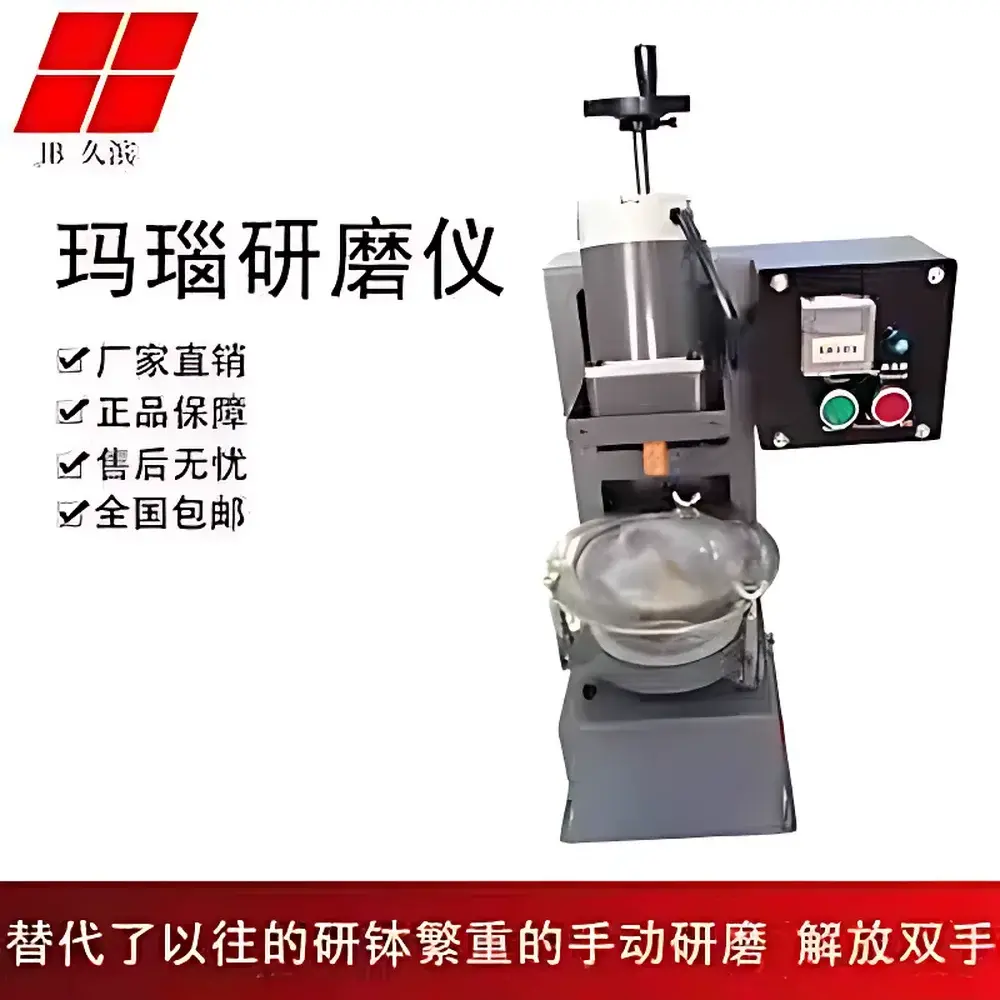
Jiubin JB-120 Agate Mortar Grinder
| Brand | Jiubin |
|---|---|
| Origin | Shanghai, China |
| Model | JB-120 |
| Instrument Type | Mortar Grinder |
| Sample Suitability | Hard & Brittle Solids |
| Output Particle Size | 0.01–0.5 mm |
| Mortar Diameter | 120 mm |
| Mortar Depth | 34 mm |
| Pestle Speed | 20–90 rpm |
| Mortar Speed | 10 rpm |
| Pestle Power | 25 W |
| Mortar Power | 10 W |
| Grinding Time Range | 1–900 min |
| Dimensions (L×W×H) | 240 × 240 × 500 mm |
| Weight | 12 kg |
| Voltage | 110/220 V, 50/60 Hz |
| Material | Natural Agate (Mortar & Pestle) |
Overview
The Jiubin JB-120 Agate Mortar Grinder is an electromechanical laboratory grinding instrument engineered for precision size reduction of hard, brittle, and chemically inert solid samples. Unlike conventional mortar-and-pestle setups or high-energy ball mills, this device employs a controlled, low-shear conical碾压 (rolling-compression) mechanism between two precisely shaped agate surfaces — a hemispherical agate mortar rotating at 10 rpm and a spring-loaded agate pestle rotating at 20–90 rpm along a conical trajectory. This geometry ensures uniform contact pressure and consistent shear distribution across the entire sample bed, minimizing localized overheating and amorphization while preserving crystallinity and chemical integrity. Designed for microscale preparation in analytical, pharmaceutical, and materials science laboratories, it delivers reproducible particle size distributions in the 10–500 µm range — with extended operation enabling sub-10 µm median diameters under optimized conditions. Its all-agate wet/dry grinding chamber eliminates metallic contamination, making it suitable for trace-element analysis, XRD sample prep, and high-purity powder synthesis.
Key Features
- Natural agate mortar (Ø120 mm × 34 mm depth) and matching agate pestle — certified non-reactive, ultra-hard (Mohs 7), and non-porous for zero cross-contamination
- Independent dual-motor drive system: slow-speed mortar rotation (10 rpm) + adjustable high-torque pestle rotation (20–90 rpm)
- Precision-engineered conical motion path of pestle head ensures continuous rolling-compression without slippage or dead zones
- Integrated compression spring maintains constant normal force between pestle tip and mortar base, ensuring stable grinding kinetics across variable load conditions
- Digital timer control (1–900 minutes) with automatic shutdown and audible alert; no manual intervention required during operation
- Low-power consumption design (total ≤35 W) enables unattended overnight operation in fume hoods or gloveboxes
- Compact footprint (240 × 240 × 500 mm) and lightweight chassis (12 kg) facilitate integration into ISO Class 5–7 cleanrooms or regulated QC labs
Sample Compatibility & Compliance
The JB-120 is validated for use with abrasive, temperature-sensitive, and oxidation-prone materials including silicon carbide, fused silica, borosilicate glass, pharmaceutical actives (e.g., ibuprofen, paracetamol), food-grade spices, and semiconductor-grade silicon. It complies with general laboratory safety standards per IEC 61010-1 and meets mechanical stability requirements outlined in ASTM D2849 (Standard Practice for Sampling and Testing Ground Mineral Specimens). While not intrinsically rated for explosion-proof environments, its spark-free agate-on-agate operation makes it appropriate for Class II, Division 2 dust-hazard locations when used with appropriate local exhaust ventilation. For GMP-regulated environments, the unit supports audit-ready documentation via external loggers (time-stamped start/stop events, RPM verification); full 21 CFR Part 11 compliance requires integration with validated LIMS or ELN systems.
Software & Data Management
The JB-120 operates via a standalone digital control panel with LED display — no proprietary software or PC interface is included. All operational parameters (grinding time, pestle speed) are set manually and retained in non-volatile memory. For laboratories requiring electronic records, optional RS-232 or USB-to-serial adapters enable connection to third-party data acquisition platforms (e.g., LabVIEW, Python-based logging scripts) that capture timestamped event logs. The absence of embedded firmware updates or cloud connectivity ensures long-term validation stability — critical for GLP/GMP workflows where change control and version traceability are mandated. Routine calibration verification is performed using NIST-traceable tachometers and certified reference powders (e.g., SRM 1979 Alumina).
Applications
- Preparation of X-ray diffraction (XRD) and SEM/EDS specimens requiring phase-pure, strain-minimized particles
- Homogenization of API-excipient blends prior to tablet compaction studies (USP & Ph. Eur. compliant milling)
- Production of nanostructured ceramic precursors (e.g., ZnO, TiO₂) without solvent or surfactant introduction
- Grinding of geological samples (quartz, feldspar) for geochemical analysis by ICP-MS or AAS
- Particle size standardization of reference materials for laser diffraction or dynamic image analysis validation
- Controlled comminution of brittle polymers (e.g., PTFE, polyimide) for thermal analysis (DSC/TGA) sample prep
FAQ
Is the JB-120 suitable for cryogenic grinding?
No — the unit lacks integrated cooling capability and is not rated for sub-0°C ambient operation. For cryo-grinding, liquid nitrogen-cooled planetary ball mills are recommended.
Can the agate mortar be replaced with other materials (e.g., stainless steel or tungsten carbide)?
No — the mechanical design, torque transmission, and motion geometry are calibrated exclusively for agate components. Substitution voids performance specifications and compromises safety certification.
What maintenance is required beyond routine cleaning?
Annual inspection of motor brushes, spring preload verification, and visual assessment of agate surface wear (using 10× magnification) are advised. No lubrication is required inside the grinding chamber.
Does the JB-120 meet ISO 8573-1 for compressed air purity?
Not applicable — the instrument contains no pneumatic components. Air-independent operation enhances reliability in controlled environments.
How is particle size distribution verified post-grinding?
Users must employ orthogonal characterization methods — e.g., laser diffraction (ISO 13320), sieve analysis (ISO 9276-2), or scanning electron microscopy — as the JB-120 does not incorporate real-time particle sizing.



