
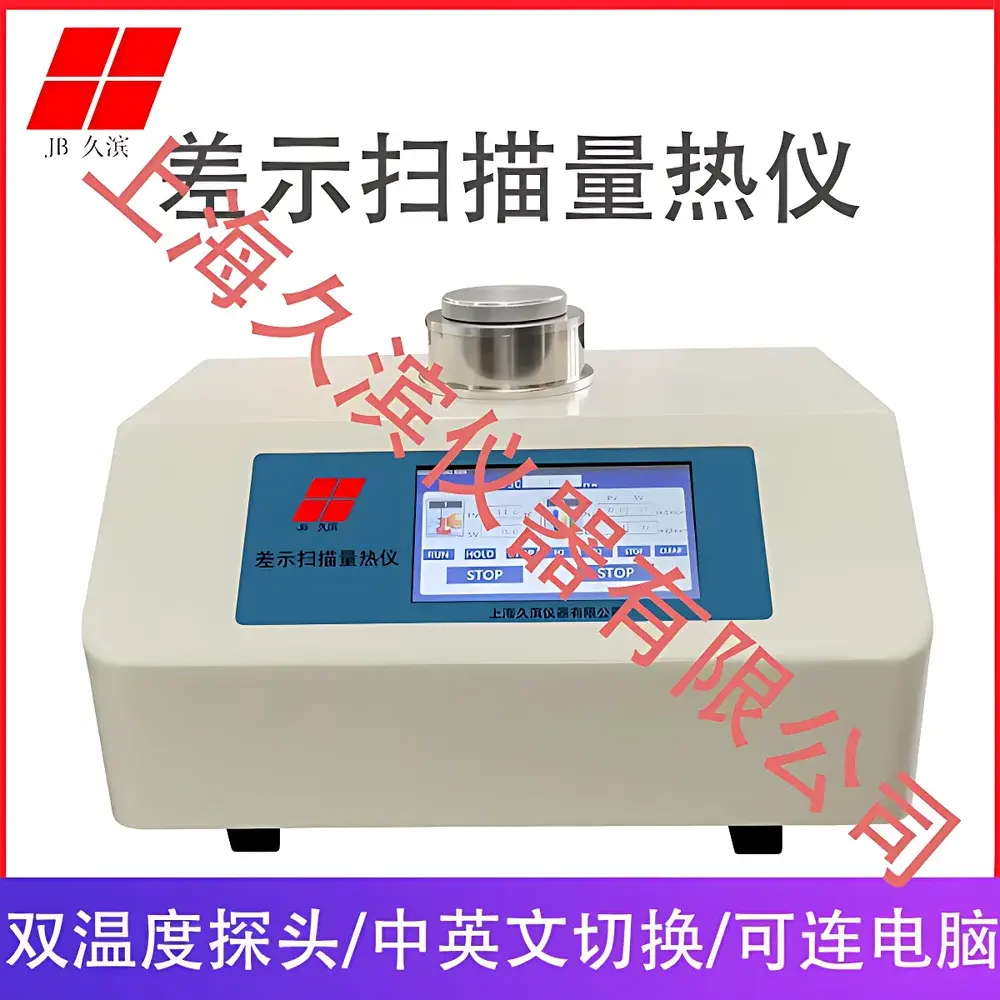
JB-DSC-800 Glass Transition Temperature Analyzer (Differential Scanning Calorimeter)
| Brand | Jiubin Instruments |
|---|---|
| Origin | Shanghai, China |
| Model | JB-DSC-800 |
| Temperature Range | Ambient to 800 °C |
| Temperature Accuracy | ±0.1 °C |
| Heating/Cooling Rate | 1–80 K/min |
| Heat Flow Resolution | 0.1 μW |
Overview
The JB-DSC-800 Glass Transition Temperature Analyzer is a high-performance differential scanning calorimeter (DSC) engineered for precise thermal characterization of polymeric, pharmaceutical, metallic, and composite materials. It operates on the fundamental principle of heat flux DSC—measuring the difference in heat flow between a sample and an inert reference as both are subjected to identical, controlled temperature programs. This enables quantitative determination of thermal transitions including glass transition temperature (Tg), melting point (Tm), crystallization onset (Tc), heat capacity (Cp), and enthalpy changes (ΔH). Designed for laboratory environments requiring reproducible, traceable thermal data, the JB-DSC-800 delivers stable baseline performance across its full operating range from ambient to 800 °C—making it suitable for both routine quality control and advanced research applications in polymer science, materials development, and formulation stability assessment.
Key Features
- Wide operational temperature range: ambient to 800 °C, supporting high-temperature polymer degradation studies, metal alloy phase analysis, and ceramic sintering behavior evaluation.
- Precise temperature control with ±0.1 °C accuracy and programmable heating/cooling rates from 1 to 80 K/min—enabling dynamic thermal profiling per ASTM E1356 and ISO 11357 standards.
- High-sensitivity heat flow detection with 0.1 μW resolution, facilitating accurate quantification of subtle thermal events such as secondary relaxations and low-enthalpy transitions.
- Robust furnace architecture with optimized thermal shielding and symmetric sensor design to minimize thermal lag and ensure baseline symmetry and repeatability.
- Modular sample pan system compatible with standard aluminum, gold-plated aluminum, and high-temperature ceramic crucibles—supporting sealed, open, or high-pressure configurations.
- Integrated purge gas control (N2, Ar, O2) with mass flow regulation for atmosphere-sensitive measurements, oxidation induction time (OIT) testing, and controlled oxidative degradation analysis.
Sample Compatibility & Compliance
The JB-DSC-800 accommodates solid, semi-crystalline, amorphous, and powdered samples weighing 1–20 mg, with minimal preparation requirements. It supports compliance-critical workflows in regulated industries: raw material qualification per USP and ICH Q5C, thermal stability assessment per ICH Q1A(R2), and polymer characterization aligned with ASTM D3418 and ISO 11357-1 through -7. Data integrity meets GLP/GMP expectations through secure user access levels, audit trail logging, and electronic signature support—facilitating FDA 21 CFR Part 11 readiness when deployed with validated software configurations.
Software & Data Management
Equipped with proprietary thermal analysis software, the JB-DSC-800 provides real-time instrument control, multi-step temperature programming, automatic peak detection, and baseline correction algorithms. Raw data is stored in vendor-neutral ASCII format with embedded metadata (operator ID, date/time stamp, method name, calibration history). Advanced post-processing includes Cp calculation via stepwise heating rate analysis, Tg determination using midpoint, onset, or inflection methods per ISO 11357-2, and kinetic modeling (e.g., Ozawa-Flynn-Wall) for decomposition activation energy estimation. Export options include CSV, PDF reports, and integration-ready XML for LIMS or ELN systems.
Applications
- Determination of glass transition temperature (Tg) in thermoplastics, elastomers, and amorphous pharmaceuticals—critical for processing window definition and storage condition validation.
- Thermal stability screening of battery electrode materials, including cathode/anode cycling behavior and electrolyte decomposition thresholds.
- Crystallinity quantification in polyolefins and biopolymers via fusion enthalpy integration against reference standards (e.g., pure polyethylene).
- Reaction enthalpy measurement for crosslinking, curing, and polymerization kinetics in composites and adhesives.
- Oxidative induction time (OIT) testing per ASTM D3895 to assess antioxidant efficacy in polymeric packaging and automotive components.
- Phase transformation analysis in shape-memory alloys, solder pastes, and metallurgical intermetallics.
FAQ
What thermal transitions can the JB-DSC-800 detect besides glass transition?
It detects melting, crystallization, solid-solid transitions, curing exotherms, oxidative decomposition, and specific heat capacity changes—all under controlled atmosphere and variable scan rates.
Is the instrument compliant with international thermal analysis standards?
Yes—it supports methodology alignment with ASTM E793, E1356, D3418; ISO 11357 series; and USP , with hardware and software features enabling traceable calibration and documentation for regulatory submissions.
Can the JB-DSC-800 perform modulated DSC (MDSC®)?
No—the JB-DSC-800 implements conventional heat-flux DSC architecture; MDSC requires specialized oscillatory temperature modulation not supported by this model.
What is the typical calibration protocol for temperature and enthalpy accuracy?
Temperature calibration uses high-purity indium (156.6 °C), tin (231.9 °C), and zinc (419.5 °C); enthalpy calibration employs certified indium and tin standards traceable to NIST or equivalent national metrology institutes.
Does the system support automated sample loading?
No—sample loading is manual; however, the instrument interface supports batch method sequencing and auto-zeroing between runs to improve throughput consistency.



