
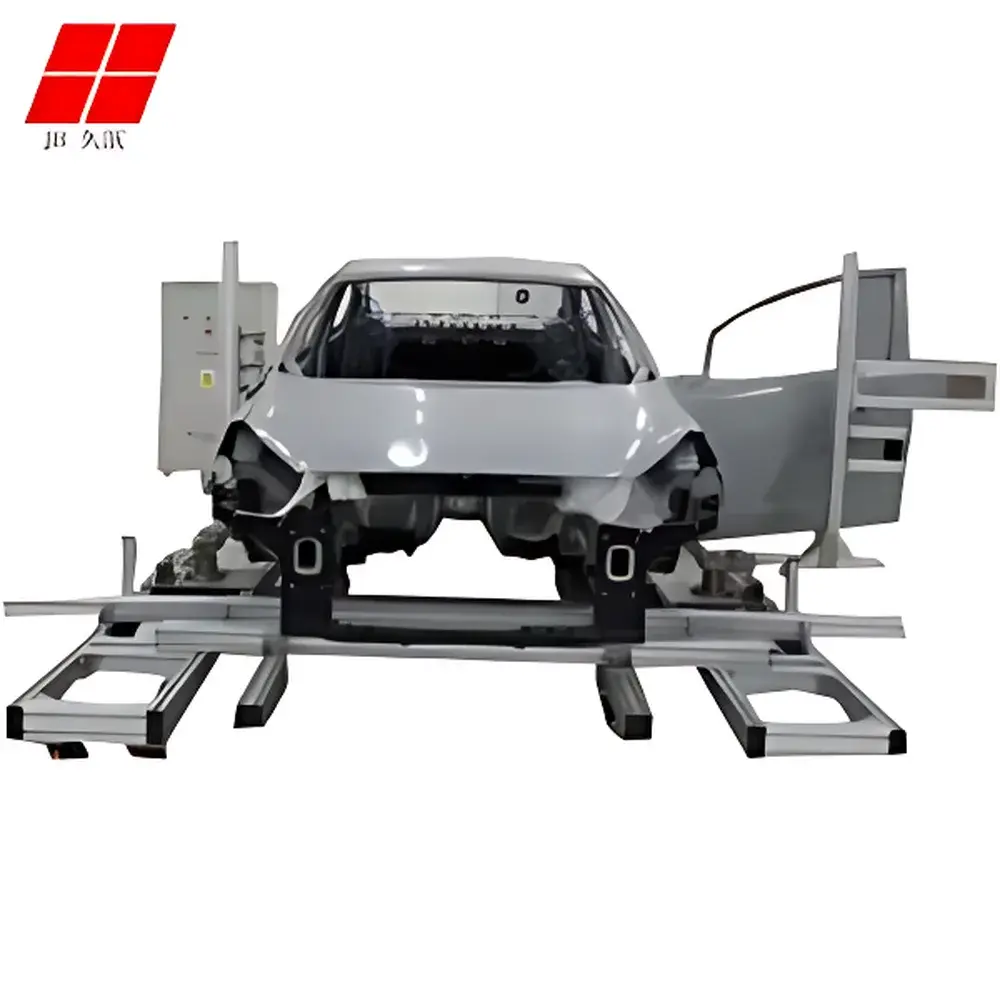
Jiubin JB-S Four-Door & Two-Lid Durability Test System
| Brand | Jiubin |
|---|---|
| Origin | Shanghai, China |
| Manufacturer Type | Authorized Distributor |
| Country of Origin | China |
| Model | JB-S |
| Pricing | Available Upon Request |
Overview
The Jiubin JB-S Four-Door & Two-Lid Durability Test System is an engineered electromechanical test platform designed for systematic, repeatable endurance validation of automotive body-in-white (BIW) door and lid systems. It replicates human-like kinematic profiles—specifically hand-driven opening/closing motions—across four side doors (front/rear left/right), hood (front lid), and trunk lid (rear lid). The system operates on a dual-principle foundation: programmable servo-driven actuation combined with pneumatic-assisted force modulation, enabling precise control of velocity, acceleration, deceleration, and dwell timing throughout each cycle. Unlike generic cycling rigs, the JB-S integrates biomechanically informed motion trajectories—particularly in ramp-up/ramp-down phases—to replicate real-world operator interaction, thereby exposing fatigue mechanisms in hinges, latches, strikers, seals, and structural mounting points under representative loading conditions.
Key Features
- Modular architecture supporting concurrent testing of all four doors and both lids—enabling full-vehicle system-level durability assessment without disassembly
- Independent speed-controlled actuation per module: side doors (0.1–2.0 m/s), sliding doors (0.1–1.2 m/s), hood (0.1–0.8 m/s), trunk lid (0.1–0.8 m/s)
- Biomechanical motion profiling: programmable acceleration/deceleration envelopes to emulate human hand dynamics during latch engagement/disengagement
- High-precision servo motors with closed-loop position/velocity feedback and torque monitoring
- Imported linear guide rails ensuring sub-millimeter repeatability over >500,000 cycles
- ESON-based industrial PLC control system with real-time data logging, cycle counting, fault diagnostics, and emergency stop interlocks
- Configurable dwell times at fully open/closed positions to simulate static load retention and seal compression relaxation
Sample Compatibility & Compliance
The JB-S accommodates production-intent white bodies and pre-assembled door/lid subassemblies with standard mounting interfaces (e.g., hinge flanges, striker plates, latch brackets). Fixture adaptability supports vehicles ranging from compact sedans to mid-size SUVs. All test protocols are structured to satisfy mandatory regulatory and industry standards, including:
- QC/T 586–2016: Technical Requirements and Test Methods for Automotive Door Latches and Hinges
- GB 15086–2013: Safety Regulations for Vehicle Doors (China National Standard)
- GB 15743–2019: Safety Requirements for Vehicle Hood Latches
- ECE Regulation No. 11: Uniform Provisions Concerning the Approval of Vehicles with Regard to the Strength of Their Doors
- SAE J934: Motor Vehicle Door Latch Systems – Performance Requirements
Test reports generated by the system include timestamped cycle logs, positional anomalies, actuation force deviations, and failure event markers—structured for traceability in APQP, PPAP, and GLP-aligned development workflows.
Software & Data Management
The JB-S runs on ESON’s proprietary HMI software suite, accessible via touch-panel interface or remote Ethernet connection. The software enables creation and storage of multi-stage test programs—including variable-speed segments, conditional branching (e.g., “if force exceeds threshold X, pause and log”), and automatic pass/fail evaluation against user-defined criteria (e.g., latch engagement torque drop >15%, positional drift >0.3 mm after 10,000 cycles). All operational data—including motor current, encoder position, pneumatic pressure, and I/O status—is time-synchronized and exportable in CSV or XML format. Audit trails comply with ISO 9001:2015 documentation requirements; raw logs retain full metadata (operator ID, calibration date, firmware version) to support internal quality audits and customer-facing validation submissions.
Applications
- Pre-production validation of door/hood/trunk lid mechanisms across OEM and Tier-1 supplier development cycles
- Root cause analysis of premature wear in hinge bushings, latch pawl surfaces, and striker alignment tolerances
- Correlation testing between physical durability results and multibody dynamic (MBD) simulations
- Supplier component qualification per AIAG CQI-17 (Special Process: Automotive Steel Heat Treatments) and CQI-23 (Special Process: Molding)
- End-of-line functional verification for high-volume assembly lines requiring statistical process control (SPC) integration
FAQ
What types of vehicle platforms can the JB-S accommodate?
The system supports BIW fixtures and door assemblies from B-segment to D-segment vehicles, with adjustable mounting frames and modular tooling kits for rapid reconfiguration.
Is the system compliant with FDA or ISO 13485 requirements?
While primarily designed for automotive applications, its documented calibration procedures, change control logs, and electronic record retention align with ISO 13485 clause 7.6 and FDA 21 CFR Part 11 principles—making it adaptable for medical device enclosure testing where mechanical durability is critical.
Can test sequences be exported for use in third-party CAE tools?
Yes—motion profiles (position vs. time), force traces, and event timestamps are exportable in ASCII-compatible formats compatible with MATLAB, ANSYS Motion, and ADAMS preprocessing workflows.
What maintenance intervals are recommended for long-term reliability?
Servo motor encoder calibration every 12 months; pneumatic filter/regulator servicing every 3 months; linear rail lubrication and backlash verification every 6 months—documented in the included Preventive Maintenance Manual.



