
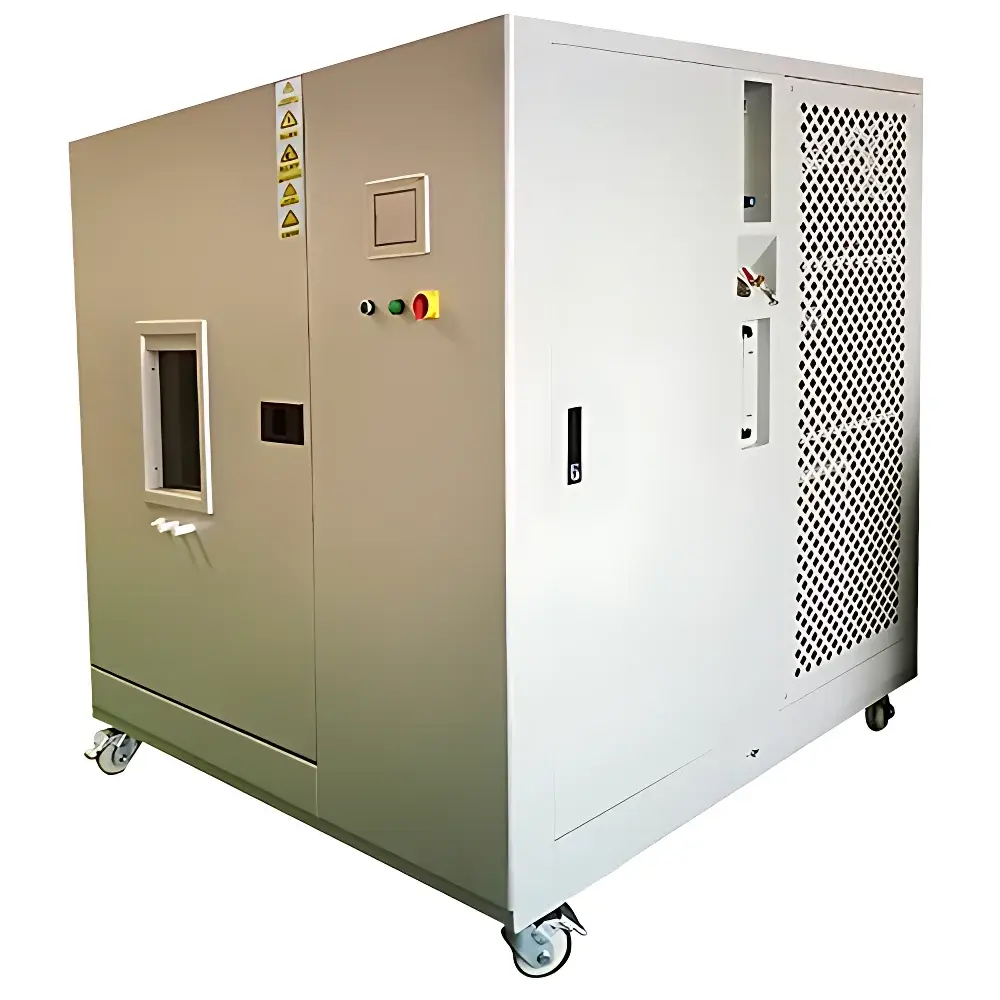
JB-220E Formaldehyde & TVOC Environmental Test Chamber
| Brand | Jiubin Instruments |
|---|---|
| Origin | Shanghai, China |
| Manufacturer Type | Authorized Distributor |
| Country of Origin | China |
| Model | JB-220E |
| Price Range | USD 14,000 – 42,500 (FOB Shanghai) |
| Detection Principle | Dynamic Chamber Method with Integrated PID/EC Sensor Array |
| Instrument Type | Continuous Online Monitoring System |
| Standard Configuration | Integrated TVOC + Formaldehyde Dual-Channel Analysis Module |
| Humidity Control Range | 30–70% RH |
| Humidity Control Accuracy | ±3.0% RH |
| Humidity Resolution | ±2% RH |
| Airflow Velocity in Chamber | 0.1–0.3 m/s |
| Chamber Volume | 1 m³ (standard), configurable to 0.5–5 m³ |
| Temperature Control Range | 15–35°C (±0.5°C stability) |
| Material | Electropolished 316L Stainless Steel Interior with Silicone-Free Sealing |
| Compliance | Meets ASTM D6007–22, ISO 16000-9:2022, GB/T 18883–2022, and JIS A 1912:2020 requirements for chamber-based emission testing |
Overview
The JB-220E Formaldehyde & TVOC Environmental Test Chamber is an engineered environmental simulation system designed for standardized determination of volatile organic compound (VOC) and formaldehyde emissions from building materials, furniture, adhesives, coatings, and interior finishes. It operates on the dynamic chamber method—per ASTM D6007–22 and ISO 16000-9:2022—where test specimens are conditioned under precisely controlled temperature (15–35°C, ±0.5°C) and relative humidity (30–70% RH, ±3.0% RH) while a constant, laminar airflow (0.1–0.3 m/s) sweeps emitted compounds toward integrated analytical modules. Unlike point-sampling gas detectors, the JB-220E functions as a closed-loop emission quantification platform: its 1 m³ electropolished 316L stainless steel chamber minimizes adsorption artifacts and ensures trace-level chemical inertness, enabling reproducible mass-transfer kinetics essential for regulatory-grade data generation.
Key Features
- Electropolished 316L stainless steel chamber interior with zero silicone gasketing—eliminates background VOC interference and supports cleaning validation per ISO 16000-11.
- Dual-channel real-time analysis: photoionization detector (PID) for total VOC (C2–C12, 0.5–2000 ppb detection limit) and electrochemical sensor array calibrated for formaldehyde (0.005–5 ppm, cross-interference compensated).
- Automated climate control system with dual-stage humidity regulation (ultrasonic humidification + desiccant drying) and Peltier-assisted thermal stabilization.
- Adjustable chamber volume configuration (0.5–5 m³) via modular extension kits—validated for surface-area-to-volume ratio compliance across ISO and GB standards.
- Integrated air handling unit with HEPA + activated carbon pre-filtration, ensuring baseline air purity < 0.5 µg/m³ total hydrocarbons prior to chamber introduction.
- Modular I/O architecture supporting RS485, Ethernet, and optional Profibus DP—enabling integration into centralized LIMS or factory MES environments.
Sample Compatibility & Compliance
The JB-220E accommodates flat, rigid, or porous substrates up to 1.2 m × 0.6 m, including laminate flooring, particleboard, PVC wallcoverings, insulation foams, and textile composites. Sample loading follows strict ISO 16000-9 conditioning protocols: 7-day equilibration at 23°C/50% RH prior to chamber insertion. The system meets full technical alignment with ASTM D6007–22 (wood-based panels), ISO 16000-23 (emission testing of floor coverings), GB/T 18883–2022 (Chinese indoor air quality standard), and JIS A 1912:2020 (Japanese emission classification). All calibration certificates are traceable to NIM (National Institute of Metrology, China) and include uncertainty budgets compliant with ISO/IEC 17025:2017.
Software & Data Management
JB-Link™ v4.2 control software provides ISO 17025-compliant audit trails, user role-based access (admin/operator/auditor), and electronic signature support aligned with FDA 21 CFR Part 11 requirements. Real-time emission curves (µg/m²·h), cumulative mass release plots, and kinetic modeling (first-order decay fitting) are auto-generated. Raw sensor outputs, climate logs, and chamber pressure differentials are stored in encrypted SQLite databases with daily automated backup to network shares or cloud endpoints (AWS S3 or Azure Blob). Export formats include CSV, PDF test reports (with digital seal), and XML for direct ingestion into enterprise QA systems.
Applications
- Regulatory emission certification for CE-marked construction products under EU Construction Products Regulation (CPR) Annex ZA.
- Product development validation for low-emission cabin interiors in automotive OEMs (e.g., BYD, Geely, FAW-Volkswagen).
- QC/QA screening of raw materials in pharmaceutical packaging (e.g., Kangmei, Poly Pharmaceutical) per USP and ICH Q5C guidelines.
- Research on sorption-desorption dynamics of formaldehyde in bio-based binders—deployed at Tsinghua University, SJTU, and CAS Guangzhou Institutes.
- Third-party conformity assessment for China’s “Green Product Certification” (GCC Mark) and Japan’s JIS A 1912 Class F☆☆☆☆ labeling program.
FAQ
What standards does the JB-220E comply with for formaldehyde emission testing?
It fully supports ASTM D6007–22, ISO 16000-3:2022, GB/T 17657–2022 (Method 4.12), and JIS A 1912:2020 Annex B.
Can the chamber be validated for GLP or GMP environments?
Yes—its software includes 21 CFR Part 11-compliant audit trail, electronic signatures, and IQ/OQ documentation templates meeting OECD GLP Principles and Annex 11 requirements.
Is external gas chromatography required for speciation?
No—while the JB-220E provides quantitative TVOC and formaldehyde totals, optional GC-MS coupling (via 1/8″ Swagelok port) enables compound-specific identification per ISO 16000-6.
How is chamber background contamination monitored and corrected?
Automated blank runs (≥24 h, no sample) are scheduled weekly; baseline drift correction is applied algorithmically using NIST-traceable zero-air reference cycles.
What maintenance intervals are recommended for sensor longevity?
PID lamps require annual replacement; electrochemical formaldehyde sensors are calibrated biweekly and replaced every 18 months under continuous operation.







