
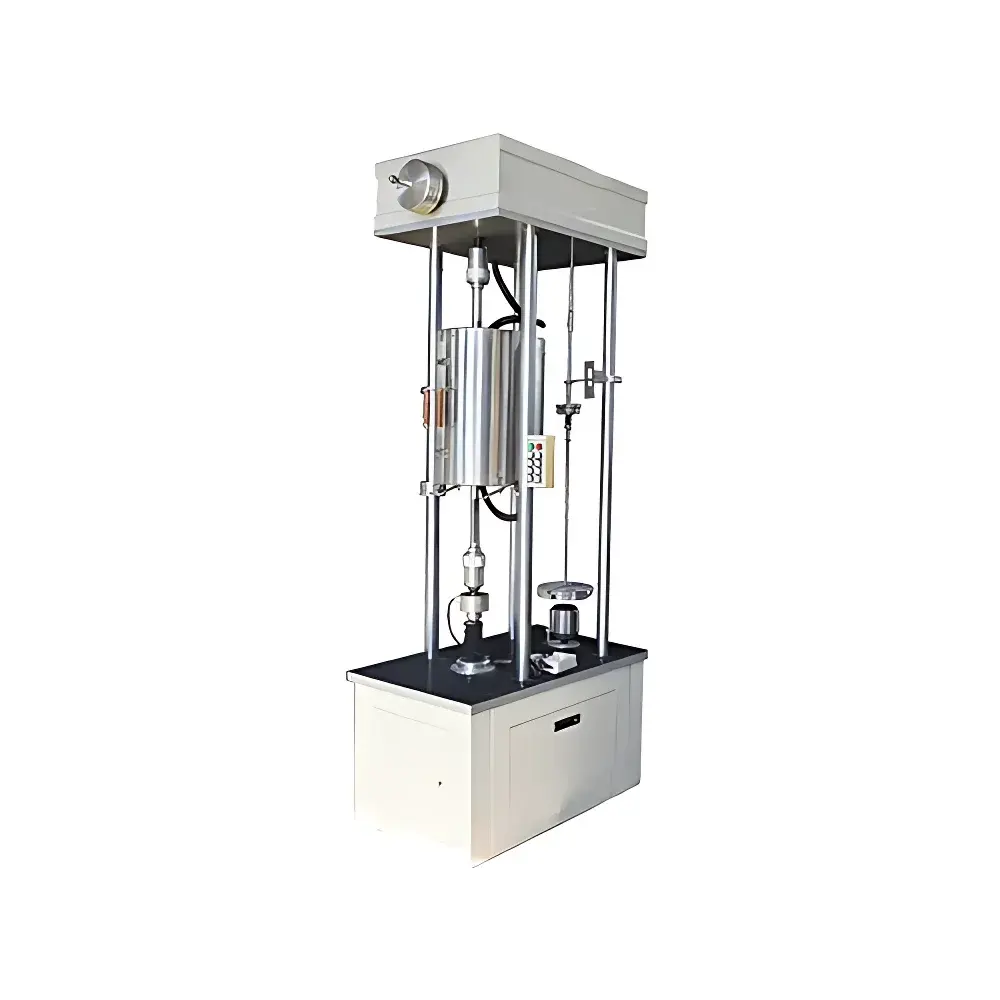
Jiubin Instruments JB/RB-30 Mechanical High-Temperature Creep Testing Machine
| Brand | Jiubin Instruments |
|---|---|
| Origin | Shanghai, China |
| Model | JB/RB-30 |
| Instrument Type | Mechanical |
| Maximum Test Load | 30 kN |
| Maximum Rod Stroke | 500 mm |
| Dimensions (L×W×H) | 2100 × 710 × 540 mm |
| Unit Weight | 500 kg |
Overview
The Jiubin Instruments JB/RB-30 Mechanical High-Temperature Creep Testing Machine is a precision-engineered mechanical testing system designed for uniaxial tensile creep and stress rupture evaluation of metallic materials under sustained load at elevated temperatures or ambient conditions. It operates on the fundamental principle of mechanical dead-weight loading, where calibrated masses apply constant axial force to the specimen via a lever-arm and pulley system—ensuring long-term load stability without reliance on servo-hydraulic or electromechanical actuation. This architecture delivers inherent load fidelity, minimal thermal drift, and high reproducibility over extended test durations (up to 10,000 hours), making it suitable for qualification testing in power generation, aerospace component development, and metallurgical research. The system complies with core international metrological and methodological standards—including JJG276-2009 (Calibration Procedure for High-Temperature Creep and Stress Rupture Testing Machines) and JJF 1298-2011 (Type Evaluation Outline)—and supports full alignment with GB/T 2039-2012 (Metallic Materials — Uniaxial Tensile Creep Testing Method) and HB 5151-1996 (High-Temperature Tensile Creep Testing of Metals).
Key Features
- Mechanically actuated dead-weight loading system with 30 kN maximum capacity, engineered for zero electronic drift and continuous load maintenance over multi-thousand-hour tests
- Robust cast-iron frame and precision-machined load train components ensure dimensional stability and minimal deflection under thermal expansion
- Adjustable lever ratio design enables fine-tuned load resolution and accurate force transmission across the full 30 kN range
- 500 mm maximum rod stroke accommodates standard ASTM E139 and ISO 204 specimen geometries, including gauge lengths up to 100 mm
- Integrated furnace compatibility (optional) supports temperature ranges from ambient to 1100 °C, with independent thermocouple inputs for specimen mid-gauge monitoring per HB 5150-1996
- Modular base structure allows integration with digital extensometers (e.g., clip-on or laser-based) and high-resolution LVDTs for strain measurement per GB/T 2039-2012 requirements
Sample Compatibility & Compliance
The JB/RB-30 accepts standard round and flat metallic specimens conforming to ISO 204, ASTM E139, and GB/T 2039-2012 dimensional specifications. It is routinely deployed for evaluating creep behavior of austenitic stainless steels, nickel-based superalloys (e.g., Inconel 718, GH4169), titanium alloys, and ferritic-martensitic steels used in boiler tubes, turbine discs, and airframe structures. All mechanical load train components are traceably calibrated per JJG276-2009, and system verification includes load accuracy ≤ ±0.5% of reading and displacement repeatability ≤ ±2 µm over 500 mm stroke. The machine meets essential requirements for GLP-compliant laboratories and supports audit-ready documentation for GMP-regulated material qualification per ICH Q5E guidelines.
Software & Data Management
While the JB/RB-30 is fundamentally a mechanical platform, its analog outputs (load cell mV/V, LVDT voltage, thermocouple mV) are compatible with third-party data acquisition systems compliant with IEEE 1451.2 and USB/RS-485 industrial protocols. When paired with validated DAQ hardware (e.g., National Instruments cDAQ or Dewesoft X), users can implement full 21 CFR Part 11–compliant data logging—including electronic signatures, audit trails, and user-access controls. Strain-time, load-time, and temperature-time datasets are exportable in CSV, TDMS, or HDF5 formats for post-processing in MATLAB, Python (SciPy/Pandas), or commercial creep analysis software (e.g., CREEPMASTER, NIMS-CreepDB). Calibration certificates and system verification reports are generated in accordance with ISO/IEC 17025 requirements.
Applications
- Long-term creep life prediction of pressure vessel steels per ASME BPVC Section II, Part D and EN 13445-3 Annex C
- Stress rupture characterization of Ni-base superalloys for gas turbine hot-section components
- Intergranular creep damage assessment in welded joints subjected to service temperatures >0.4Tm
- Validation of constitutive models (e.g., Norton-Bailey, Garofalo) for finite element simulation of component deformation
- Material certification testing for nuclear-grade zirconium alloys (ASTM B551) and steam generator tubing (ASTM B111)
- Academic research on dislocation climb mechanisms and grain boundary sliding kinetics in polycrystalline metals
FAQ
What is the primary advantage of a mechanical (dead-weight) creep testing system over servo-hydraulic alternatives?
Mechanical systems eliminate electronic feedback loop dependencies, ensuring absolute load constancy over decades of operation—critical for ultra-long-duration tests where even 0.1% load decay would invalidate rupture time data.
Can the JB/RB-30 be used for stress relaxation testing?
Yes—it supports GB/T 10120-1996 and ASTM E328 procedures when configured with high-stability extensometry and real-time strain-controlled data capture.
Is furnace integration included as standard equipment?
No—the JB/RB-30 is supplied as a load frame only; high-temperature furnaces (vertical or three-zone) are optional accessories selected based on required max temperature and uniformity class.
How is load calibration performed and how frequently is it required?
Calibration follows JJG276-2009 using certified dead weights traceable to NIM (China National Institute of Metrology); annual recalibration is recommended, with interim verification prior to each critical test campaign.
Does the system support automated test interruption and restart after power failure?
As a purely mechanical platform, it requires no power for load application; however, ancillary instrumentation (DAQ, furnace controllers) must incorporate UPS and non-volatile memory for uninterrupted data continuity.



