
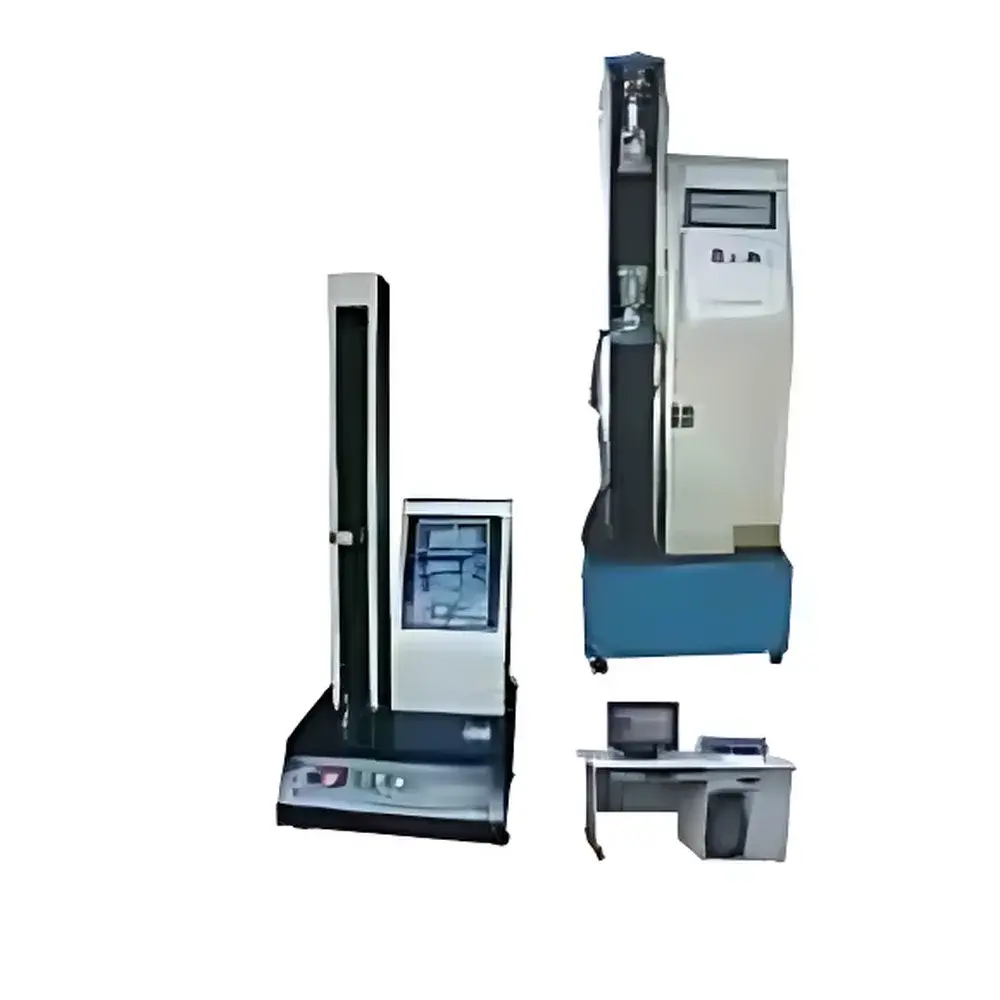
Jiubin JB-126A Universal Testing Machine for Leather and General Material Mechanical Property Evaluation
| Brand | Jiubin (JByq) |
|---|---|
| Origin | Taiwan |
| Model | JB-126A |
| Type | Electromechanical Universal Testing Machine |
| Load Capacity | 0–200 kg (user-selectable) |
| Load Cell | High-precision U.S.-made load cell |
| Load Accuracy | ≤0.5% FS |
| Effective Test Width | 380 mm |
| Max. Extension Travel | 1000 mm |
| Drive System | Japanese servo motor |
| Mechanical Transmission | Taiwan-made precision ball screw |
| Test Speed Range | 0.001–500 mm/min (infinitely variable, programmable) |
| Displacement Accuracy | ±0.005% of full scale |
| Resolution | 1/200,000 |
| Safety Features | Upper/lower mechanical limits, emergency stop button |
| Display Interface | Dual-mode — PC-based software + embedded microcomputer display |
| Unit Options | g, kg, N, kN, lb |
| Power Supply | 220 V, 50 Hz |
| Net Weight | 160 kg |
| Dimensions (W×D×H) | 450 × 450 × 900 mm |
| Standard Fixture | One pair (customizable per specimen geometry) |
| Optional Accessories | Desktop PC, inkjet printer, extensometer, proprietary test software |
Overview
The Jiubin JB-126A Universal Testing Machine is an electromechanical materials testing system engineered for precision mechanical property evaluation across diverse industrial sectors—including leather manufacturing, footwear, textiles, rubber, plastics, metals, composites, and electrical insulation components. It operates on the fundamental principle of controlled uniaxial force application—using a servo-driven ball-screw actuator to impose tensile, compressive, flexural, or shear loads on standardized or custom specimens. Force is measured via a traceable, high-stability load cell compliant with ISO 7500-1 Class 0.5 accuracy requirements; displacement is resolved through a calibrated encoder integrated with the motion system. The machine conforms to core mechanical testing standards including ASTM D638 (tensile properties of plastics), ASTM D790 (flexural properties), ISO 179 (impact resistance), ISO 2285 (rubber tensile testing), and EN 14354 (leather tensile strength). Its modular architecture supports rapid reconfiguration between test modes without recalibration—enabling laboratories to maintain consistent measurement traceability across multi-parameter quality control workflows.
Key Features
- High-fidelity dual-display architecture: real-time synchronized data visualization on both embedded microcomputer interface and Windows-based PC software—ensuring operational continuity during network interruptions or software updates.
- Infinitely variable speed control (0.001–500 mm/min) with programmable ramp-hold profiles, supporting quasi-static and slow-rate dynamic testing in compliance with ISO 6892-1 Annex C for strain-controlled tests.
- Integrated safety interlock system featuring dual mechanical end-limit switches, hardware-triggered emergency stop circuitry, and automatic load cutoff at user-defined thresholds—meeting IEC 61800-5-2 functional safety requirements for drive systems.
- Modular fixture mounting platform compatible with ASTM E8/E8M-compliant tensile grips, three-point bend fixtures, compression platens, and peel test assemblies—enabling rapid transition between leather tensile strength, shoe upper tear resistance, and cable jacket adhesion verification.
- 200,000-count internal resolution with <0.005% full-scale displacement repeatability—supporting precise quantification of yield point, modulus, elongation at break, and permanent set in low-modulus elastomeric leathers and coated fabrics.
Sample Compatibility & Compliance
The JB-126A accommodates flat, tubular, or irregular-section specimens up to 380 mm wide and 1000 mm active gauge length. It is routinely deployed for ISO 2418 (leather—sampling and preparation of test samples), ISO 2419 (leather—tensile strength and percentage extension), and ASTM D2209 (leather—tear resistance) conformance testing. Specimen clamping utilizes pneumatic or mechanical wedge-action grips with serrated jaws to prevent slippage during high-strain-rate tests on chrome-tanned bovine hides or synthetic microfiber leathers. All test configurations adhere to GLP documentation requirements: audit trails record operator ID, calibration date, environmental conditions (optional sensor integration), and raw data checksums—fully compatible with FDA 21 CFR Part 11 electronic signature validation when paired with validated software modules.
Software & Data Management
The proprietary Jiubin TestSuite v4.x software provides ISO/IEC 17025-aligned data acquisition, curve overlay analysis, statistical process control (SPC) charting, and automated report generation per ISO 14289 (PDF/UA) accessibility standards. Raw force-displacement datasets are stored in vendor-neutral ASCII CSV format with embedded metadata headers (test standard, specimen ID, operator, timestamp, environmental notes). Multi-user role-based access controls support QA/QC segregation of duties; revision history logs all parameter edits and report exports. Optional GMP-compliant configuration includes electronic signature workflows, instrument qualification (IQ/OQ/PQ) templates, and deviation tracking linked to CAPA systems.
Applications
- Leather goods QC: Tensile strength, elongation, and tear propagation resistance of finished leathers per ISO 2419 and ISO 23537.
- Footwear component validation: Bond strength of sole-to-upper attachments, flex fatigue resistance of vamp materials, and compression set of midsole foams.
- Textile & apparel testing: Seam slippage, fabric bursting strength (ASTM D3786), and elastic recovery of stretch denim or performance knits.
- Electrical safety verification: Tensile integrity of insulated wire jackets (UL 1581 Section 1060), crimp retention force of terminal connectors (SAE J2044).
- Rubber compound development: Stress-strain hysteresis loops, Payne effect characterization, and compression set under elevated temperature (with optional environmental chamber integration).
FAQ
What international standards does the JB-126A support out-of-the-box?
It natively supports ASTM D638, D790, D2209; ISO 6892-1, 2419, 23537, 2285; EN 14354; and GB/T 1040 series—via preloaded test method templates and unit-conversion libraries.
Can the system be integrated into a centralized LIMS environment?
Yes—through OPC UA or TCP/IP API interfaces, enabling bidirectional data exchange with LabVantage, Thermo Fisher SampleManager, or custom MES platforms.
Is third-party calibration certification available?
Jiubin provides NIST-traceable calibration certificates (ISO/IEC 17025 accredited labs) upon request, including uncertainty budgets per ISO 17025:2017 Clause 7.7.
Does the machine meet CE Machinery Directive requirements?
Yes—the JB-126A carries CE marking under 2006/42/EC, with full technical file documentation covering risk assessment (EN ISO 12100), electrical safety (EN 61000-6-2/6-3), and EMC compliance.
What is the recommended maintenance interval for the ball screw and load cell?
Preventive maintenance is scheduled every 12 months or 2,000 test cycles—performed by certified field engineers using manufacturer-specified lubricants and torque protocols.



