
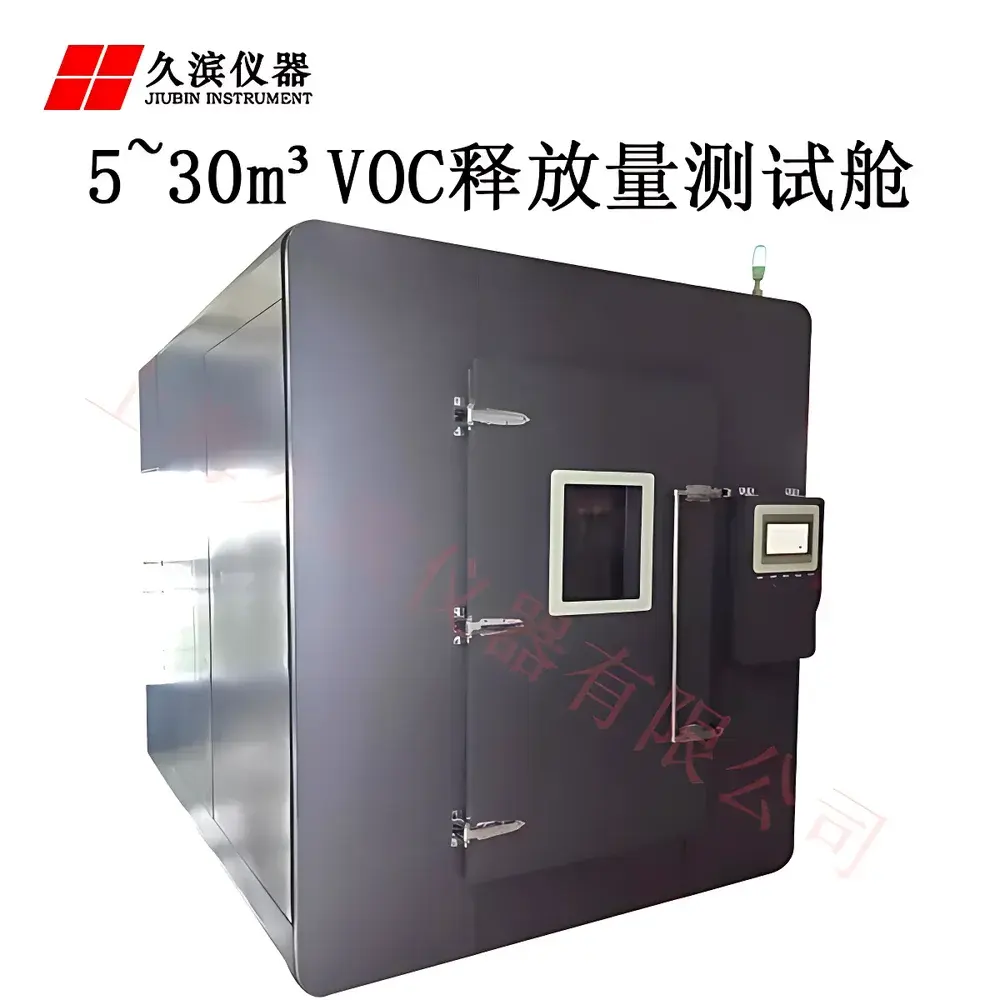
Jiubin JB-160-B Walk-in Vehicle VOC & Formaldehyde Emission Test Chamber
| Brand | Jiubin Instruments |
|---|---|
| Origin | Shanghai, China |
| Model | JB-160-B |
| Type | Walk-in Environmental Emission Test Chamber for Automotive Interior Materials and Whole Vehicles |
| Compliance Basis | ISO 12219-4, VDA 278, DIN 75201, GB/T 27630–2019, QC/T 922–2013 |
| Internal Volume | 160 m³ |
| Temperature Control Range | 15–80 °C (±0.5 °C uniformity) |
| Humidity Control Range | 10–90% RH (±3% RH accuracy) |
| Air Exchange Rate | 0.5–2.0 h⁻¹ (adjustable, traceable via mass flow meters) |
| Chamber Wall Material | 316L stainless steel with electropolished interior surface |
| Sealing Integrity | ≤0.5% volume loss per hour (per ASTM E283) |
| Power Supply | 380 VAC, 50 Hz, 3-phase |
Overview
The Jiubin JB-160-B Walk-in Vehicle VOC & Formaldehyde Emission Test Chamber is an engineered environmental simulation system designed to quantify volatile organic compound (VOC) and carbonyl emissions—including formaldehyde—from automotive interiors under standardized thermal desorption conditions. Based on the principles of controlled-environment dynamic emission testing, the chamber maintains precise, traceable temperature, humidity, and air exchange profiles to replicate real-world cabin conditions during vehicle operation and parking. Its 160 m³ internal volume accommodates full-size passenger vehicles or multiple interior component assemblies, enabling whole-vehicle-level compliance verification per international regulatory frameworks. The system operates as a closed-loop, forced-convection environment with laminar airflow distribution, minimizing boundary-layer interference and ensuring reproducible sample exposure geometry—critical for inter-laboratory comparability in OEM supplier qualification and type-approval workflows.
Key Features
- Electropolished 316L stainless steel chamber walls with welded seams and helium-leak-tested integrity (<0.5% vol/h leakage), eliminating adsorption artifacts and enabling rigorous cleaning validation between test cycles.
- Independent dual-climate control: high-stability PID-regulated heating/cooling system coupled with steam-based humidification and desiccant dehumidification—achieving ±0.5 °C temperature uniformity and ±3% RH accuracy across the full operational envelope (15–80 °C / 10–90% RH).
- Programmable air exchange module utilizing calibrated mass flow controllers (MFCs) for accurate, auditable ventilation rates from 0.5 to 2.0 h⁻¹—fully compliant with ISO 12219-4 Annex C and VDA 278 Section 4.2 requirements.
- Integrated sensor suite with NIST-traceable Pt100 temperature probes, capacitive RH sensors, and electrochemical O₂/CO₂ monitors—all mounted on retractable arms to avoid contamination and support post-test calibration verification.
- Structural walk-in configuration with double-sealed, argon-filled thermal-insulated door (U-value ≤0.35 W/m²·K), overhead service gantry for sampling port routing, and floor-mounted vehicle access ramp rated for 3,000 kg axle load.
Sample Compatibility & Compliance
The JB-160-B supports emission testing of complete vehicles, instrument panels, seat assemblies, headliners, trim components, adhesives, foams, and textile composites. It is validated for use in accordance with ISO 12219-4 (Interior air of road vehicles — Part 4: Determination of VOC emissions from vehicle interior parts and materials using a 1 m³ chamber — Small chamber method extended to large chambers), VDA 278 (Determination of organic emissions from heated interior parts), DIN 75201 (Fogging characteristics of interior materials), and Chinese national standards GB/T 27630–2019 and QC/T 922–2013. Chamber performance data—including temperature/humidity uniformity maps, air exchange rate linearity, and background VOC baseline (<0.5 µg/m³ total VOC at 65 °C soak) — are documented in the delivered IQ/OQ protocol, supporting GLP-compliant laboratory accreditation (CNAS, ILAC-MRA) and OEM audit readiness.
Software & Data Management
The embedded control interface (JB-ChamberControl v3.2) provides real-time monitoring, automated test sequence execution (soak → emission → purge), and digital log export in CSV and PDF formats. All setpoints, sensor readings, actuator states, and alarm events are timestamped with microsecond resolution and stored locally on an encrypted industrial SSD. Audit trail functionality complies with FDA 21 CFR Part 11 requirements: user authentication (role-based access), electronic signatures for method approval, and immutable record retention for ≥15 years. Raw data exports integrate natively with third-party GC-MS and HPLC-UV analysis platforms via ASTM E1382-compliant metadata tagging.
Applications
- OEM and Tier-1 supplier validation of low-emission material substitutions under accelerated aging protocols (e.g., 65 °C/6 hr soak per VDA 278).
- Regulatory submission testing for CNAS-accredited reports supporting China’s “Green Vehicle” certification and EU REACH SVHC screening.
- Root-cause analysis of odor complaints via time-resolved VOC profiling (C2–C20 hydrocarbons, aldehydes, siloxanes) coupled with TD-GC-MS.
- Developmental evaluation of photocatalytic coatings, activated carbon filters, and plasma-based air purification modules installed within the cabin space.
- Interlaboratory round-robin studies coordinated by SAE J2725 or ISO/TC 22/SC 32 working groups.
FAQ
What standards does the JB-160-B chamber comply with for automotive VOC testing?
It is configured and verified per ISO 12219-4, VDA 278, DIN 75201, GB/T 27630–2019, and QC/T 922–2013.
Can the chamber accommodate electric vehicles with high-voltage battery systems?
Yes—equipped with isolated power feedthroughs, non-magnetic interior fixtures, and dedicated grounding busbars meeting IEC 61000-6-4 EMC immunity requirements.
Is background VOC contamination monitored and reported?
Each commissioning includes a 72-hour blank run at 65 °C; certified background levels (<0.5 µg/m³ TVOC) are provided in the factory acceptance test report.
How is temperature uniformity validated across the 160 m³ volume?
Using 12 NIST-traceable Pt100 probes arranged in a 3×2×2 orthogonal grid per ISO 12219-4 Annex D; uniformity deviation is ≤±0.5 °C at all operational setpoints.
Does the system support remote operation and data review?
Yes—via secure TLS 1.3 web interface with configurable user roles, live dashboard views, and automated daily backup to network-attached storage (NAS) or cloud archive.
Related Products







