
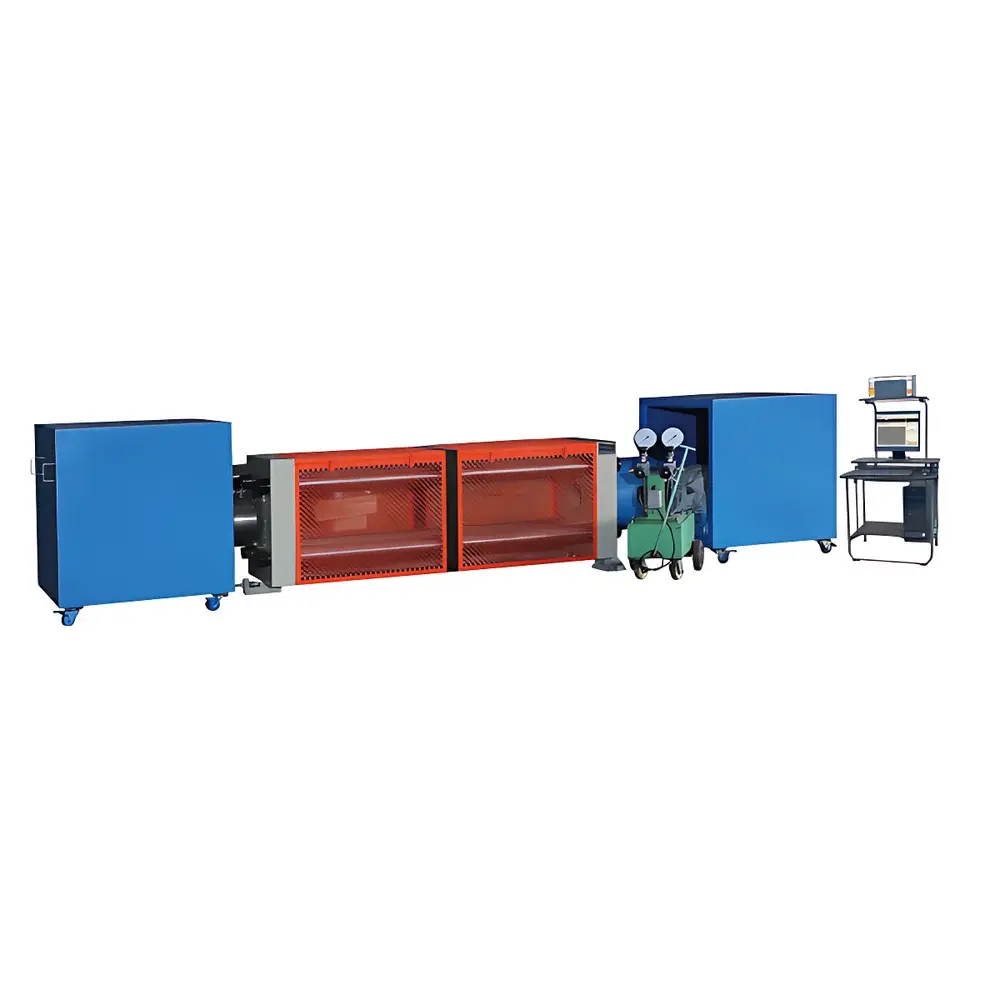
Jiubin JBMG-6500 Microcomputer-Controlled Steel Strand Stress Relaxation Testing Machine
| Brand | Jiubin |
|---|---|
| Origin | Shanghai, China |
| Manufacturer Type | Authorized Distributor |
| Origin Category | Domestic (China) |
| Model | JBMG-6500 |
| Price Range | USD 7,000 – 14,000 |
| Instrument Type | Electro-Hydraulic Universal Testing Machine |
| Max Test Load | 6500 kN |
| Load Accuracy | ±1% of reading within full scale |
| Load Measurement Range | 2–100% FS |
| Load Resolution | 0.025 kN |
| Displacement Resolution | 0.1 mm |
| Effective Tensile Stroke (excl. piston) | 3400 mm |
| Piston Stroke | 200 mm |
| Piston Displacement Range | 20 mm |
| Piston Displacement Accuracy | <0.5 mm absolute error (≤10 mm) |
| Standard Anchorage Fixture Compatibility | YM15 round anchors (1/3/4/5/7/9/12/14/16-hole), YMB15 flat anchors (2/3/4/5-hole) |
| default supplied | 5- and 7-hole round, 5-hole flat |
| Overall Dimensions (L×W×H, excl. piston extension) | 3400 × 800 × 800 mm |
| Mass | ~6000 kg |
| Power Supply | 6.5 kW, 3-phase 4-wire, 380 V AC |
Overview
The Jiubin JBMG-6500 Microcomputer-Controlled Steel Strand Stress Relaxation Testing Machine is a high-capacity electro-hydraulic universal testing system engineered specifically for static load anchorage performance evaluation of prestressed tendon anchorages and couplers. It operates on the principle of controlled hydraulic force application combined with real-time high-fidelity load and displacement transduction, enabling precise determination of anchorage efficiency coefficient (ηa) and total strain at measured ultimate tensile load — two critical parameters defined in ISO 6934-4, ASTM A416/A416M, and GB/T 14370–2007. Designed for compliance-critical environments including precast concrete manufacturing, bridge construction QA/QC laboratories, and national highway materials inspection centers, the JBMG-6500 integrates structural rigidity, thermal stability, and long-term load-holding capability to support extended-duration relaxation tests (up to 1000 hours) under sustained loads up to 6500 kN.
Key Features
- Electro-hydraulic servo loading architecture with dual-stage pressure regulation ensures stable load maintenance during prolonged relaxation phases, minimizing drift (<0.5% per hour at 80% FS).
- High-stiffness monolithic frame (3400 mm effective test length, 6000 kg mass) minimizes deflection-induced measurement uncertainty and supports multi-anchor assemblies under simultaneous loading.
- Dual-channel synchronized acquisition: load cell (0.025 kN resolution) and linear variable differential transformer (LVDT)-based piston displacement sensor (0.1 mm resolution) are sampled at ≥100 Hz via industrial-grade PCI-1716 data acquisition card.
- Real-time Windows-based control software provides closed-loop load ramping, step-hold profiles, auto-calibration traceability, and digital signature-enabled report generation compliant with GLP documentation requirements.
- Modular anchorage fixture interface accommodates standardized YM15 round anchors (1–16 holes) and YMB15 flat anchors (2–5 holes), with mechanical alignment guides ensuring concentricity ≤0.2 mm deviation across all configurations.
- Integrated safety interlocks include over-pressure cutoff, emergency stop circuit with hardware bypass, and redundant load limit validation against firmware-set thresholds.
Sample Compatibility & Compliance
The JBMG-6500 is validated for testing ASTM A416 Grade 270 low-relaxation steel strands (12.7–15.2 mm diameter), post-tensioning anchor systems per EN 10138-3, and bonded/unbonded mono-strand assemblies used in segmental bridge construction. It fully satisfies the mechanical verification requirements of GB/T 14370–2007, JT 329.1–1997, and JT 329.2–1997, and supports audit-ready test execution per ISO/IEC 17025:2017 clause 7.2.2 (method validation) and clause 7.8.2 (result reporting). All calibration certificates reference NIM (National Institute of Metrology, China) traceable standards; optional UKAS-accredited calibration available upon request.
Software & Data Management
The proprietary Jiubin TestMaster v4.2 software runs on Windows 10 IoT Enterprise and implements role-based user access control (administrator, operator, reviewer). Raw data streams are stored in encrypted binary format (.jtb) with embedded metadata (operator ID, environmental conditions, calibration expiry, test standard version). Export functions generate PDF reports with embedded digital signatures, CSV time-series datasets, and XML files compatible with LIMS integration (ASTM E1482-compliant schema). Audit trail logs record all parameter changes, report modifications, and user logins with timestamps — satisfying FDA 21 CFR Part 11 electronic record requirements when configured with time-stamped digital certificates.
Applications
- Verification of anchorage efficiency coefficient (ηa) and ultimate strain (εu) for qualification of new anchor designs prior to CE or CCC marking.
- Routine quality surveillance of production batches in anchor manufacturing facilities operating under ISO 9001:2015 Clause 8.6.
- Third-party certification testing for highway infrastructure projects governed by MoHURD Technical Specification CJJ/T 294–2019.
- Research into time-dependent viscoelastic behavior of grouted tendon systems under elevated temperature (10–35 °C ambient range, humidity <80% RH).
- Calibration transfer between national metrology institutes and provincial construction material testing centers.
FAQ
What standards does the JBMG-6500 directly support for anchorage testing?
GB/T 14370–2007, JT 329.1–1997, JT 329.2–1997, ASTM A416/A416M, and ISO 6934-4.
Can the system perform both static anchorage and long-term stress relaxation tests?
Yes — the hydraulic power unit and control algorithm support continuous load hold for up to 1000 hours with automatic compensation for thermal drift and seal relaxation.
Is remote monitoring or network integration possible?
Standard Ethernet port enables OPC UA server mode for SCADA integration; optional 4G LTE module supports cloud-based data backup and real-time dashboard viewing via secure TLS 1.2 tunnel.
What is the recommended maintenance interval for hydraulic system integrity?
Every 500 operational hours or annually — includes filter replacement, fluid analysis (ISO 4406:2017 code ≤18/16/13), and pressure transducer recalibration.
Does the system meet international electromagnetic compatibility requirements?
Complies with IEC 61326-1:2013 Class A emission limits and IEC 61000-4-2/3/4/6 immunity testing for industrial environments.



