
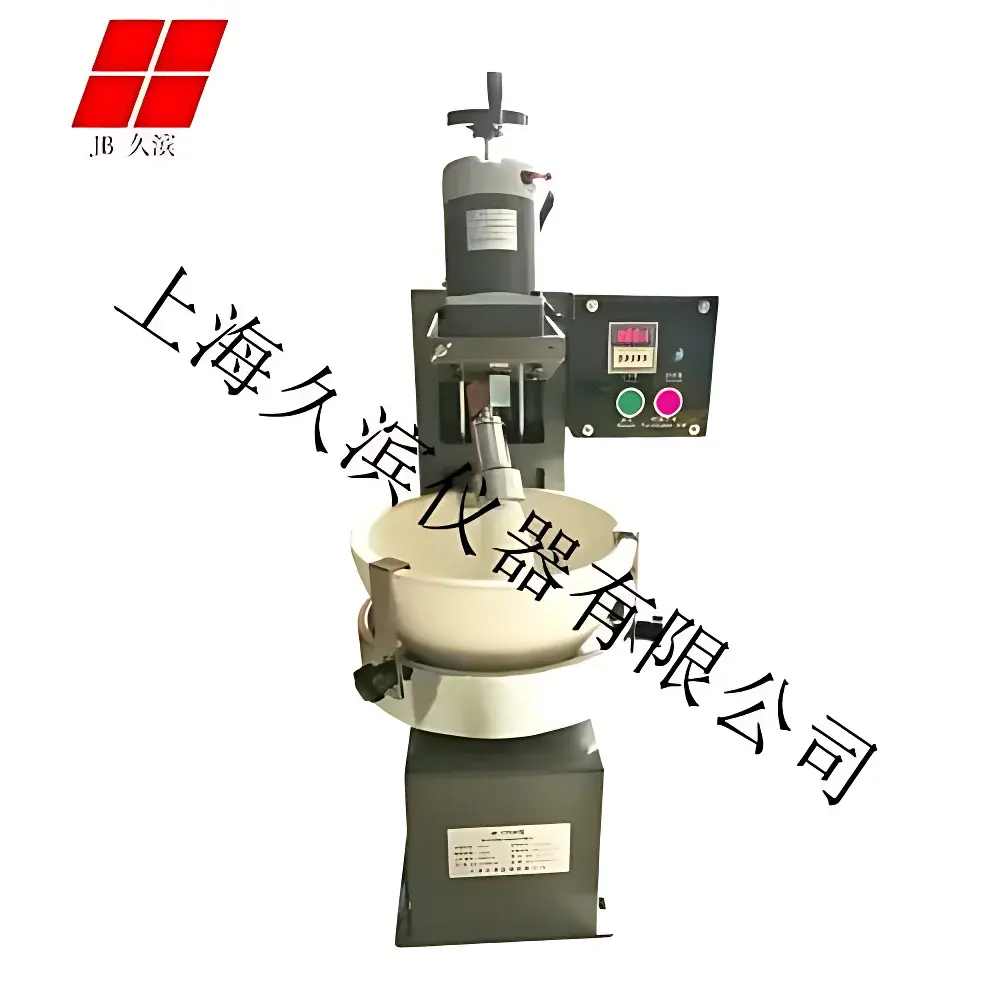
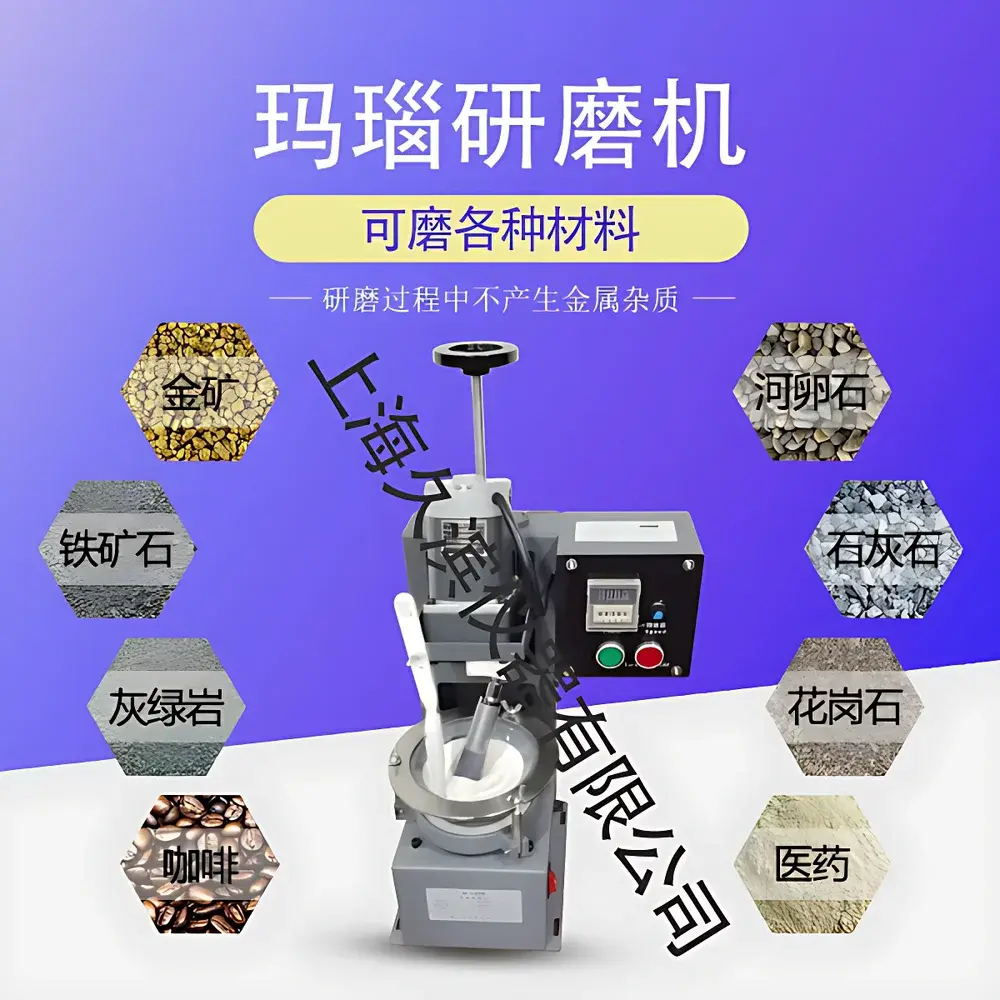
Jiubin JB-250A Ceramic Mortar-Type Ultrafine Grinder
| Brand | Jiubin |
|---|---|
| Model | JB-250A |
| Origin | Shanghai, China |
| Type | Mortar-and-Pestle Grinder |
| Sample Hardness | Unrestricted (Suitable for Ultra-Hard Materials) |
| Max Feed Size | ≤0.5 mm |
| Final Particle Size | <10 µm (Sub-micron to Nanoscale Distribution) |
| Batch Capacity | 550 g |
| Mortar Diameter | 250 mm |
| Pestle Speed | 120 rpm |
| Mortar Speed | 10 rpm |
| Pestle Motor Power | 60 W |
| Mortar Motor Power | 40 W |
| Mortar Material | High-Alumina Ceramic (Al₂O₃ ≥92%) |
| Pestle Tip Material | High-Alumina Ceramic |
| Programmable Runtime | Yes |
| Dimensions (L×W×H) | 500 × 500 × 920 mm |
| Net Weight | 35 kg |
| Voltage | 220 V, 50/60 Hz |
Overview
The Jiubin JB-250A Ceramic Mortar-Type Ultrafine Grinder is an engineered laboratory grinding system based on the classical mortar-and-pestle principle, adapted for controlled, reproducible, and scalable ultrafine comminution. Unlike high-energy ball mills or jet mills, this instrument employs low-shear, high-contact-pressure mechanical attrition between a rotating ceramic mortar and a counter-rotating ceramic pestle—generating consistent compressive and shearing forces ideal for brittle, ultra-hard materials. Its design prioritizes minimal contamination, thermal stability, and operator safety, making it suitable for applications where metallic wear debris, oxidation, or temperature-induced phase transformation must be avoided. The JB-250A is routinely deployed in R&D laboratories conducting material science studies, pharmaceutical formulation development, electronic ceramic processing, and quality control of abrasive micrograins—especially where final particle size distribution must reach sub-micron levels (d₅₀ < 1 µm) with narrow width (Span < 1.8) under dry or solvent-assisted conditions.
Key Features
- High-purity high-alumina ceramic (≥92% Al₂O₃) mortar and pestle tip—ensuring zero metal contamination and exceptional wear resistance against diamond, silicon carbide, boron nitride, and fused quartz
- Independent dual-speed motor control: mortar rotates at 10 rpm while pestle rotates at 120 rpm, enabling precise tuning of shear-to-compression ratio for optimized deagglomeration and size reduction
- Programmable runtime with digital timer (0–99 min), supporting unattended operation and repeatable process validation
- Robust cast-aluminum frame with vibration-damping base and interlocked safety cover compliant with IEC 61000-6-2 EMC standards
- Modular feed port with silicone-sealed lid and optional inert gas purge fitting (N₂ or Ar) for oxygen- or moisture-sensitive samples
- No internal lubrication required—ceramic-on-ceramic kinematics eliminate oil migration risk, critical for GMP-aligned pharmaceutical or semiconductor powder processing
Sample Compatibility & Compliance
The JB-250A accepts feed particles up to 0.5 mm in maximum dimension and delivers consistent output below 10 µm—with typical d₉₀ values ranging from 300 nm to 800 nm depending on material brittleness, dwell time, and ambient humidity. It accommodates both dry grinding and wet grinding (with ethanol, isopropanol, or aqueous surfactant solutions). Verified compatibility includes diamond microabrasives (ISO 6344-2), silicon carbide powders (ASTM C703), pharmaceutical excipients (USP ), and battery-grade lithium cobalt oxide (LiCoO₂). The unit meets CE marking requirements for machinery (2006/42/EC) and conforms to ISO 13849-1 for functional safety architecture. For regulated environments, its programmable parameters support audit-ready batch records when integrated with external data loggers compliant with FDA 21 CFR Part 11.
Software & Data Management
While the JB-250A operates via standalone digital panel controls (no embedded OS), it features RS-232 and optional USB-to-serial interface for integration into laboratory information management systems (LIMS) or SCADA platforms. All operational parameters—including runtime, motor status, and error codes—are timestamped and exportable as CSV. When used alongside validated third-party software (e.g., LabArchives ELN or Thermo Fisher SampleManager), the grinder supports full traceability per GLP and GMP documentation requirements. Optional firmware upgrade enables real-time torque monitoring (via current draw correlation), providing indirect feedback on powder rheology evolution during grinding—valuable for process analytical technology (PAT) frameworks.
Applications
- Preparation of nanoscale reference standards for SEM/TEM calibration and DLS validation
- Size reduction of sintering aids (e.g., Y₂O₃, MgO) prior to ceramic green body formation
- Homogenization of active pharmaceutical ingredients (APIs) with polymeric carriers in hot-melt extrusion pre-blends
- Deagglomeration of quantum dot precursors (CdSe, CsPbBr₃) without solvent degradation
- Grinding of pyrophoric metal powders (e.g., aluminum, magnesium) under inert atmosphere
- Production of uniform coffee microgrinds for sensory analysis and extraction kinetics modeling
FAQ
Can the JB-250A achieve true nanoparticle dispersion without agglomeration?
Yes—when combined with wet grinding using dispersants (e.g., sodium hexametaphosphate) and post-grinding ultrasonication (≤5 min, 20 kHz), primary particle sizes down to 50–100 nm are routinely achieved and stabilized for >24 h in aqueous suspension.
Is the mortar geometry optimized for heat dissipation during extended runs?
The 250 mm diameter high-alumina ceramic mortar has a thermal conductivity of ~30 W/m·K and surface-area-to-volume ratio engineered to limit bulk temperature rise to <15 °C above ambient over 30-min continuous operation at rated load.
What maintenance intervals are recommended for long-term reliability?
No scheduled lubrication is required. Annual inspection of motor brushes, belt tension (if applicable), and ceramic surface integrity—verified via visual and profilometric assessment—is sufficient for >10,000 operating hours under standard lab use.
Does the unit comply with explosion-proof requirements for organic solvent grinding?
The base configuration is not ATEX-certified; however, the enclosure can be retrofitted with intrinsically safe (IS) motor drivers and static-dissipative components upon request—subject to site-specific hazardous area classification (Zone 21/22).



