
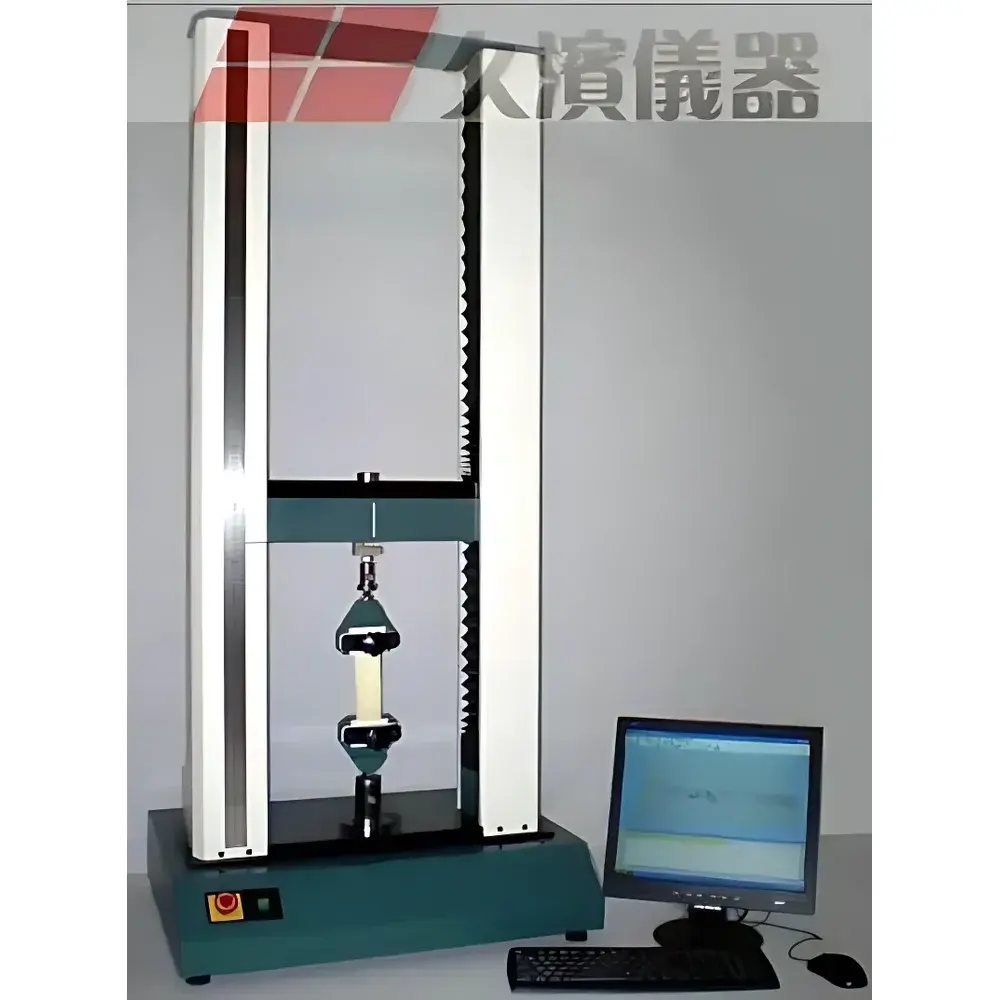
Jiubin JB-126A Universal Testing Machine
| Brand | Jiubin Instruments |
|---|---|
| Origin | Taiwan |
| Instrument Type | Electronic Universal Testing Machine |
| Model | JB-126A |
| Load Capacity | 0–200 kg (user-selectable) |
| Load Cell Accuracy | ±0.5% |
| Effective Test Width | 380 mm |
| Max. Extension Travel | 1000 mm |
| Drive System | Servo Motor (Japan-made) |
| Transmission | Precision Ball Screw (Taiwan-made) |
| Test Speed Range | 0.001–500 mm/min (infinitely variable, presettable) |
| Displacement Resolution | 0.005% |
| Force Resolution | 1/200,000 |
| Safety Features | Upper/Lower Mechanical Limits, Emergency Stop Button |
| Display Interface | Dual-mode — PC-based software + Embedded Microcomputer Display |
| Unit Options | g, kg, N, kN, lb |
| Power Supply | 220 V, 50 Hz |
| Net Weight | 160 kg |
| Dimensions (W×D×H) | 450 × 450 × 900 mm |
| Clamping Fixture | One standard set (customizable per specimen requirements) |
| Optional Accessories | Desktop PC, Inkjet Printer, Extensometer (two-point), Dedicated Testing Software |
Overview
The Jiubin JB-126A Universal Testing Machine is an electromechanical materials testing system engineered for precision mechanical property evaluation of metallic, polymeric, elastomeric, textile, leather, and composite specimens. It operates on the fundamental principle of controlled uniaxial force application—either tensile, compressive, flexural (three-point bending), or shear—while continuously measuring load, displacement, and time. The system integrates a high-fidelity load cell (U.S.-sourced), a servo-driven actuation train (Japan-specified), and a rigid frame with precision-ground ball screws (Taiwan-manufactured) to ensure structural stability and kinematic fidelity across the full operational range. Designed for compliance with ISO 7500-1 (Class 1 static force calibration), ASTM E4 (load verification), and ASTM E8/E9 (tensile/compression testing of metals), the JB-126A supports standardized test execution in quality control laboratories, R&D facilities, and production line validation environments.
Key Features
- Modular dual-display architecture: Simultaneous real-time monitoring via embedded microcomputer interface and Windows-based PC software—enabling both standalone operation and networked data management.
- Infinitely variable speed control from 0.001 to 500 mm/min, programmable in discrete steps or continuous ramp profiles—optimized for quasi-static and low-rate dynamic testing per ISO 6892-1 and ASTM D638.
- High-resolution force transduction (1/200,000 internal resolution) and sub-micron displacement repeatability (±0.005% of full scale), ensuring metrological traceability for GLP/GMP-regulated workflows.
- Robust mechanical design featuring reinforced steel frame, anti-backlash ball screw transmission, and dual-limit mechanical stops—validated for >100,000 cycles under rated load conditions.
- Comprehensive safety suite including hardware-based emergency stop, software-enforced travel limits, and automatic load cutoff upon specimen failure detection.
- Configurable fixture mounting platform (380 mm effective width) accommodating standard tensile grips, compression platens, bend fixtures, and custom-designed tooling per ISO 20795-1 or IEC 60811-501 requirements.
Sample Compatibility & Compliance
The JB-126A accommodates a broad spectrum of specimen geometries—from thin polymer films (≥0.1 mm thickness) and wire terminals to machined metal coupons (up to 200 mm gauge length) and molded elastomer strips. Its modular clamping system supports flat, round, threaded, and irregular cross-sections using pneumatic, wedge, or screw-type grips. The instrument meets essential regulatory prerequisites for routine QC use: conformity with ISO 17025 documentation practices, compatibility with FDA 21 CFR Part 11-compliant audit trail modules (when paired with optional software package), and alignment with ASTM D882 (thin plastics), ASTM D790 (flexural properties), and EN ISO 12192 (acoustic insulation material compression). Calibration certificates are traceable to NIST or national metrology institutes via accredited third-party providers.
Software & Data Management
The included Windows-native testing software provides full test method definition, real-time curve overlay, automated parameter extraction (e.g., yield strength, modulus, elongation at break, peak load), and export to CSV, PDF, or XML formats. All test sessions generate timestamped metadata—including operator ID, environmental conditions (if sensor-integrated), calibration status, and version-controlled method files—to satisfy GLP audit requirements. Optional extensions enable multi-user role-based access control, electronic signature workflows, and integration with LIMS platforms via ODBC or RESTful API. Raw data integrity is preserved through write-once storage protocols and SHA-256 hash logging for forensic traceability.
Applications
- Mechanical validation of fasteners, hinges, and stamped metal components per SAE J429 and ISO 898-1.
- Tensile characterization of extruded PVC cables, silicone rubber seals, and thermoplastic elastomer gaskets under ambient and elevated temperature conditions.
- Compression testing of foam packaging, cushioning materials, and biomedical polymer scaffolds per ISO 13314.
- Three-point flexural analysis of printed circuit board substrates (FR-4), composite laminates, and ceramic tiles per ASTM D7264.
- Peel and shear adhesion assessment of pressure-sensitive tapes, laminated labels, and medical device bonding interfaces per ASTM D903 and ISO 8510-2.
- Quality gate screening for incoming raw materials (e.g., stainless steel wire, aluminum alloy strips) prior to machining or forming operations.
FAQ
What standards does the JB-126A support out-of-the-box?
It natively implements test templates aligned with ASTM D638, ASTM D790, ISO 6892-1, ISO 179-1, and EN 13432—configurable via software method libraries.
Is the load cell factory-calibrated and traceable?
Yes—each unit ships with a certificate of calibration traceable to NIST-equivalent standards, valid for 12 months under normal operating conditions.
Can the system perform cyclic loading or fatigue tests?
No—the JB-126A is designed for static and quasi-static monotonic loading only; fatigue-capable variants require hydraulic or electrodynamic actuation systems.
What is the maximum specimen height for compression testing?
With standard platens installed, vertical clearance allows up to 250 mm specimen height; extended-height configurations are available upon request.
Does the software support multi-language UI and report generation?
Yes—interface language and report templates (including bilingual English/Chinese output) are configurable within the software settings module.



