
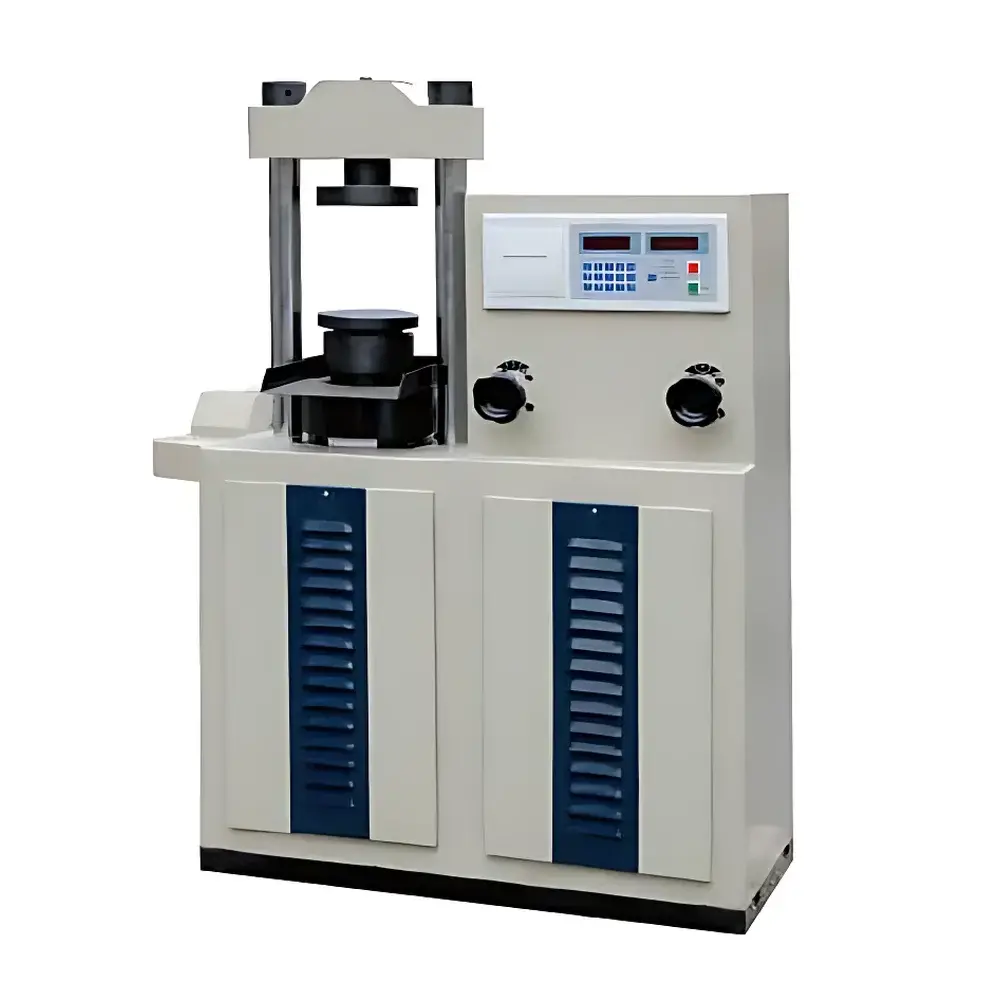
JB/YAW-300 Electro-Hydraulic Compression and Flexural Testing Machine
| Brand | Jiubin Instruments |
|---|---|
| Origin | Shanghai, China |
| Model | JB/YAW-300 |
| Max. Test Load | 300 kN |
| Load Measurement Range | 30–300 kN |
| Load Indication Accuracy | ≤ ±1% of reading |
| Load Resolution | 0.01 kN |
| Hydraulic Pump Rated Pressure | 25 MPa |
| Compression Platen Diameter | φ155 mm |
| Max. Platen Spacing | 230 mm |
| Flexural Roller Diameter | φ30 mm |
| Lower Roller Span | 450 mm |
| Upper Roller Center Distance | 150 mm |
| Piston Diameter | φ130 mm |
| Piston Stroke | 80 mm |
| Motor Power | 0.75 kW (3-phase) |
| Dimensions (W×D×H) | 850×620×1340 mm |
| Net Weight | 450 kg |
Overview
The JB/YAW-300 Electro-Hydraulic Compression and Flexural Testing Machine is a dual-function static materials testing system engineered for standardized mechanical evaluation of construction materials in accordance with ASTM C39/C109, ISO 7500-1, GB/T 3159, and EN 12390-3. It integrates a high-stiffness hydraulic actuation system with digital load sensing to deliver precise, repeatable compression and three-point flexural testing on brittle and quasi-brittle specimens—including cement mortars, concrete cubes and prisms, fired clay bricks, natural stone blocks, and autoclaved aerated concrete (AAC). The machine operates on the principle of controlled displacement-driven hydraulic loading, where a servo-regulated piston applies axial force through hardened steel platens while a calibrated load cell continuously transduces force output with real-time digital feedback. Its rigid C-frame architecture ensures minimal frame deflection (<0.05 mm under full 300 kN load), critical for maintaining measurement integrity during high-force compressive tests.
Key Features
- Electro-hydraulic actuation with pressure-limited, flow-stabilized loading—enabling programmable strain-controlled or load-controlled test profiles per ASTM E4 and ISO 5893.
- Digital load readout with 0.01 kN resolution and ≤ ±1% indication error across 10–100% of full scale (30–300 kN), verified per ISO 7500-1 Class 1 calibration requirements.
- Integrated digital controller mounted directly on the frame, providing real-time display of load, loading rate (kN/s), peak hold, and overload cutoff with audible/visual alarm.
- Dual-mode mechanical configuration: interchangeable compression platens (φ155 mm) and standardized three-point bending fixture with adjustable lower roller span (450 mm) and fixed upper roller center distance (150 mm).
- Self-contained hydraulic power unit featuring a 25 MPa-rated gear pump, low-noise 0.75 kW three-phase motor, and temperature-stable mineral oil reservoir pre-filled at factory.
- Robust cast-iron base and reinforced steel frame (net weight: 450 kg) minimize vibration coupling and ensure long-term geometric stability under cyclic loading.
Sample Compatibility & Compliance
The JB/YAW-300 accommodates standard-sized specimens used in civil engineering quality control laboratories: 150 mm concrete cubes (compression), 40×40×160 mm mortar prisms (flexure), 240×115×53 mm clay bricks (compressive strength), and 100×100×100 mm AAC blocks. All mechanical interfaces—including spherical seating, hardened platens (HRC ≥58), and roller supports—are designed to meet alignment tolerances specified in ASTM C109 and GB/T 17671. The system supports manual test execution compliant with GLP documentation practices; though not natively Part 11–compliant, its digital controller logs timestamped peak load values and permits manual entry into LIMS or Excel-based QA records. Calibration certificates traceable to CNAS-accredited national metrology institutes are provided upon delivery.
Software & Data Management
The built-in digital controller provides local data acquisition without external PC dependency: load vs. time traces are not stored internally, but peak load, loading rate, and test duration are displayed and retained after power loss (non-volatile memory). For enhanced traceability, users may connect optional RS232 or USB-to-serial adapters to export ASCII-formatted test records to third-party software (e.g., LabVIEW, MATLAB, or custom SQL databases). While no proprietary analysis suite is bundled, the machine’s analog/digital hybrid architecture allows integration with ISO/IEC 17025–accredited lab information management systems via Modbus RTU protocol when paired with compatible interface modules.
Applications
- Compressive strength verification of Portland cement concrete per ASTM C39 and EN 12390-3.
- Flexural tensile strength determination of hydraulic cement mortars using three-point bending (ASTM C348).
- Quality conformance testing of masonry units including solid clay bricks (GB/T 2542), fly ash bricks (JC/T 239), and calcium silicate bricks (JC/T 621).
- Research-grade mechanical characterization of novel construction composites, such as fiber-reinforced geopolymers and recycled aggregate concretes.
- In-house calibration verification of secondary reference standards (e.g., proving rings) within ±1% uncertainty budgets.
FAQ
What standards does the JB/YAW-300 comply with for compression testing?
It meets the mechanical and metrological requirements of ASTM C39, ISO 7500-1 Class 1, GB/T 3159, and EN 12390-3 for concrete cube testing.
Can the machine perform both compression and flexure tests without hardware reconfiguration?
Yes—the flexural fixture (including upper rollers, lower beam, and support rollers) is supplied as a modular kit and can be installed or removed in under 15 minutes using standard wrenches.
Is hydraulic oil included and what type is recommended for maintenance?
One factory-filled batch of ISO VG 46 anti-wear hydraulic oil is supplied; replacement must conform to DIN 51524 Part 2 specifications and undergo annual viscosity and particle count verification.
Does the controller support automatic loading rate control per ASTM C39 Annex A1?
It displays real-time loading rate (kN/s) and allows manual adjustment via front-panel potentiometer, but does not implement closed-loop rate regulation; users must monitor and modulate manually to maintain 0.2–0.5 MPa/s stress rate.
What is the recommended recalibration interval for the load cell?
Annual calibration against traceable dead-weight standards is advised; field verification using certified check weights (≥10% and ≥90% of full scale) should be performed before each shift in regulated environments.



