JB-630N Portable Brake Performance Tester by Jiubin Instruments
| Key | Brand: Jiubin Instruments |
|---|---|
| Origin | Shanghai, China |
| Model | JB-630N |
| Power Supply | DC 7.4 V (dual 18650 Li-ion, 2200 mAh each) |
| Dimensions | 205 × 145 × 55 mm |
| Weight | 0.4 kg (incl. battery) |
| Acceleration Range | ±1.5 g |
| Time Range | ≤12 s |
| Acceleration Resolution | 0.001 m/s² |
| Speed Resolution | 0.01 km/h |
| Time Resolution | 0.001 s |
| Distance Resolution | 0.001 m |
| Accuracy | ±1.5% |
| Interfaces | RS232 (9-pin), USB 2.0 |
| Data Storage | 999 test records with time-acceleration curves |
Overview
The JB-630N Portable Brake Performance Tester is a handheld, field-deployable instrumentation system engineered for quantitative evaluation of vehicle braking dynamics under real-world road conditions. It operates on the principle of high-fidelity inertial measurement using a triaxial MEMS accelerometer calibrated to capture longitudinal deceleration profiles during brake application. By synchronously recording acceleration, velocity, elapsed time, and derived stopping distance in real time, the device computes critical regulatory metrics—including stopping distance (s), brake reaction time (t), coordination time (t′), and Mean Fully Developed Deceleration (MFDD)—in strict compliance with the kinematic definitions specified in GB 7258–2012, China’s mandatory standard for motor vehicle operational safety. Designed for use in Type I (routine inspection), Type II (accident reconstruction), and Type III (R&D validation) testing scenarios, the JB-630N delivers traceable, repeatable measurements without requiring fixed infrastructure or vehicle instrumentation.
Key Features
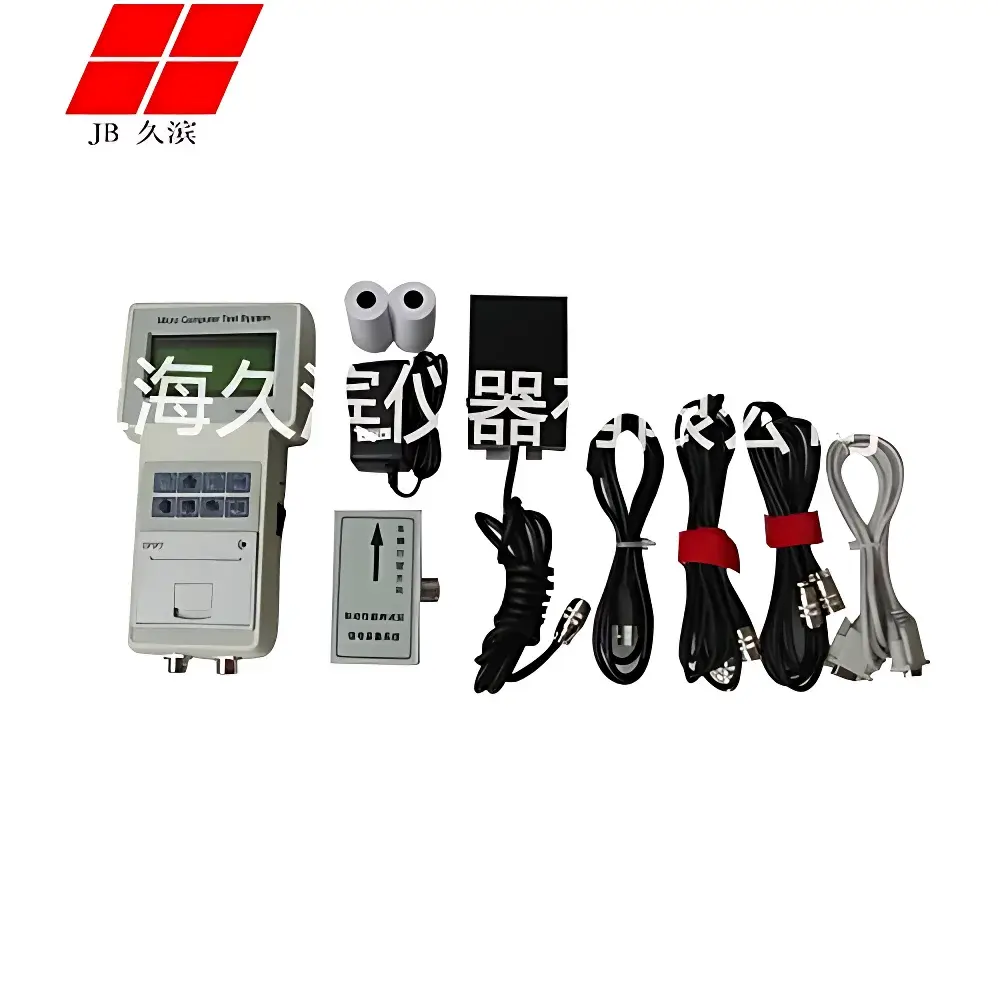
- Compact, ergonomic handheld form factor (205 × 145 × 55 mm; 0.4 kg) optimized for single-operator deployment in roadside, workshop, and forensic environments.
- High-resolution inertial sensing core with ±1.5 g dynamic range and 0.001 m/s² acceleration resolution ensures fidelity in low- and high-deceleration regimes.
- Integrated thermal printer enables immediate hard-copy output of test reports—including raw time-series data, deceleration curves, and calculated performance parameters—without external peripherals.
- On-device storage capacity for up to 999 complete test sessions, each preserving synchronized timestamped acceleration, speed, distance, and time vectors for retrospective analysis.
- Dual communication interfaces: industry-standard DB9 RS232 port and USB 2.0 host interface support bidirectional data exchange with Windows-based PC software for advanced post-processing, statistical trending, and report generation.
- Intuitive Chinese-language graphical user interface with menu-driven navigation and real-time on-screen parameter display minimizes operator training requirements and reduces procedural error risk.
- Magnetically mounted external sensor module allows rapid, tool-free attachment to vehicle chassis or test sleds—eliminating mechanical coupling uncertainties associated with adhesive or clamp-based mounting.
Sample Compatibility & Compliance
The JB-630N is validated for use across light-duty passenger vehicles (M1), light commercial vehicles (N1), motorcycles (L3–L5), and modified chassis test platforms operating at initial speeds from 20 km/h to 100 km/h. Its measurement methodology satisfies the functional requirements of GB 7258–2012 Clause 7.10.2 (road test method for service brake efficiency) and aligns with the underlying metrological principles referenced in ISO 2631-1 (mechanical vibration evaluation) and SAE J2905 (braking performance test protocols). While not certified to ISO/IEC 17025, the instrument’s stated ±1.5% accuracy is verified per internal calibration procedures traceable to national metrology institutes. Data integrity is maintained through non-volatile memory retention and timestamped record generation—supporting basic GLP documentation needs in maintenance and regulatory inspection workflows.
Software & Data Management
The accompanying Windows desktop application provides secure import of binary test files via USB or RS232, enabling conversion into CSV, PDF, and XML formats. Software features include curve overlay comparison, MFDD trend analysis across multiple tests, automatic pass/fail flagging against GB 7258 thresholds, and customizable report templates compliant with regional inspection authority formatting requirements. Audit trail functionality logs user ID, test date/time, firmware version, and calibration status for each imported session. Although the system does not implement FDA 21 CFR Part 11 electronic signature controls, its deterministic data flow architecture—where raw sensor data is written unaltered to flash memory prior to any processing—ensures reproducibility and supports manual verification workflows in quality assurance settings.
Applications
- Routine safety inspections at authorized motor vehicle inspection stations (MVIS) performing annual or biennial compliance checks.
- Post-repair verification in OEM-certified service centers and independent garages validating brake system refurbishment outcomes.
- Accident reconstruction analysis by traffic police and forensic engineering units quantifying pre-impact deceleration behavior and driver reaction timing.
- Brake component development and durability testing in automotive R&D labs evaluating friction material formulations and actuation system response.
- Educational use in vocational training institutions teaching vehicle dynamics, road safety engineering, and metrology fundamentals.
FAQ
What braking parameters does the JB-630N calculate automatically?
It computes stopping distance (s), total brake time (t), coordination time (t′), and Mean Fully Developed Deceleration (MFDD) per GB 7258–2012 Annex G definitions.
Is the device suitable for testing electric vehicles (EVs) with regenerative braking?
Yes—the inertial measurement principle captures net longitudinal deceleration regardless of energy recovery mechanism; however, interpretation must account for blended brake system behavior.
How is calibration maintained between official verification cycles?
Users perform zero-g offset verification before each test session; full calibration is recommended annually or after physical impact exposure, using manufacturer-provided reference fixtures.
Can test data be exported to third-party analysis tools like MATLAB or Python?
Yes—CSV export includes time-synchronized columns for acceleration (m/s²), speed (km/h), distance (m), and elapsed time (s), enabling direct ingestion into scientific computing environments.
Does the built-in printer support continuous label-mode output for fleet inspection logs?
No—it generates A7-format thermal receipts with fixed layout; batch printing requires PC software export and external printer integration.