
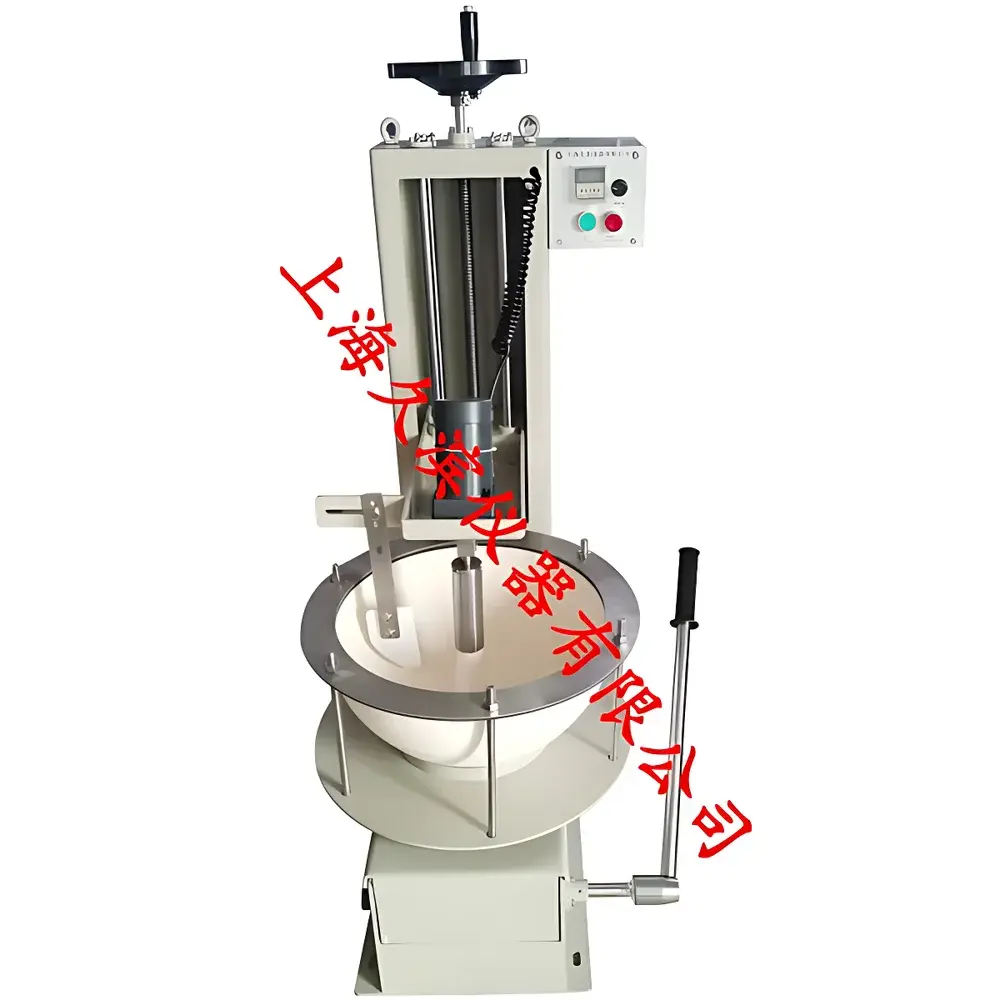
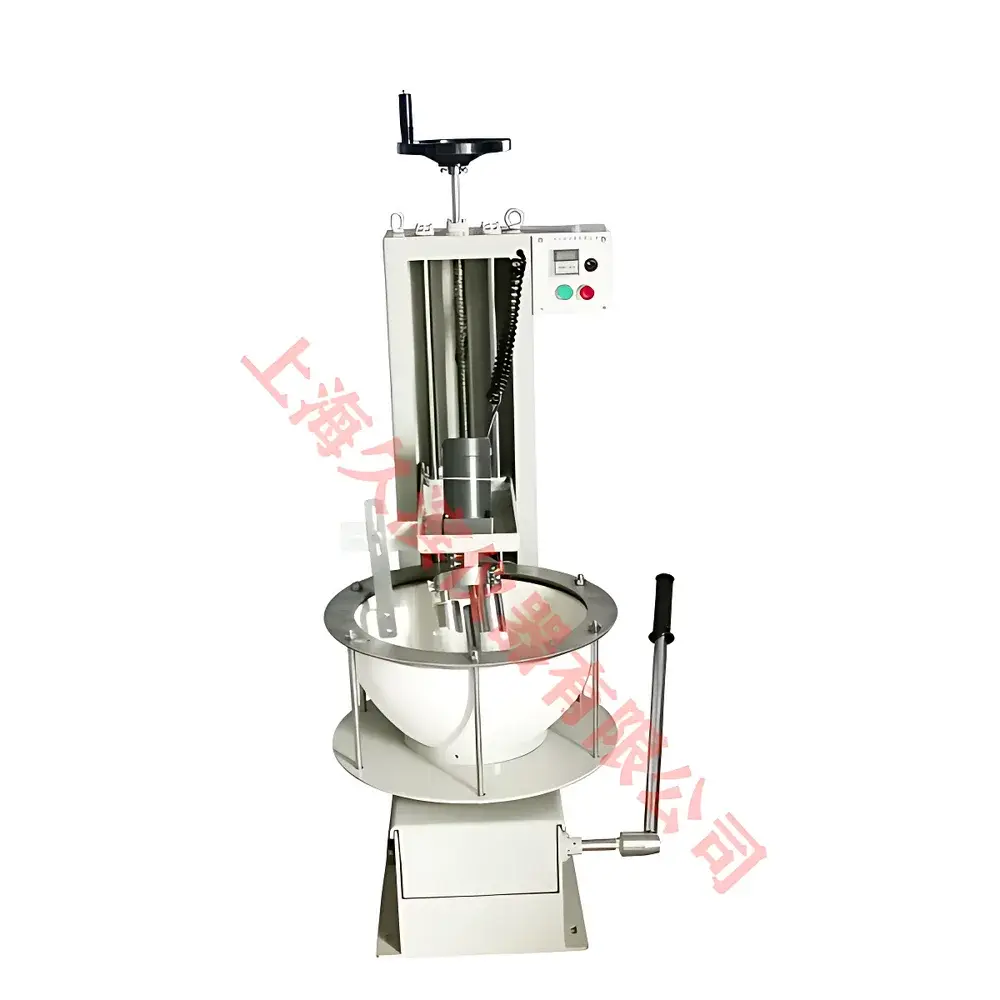
Jiubin JB-400 Series Triple-Pestle Electric Mortar Grinder
| Brand | Jiubin |
|---|---|
| Model | JB-400 Series |
| Origin | Shanghai, China |
| Equipment Type | Mortar Grinder |
| Sample Type | Hard & Brittle Solids |
| Output Particle Size | 0.01–0.5 mm |
| Batch Capacity | 5 L |
| Mortar Diameter | 400 mm |
| Mortar Depth | 200 mm |
| Pestle Speed | 1–180 rpm (adjustable) |
| Grinding Time Range | 1–999 min (programmable) |
| Mortar Material | Alumina (99.5% Al₂O₃) |
| Pestle Configuration | Triple-Pestle Design |
| Compliance | Designed for GLP-compliant lab environments |
Overview
The Jiubin JB-400 Series Triple-Pestle Electric Mortar Grinder is a precision-engineered laboratory grinding system designed for the controlled, reproducible size reduction of hard, brittle, and temperature-sensitive solid materials. Unlike conventional ball mills or jaw crushers, this instrument operates on the principle of quasi-static compression and shear between rotating pestles and a fixed alumina mortar — a mechanism closely aligned with traditional mortar-and-pestle preparation but fully automated, scalable, and quantitatively repeatable. The triple-pestle configuration generates simultaneous multi-point contact forces across the sample bed, significantly enhancing grinding efficiency while minimizing localized thermal buildup and particle agglomeration. This architecture makes the JB-400 particularly suitable for applications where phase integrity, chemical purity, and narrow particle size distribution are critical — such as in pharmaceutical active ingredient micronization, semiconductor precursor powder conditioning, or reference material homogenization.
Key Features
- Triple-pestle kinematics: Three independently mounted, vertically adjustable alumina pestles rotate synchronously at programmable speeds (1–180 rpm), ensuring uniform stress distribution and reduced grinding time versus single- or dual-pestle systems.
- High-purity alumina mortar (99.5% Al₂O₃): 400 mm diameter × 200 mm depth cavity offers excellent wear resistance, chemical inertness, and minimal contamination risk — validated for use with halides, iodides, and reactive metal oxides.
- Precision digital control interface: Enables full parameter programming including grinding duration (1–999 minutes), rotational speed, and optional pause/resume sequences; all settings retained in non-volatile memory.
- Sealed grinding chamber with inert gas purge port: Supports operation under nitrogen or argon atmospheres to prevent oxidation of air-sensitive samples (e.g., silicon nanopowders, lithium compounds).
- Integrated safety interlock: Motor automatically deactivates when lid is opened; emergency stop button compliant with IEC 60204-1 standards.
- Modular pestle alignment system: Allows rapid recalibration of pestle-to-mortar clearance (±0.1 mm resolution) to maintain optimal force geometry across extended operational life.
Sample Compatibility & Compliance
The JB-400 accommodates a broad spectrum of inorganic and organic solids with Mohs hardness up to 9.5, including diamond abrasives, fused silica, borosilicate glass, crystalline pharmaceuticals, freeze-dried biologics, and thermoplastic resins. Its absence of metallic grinding media eliminates cross-contamination risks associated with stainless-steel mills — a key requirement for USP particulate matter testing and ISO 13320 laser diffraction sample prep. The system supports documentation protocols compatible with GLP and GMP environments: audit trails for parameter changes, user access levels (operator/administrator), and timestamped grinding logs exportable via USB. While not certified to FDA 21 CFR Part 11 out-of-the-box, its firmware architecture permits integration with validated electronic lab notebook (ELN) systems for full regulatory traceability.
Software & Data Management
The embedded microcontroller provides local parameter storage and real-time status feedback (speed, elapsed time, motor load). Optional PC connectivity (RS-232/USB) enables remote monitoring and batch record generation using Jiubin’s LabGrind Control Suite v2.3 — a Windows-based application supporting CSV export, grinding curve visualization (rpm vs. torque), and comparative analysis across multiple batches. All data files include embedded metadata: operator ID, date/time stamp, mortar serial number, and calibration verification code — facilitating compliance with ISO/IEC 17025 clause 7.5 on result reporting.
Applications
- Pharmaceutical R&D: Pre-formulation grinding of API tablets and excipients prior to dissolution testing (USP ) or content uniformity analysis.
- Materials science: Homogenization of sintering feedstocks (e.g., WC-Co composites) and dispersion of nanoceramic precursors before XRD or BET surface area measurement.
- Food safety labs: Preparation of representative subsamples from whole coffee beans or spices for mycotoxin extraction and LC-MS/MS quantification.
- Geochemical reference labs: Crushing certified rock standards (e.g., NIST SRM 278) without introducing Fe/Ni contamination typical of planetary mills.
- Electronics manufacturing: Size reduction of photovoltaic-grade silicon fragments to <50 µm for slurry rheology characterization prior to screen printing.
FAQ
What is the maximum recommended hardness for samples processed in the JB-400?
Samples with Mohs hardness ≤9.5 (e.g., corundum, silicon carbide) are compatible; diamond grit may be processed but requires reduced speed (≤60 rpm) and shorter durations to minimize pestle wear.
Can the JB-400 achieve sub-10 µm particle sizes?
Yes — with optimized parameters (low speed, extended time, staged grinding), median D50 values down to 8 µm have been verified via laser diffraction for brittle oxides; however, achieving consistent sub-10 µm output depends strongly on initial morphology and fracture toughness.
Is the alumina mortar replaceable, and what is its service life under routine use?
Yes — mortars are field-replaceable consumables; typical lifespan exceeds 2,000 grinding cycles (5 L batches of quartz sand at 120 rpm) before measurable dimensional deviation (>0.3 mm radial wear) occurs.
Does the system support IQ/OQ documentation packages?
Jiubin provides standard IQ/OQ templates aligned with ASTM E2500 and ISO 9001; site-specific qualification must be performed by the end user or authorized service partner.
How is cross-contamination prevented between different sample types?
The system includes a validated cleaning protocol: vacuum-assisted residue removal followed by ultrasonic rinse in high-purity ethanol (≥99.9%), with post-cleaning verification via SEM-EDS spot analysis on blank runs.



