
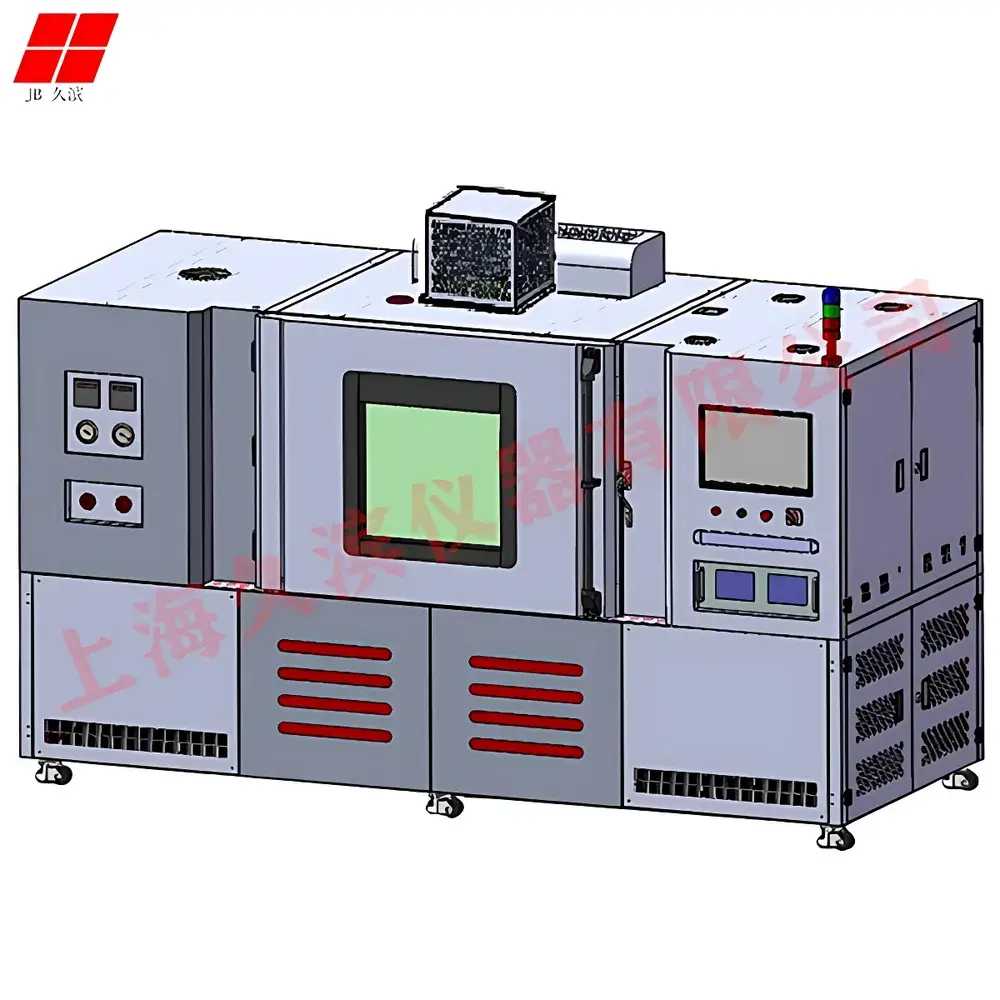
JB-JM8 Hydraulic Pulse Fatigue Testing System by Jiubin Instruments
| Brand | Jiubin Instruments |
|---|---|
| Origin | Shanghai, China |
| Model | JB-JM8 |
| Test Medium | Hydraulic Oil or Ethylene Glycol Mixture |
| Max Test Pressure | 0–5 MPa (adjustable) |
| Pressure Control Accuracy | ±0.01 MPa (full scale dependent) |
| Pulse Frequency | 5–120 cycles/min (adjustable) |
| Pulse Waveform | Square or Trapezoidal (pulse width configurable per user requirement) |
| Test Medium Temperature Range | Ambient to 160 °C |
| Environmental Temperature Range | –30 °C to 250 °C (adjustable) |
| Maximum Continuous Cycles | ≥1,000,000 |
| Control Method | PC-based Automated Control with Servo/Proportional Actuation |
| Data Interface | USB for data export and report printing |
| Compliance | Designed for ISO 6803, ISO 7241-2, SAE J1401, ASTM D3078, and GB/T 5563 testing protocols |
Overview
The JB-JM8 Hydraulic Pulse Fatigue Testing System is an engineered platform for accelerated life-cycle validation of pressure-containing components under dynamic cyclic loading conditions. It operates on the principle of controlled hydraulic pressure pulsation—generating repeatable, high-fidelity pressure waveforms (square or trapezoidal) to simulate real-world service stresses in fluid conveyance systems. Unlike static burst or proof tests, this system subjects specimens—including hoses, tubes, fittings, heat exchangers, and manifolds—to millions of pressure cycles within a thermally regulated environment, enabling quantification of fatigue resistance, seal integrity degradation, and structural deformation onset. Its architecture adheres to fundamental principles of hydrostatic fatigue mechanics, where cumulative damage is evaluated via cycle-count thresholding, pressure amplitude mapping, and waveform fidelity control—critical parameters defined in international standards such as ISO 6803 (rubber hoses), ISO 7241-2 (quick-connect couplings), and SAE J1401 (automotive hydraulic brake hoses).
Key Features
- Full PC-based automation with real-time closed-loop pressure regulation using servo or proportional hydraulic control valves, ensuring stable amplitude tracking across the full 5 MPa range.
- Precision pressure control with ±0.01 MPa accuracy (dependent on selected transducer full-scale range), validated per ISO 9001 calibration traceability requirements.
- Configurable pulse frequency from 5 to 120 cycles per minute, synchronized with programmable dwell time and ramp profiles to emulate transient operational loads.
- Integrated dual-temperature control: independent regulation of test medium temperature (ambient to 160 °C) and environmental chamber temperature (–30 °C to 250 °C), enabling combined thermal–mechanical stress testing.
- All wetted and pressure-bearing components constructed from certified forged stainless steel or high-strength alloy forgings—zero welded joints—ensuring long-term pressure integrity and compliance with ASME B31.4/B31.8 design margins.
- Onboard data acquisition system with USB interface supports export of time-stamped pressure vs. time waveforms, cycle counters, temperature logs, and alarm event timestamps.
Sample Compatibility & Compliance
The JB-JM8 accommodates a broad spectrum of pressure-rated components: rubber and thermoplastic hoses (e.g., brake, fuel, HVAC, turbocharger intercooler), metallic tubing (stainless steel, aluminum), crimped or flanged fittings, hydraulic manifolds, filter housings, and compact heat exchangers. Specimen mounting interfaces support standardized SAE 100R-series, ISO 1436, and DIN 20022 configurations. The system is configured to execute test sequences aligned with ISO 6803 (pulse endurance of rubber hoses), ISO 7241-2 (pressure cycling of quick-coupling devices), ASTM D3078 (leak detection under vacuum), GB/T 5563 (hydraulic hose pulse testing), and SAE J1401 (brake hose qualification). All control logic and data logging meet GLP audit-trail requirements, including user authentication, parameter change logs, and electronic signature-capable reporting.
Software & Data Management
The embedded Windows-based control software provides intuitive test sequence programming, including multi-step pressure ramps, hold durations, frequency sweeps, and conditional termination triggers (e.g., leakage detection via pressure decay rate thresholds). Real-time visualization includes synchronized plots of pressure, medium temperature, ambient temperature, and cycle count. All raw data are stored in CSV-compatible format with metadata headers (test ID, operator, date/time, calibration IDs). Reports comply with 21 CFR Part 11 readiness: electronic signatures, audit trails, and immutable archive mode are supported via optional software licensing. USB export enables integration with LIMS or enterprise QA databases without proprietary file dependencies.
Applications
- Automotive Tier-1 suppliers validating brake, power steering, and EV battery cooling loop components per OEM-specific durability specifications (e.g., Ford WSS-M4D772-A, GM GMW14872).
- Aerospace hose assembly qualification against MIL-DTL-87937 and SAE AS13950 requirements for pulse endurance at elevated temperatures.
- Hydraulic equipment manufacturers verifying manifold and valve block fatigue life under ISO 4413-compliant pressure spectra.
- Medical device firms assessing biocompatible tubing (e.g., silicone, TPE) for infusion pump and dialysis circuit applications under USP and environmental conditioning.
- R&D laboratories conducting comparative material studies—e.g., evaluating EPDM vs. FKM elastomer performance under combined thermal–cyclic stress.
FAQ
What standards does the JB-JM8 support out-of-the-box?
The system includes preloaded test templates for ISO 6803, ISO 7241-2, SAE J1401, ASTM D3078, and GB/T 5563. Custom waveform and sequencing logic can be implemented for proprietary or emerging standards.
Can the system detect micro-leakage during testing?
Yes—via real-time pressure decay monitoring during dwell phases; configurable threshold alarms trigger automatic test halt and event logging when decay exceeds user-defined limits (e.g., >0.1 MPa/min over 30 s).
Is remote monitoring or network integration possible?
The control PC supports standard Ethernet TCP/IP communication; OPC UA and Modbus TCP drivers are available as optional add-ons for SCADA or MES integration.
How is calibration maintained across long-duration tests?
Pressure transducers are equipped with built-in temperature compensation and zero-drift correction algorithms; annual recalibration against NIST-traceable deadweight testers is recommended per ISO/IEC 17025 guidelines.
What safety mechanisms prevent over-pressurization or thermal runaway?
Hardware-level safeguards include redundant pressure relief valves (set at 110% of max test pressure), thermocouple-based thermal cutoffs, and emergency stop circuits compliant with IEC 60204-1.



