
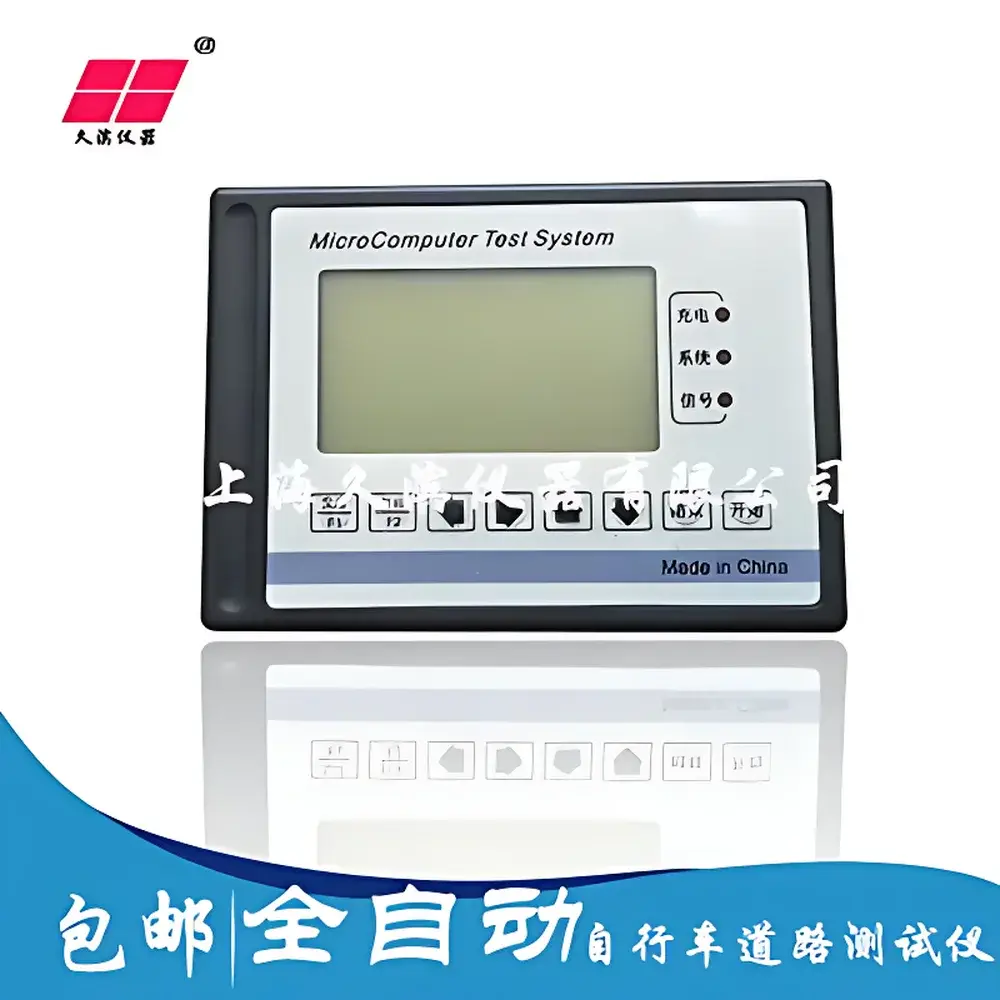
GB17761-2018 E-Bike Road Test Instrument JB-2300
| Brand | Jiubin Instruments |
|---|---|
| Origin | Shanghai, China |
| Manufacturer Type | Authorized Distributor |
| Country of Origin | China |
| Model | JB-2300 |
| Pricing | Upon Request |
| Power Consumption | <5 W (Standby: 1 W) |
| Internal Power Supply | DC 9.6 V / 1200 mAh Ni-MH Battery |
| External Power Input | DC 12 V |
| Communication Interface | Standard 9-pin RS232 (TXD on Pin 3, RXD on Pin 2, GND on Pin 5) |
| Baud Rate | 9600, 8 Data Bits, 1 Stop Bit, No Parity |
| Dimensions | 205 × 145 × 55 mm |
| Weight | 1.0 kg (including battery) |
| Operating Temperature | −15 °C to +45 °C |
| Relative Humidity | 30–80 % RH |
Overview
The JB-2300 E-Bike Road Test Instrument is a purpose-built, microcontroller-driven field measurement system engineered for compliance verification and performance validation of electric bicycles according to the mandatory Chinese national standard GB 17761–2018 (“Electric Bicycles – Technical Specifications”). Unlike general-purpose data loggers or GPS-based speed meters, the JB-2300 implements a calibrated, real-time kinematic measurement architecture optimized for low-speed, high-repeatability road testing under variable load and surface conditions. It directly acquires wheel rotation signals via integrated optical or magnetic sensors (field-configurable), enabling precise calculation of instantaneous velocity, acceleration, deceleration, and distance traveled—without reliance on satellite positioning or inertial navigation. Its design prioritizes metrological traceability in regulatory testing environments, supporting full audit trails for type approval, factory QC, and third-party certification laboratories.
Key Features
- Real-time dual-parameter acquisition: Simultaneous measurement of speed (km/h) and distance (m) with timestamped logging at 10 Hz sampling rate.
- Compliance-focused test modes: Dedicated firmware modules for GB 17761–2018-defined procedures—including maximum speed determination (under no-load and loaded conditions), speed-limit verification (e.g., cut-off at 25 km/h), and braking distance evaluation from defined initial velocities (e.g., 20 km/h, 25 km/h).
- Human-centered interface: Backlit monochrome LCD with Chinese character prompts and dynamic parameter overlays; intuitive menu navigation requiring no external PC during field operation.
- Integrated power management: Rechargeable 9.6 V Ni-MH battery pack (1200 mAh) supports ≥8 hours of continuous operation; ultra-low standby consumption (<1 W) extends readiness between tests.
- Industrial-grade connectivity: RS232 serial interface compliant with EIA/TIA-232-E specifications, enabling seamless integration with laboratory PCs, automated test benches, or thermal printers for hard-copy reporting.
- Ruggedized portable form factor: Compact housing (205 × 145 × 55 mm), IP54-rated enclosure, and shock-absorbing chassis ensure durability during transport and roadside deployment.
Sample Compatibility & Compliance
The JB-2300 is validated for use with all pedal-assist and throttle-controlled e-bikes conforming to GB 17761–2018 definitions—including vehicles with motor output ≤400 W and maximum design speed ≤25 km/h. It interfaces with standard bicycle wheel hubs (20″–29″) via optional sensor mounting kits (magnetic encoder or reflective tape adapter). While not certified to ISO/IEC 17025 as a standalone calibration instrument, its measurement chain adheres to metrological principles outlined in JJF 1001–2011 (General Terminology and Definitions for Metrology) and supports traceable calibration using reference tachometers and certified distance markers. The device meets EMC requirements per GB/T 18268.1–2010 (industrial environment) and safety specifications per GB 4943.1–2011.
Software & Data Management
Raw test data is stored internally in non-volatile memory (≥100 test records) and exportable via RS232 to host systems running Windows/Linux. Optional companion software (JB-DataLink v2.x) provides CSV/Excel export, graphical velocity vs. time plots, braking distance histograms, and customizable report templates aligned with CNAS-accredited lab documentation standards. Audit trail functionality logs operator ID, test date/time, environmental conditions (manually entered), and firmware version—supporting GLP-aligned recordkeeping. Data integrity complies with basic electronic record requirements per GB/T 22239–2019 (Information Security Technology – Basic Requirements for Cybersecurity Level Protection), though native 21 CFR Part 11 compliance requires supplementary IT infrastructure controls.
Applications
- Pre-production validation of speed governor logic and brake system responsiveness in e-bike OEM R&D labs.
- In-line QC testing on final assembly lines to verify batch conformity with GB 17761–2018 speed limit enforcement thresholds.
- Third-party certification testing for CCC mark applications and provincial market supervision bureau inspections.
- Academic research on human–machine interaction dynamics, including pedal torque–speed correlation and regenerative braking efficiency analysis.
- Aftermarket component evaluation—e.g., comparative assessment of hub motor controllers, brake pad compounds, or tire rolling resistance under standardized road conditions.
FAQ
Does the JB-2300 require external GPS or GNSS for speed measurement?
No. It uses wheel-rotation-based kinematic calculation, eliminating signal dependency and ensuring consistent accuracy indoors, under bridges, or in urban canyons.
Can test results be exported in formats compatible with LIMS or ERP systems?
Yes—ASCII-formatted serial output enables direct ingestion into LabVantage, Thermo Fisher SampleManager, or custom MES platforms via RS232-to-USB adapters.
Is firmware upgradable in the field?
Yes, via RS232 using manufacturer-provided update utilities and signed binary files; version history and change logs are maintained per ISO 9001 configuration control requirements.
What calibration intervals are recommended for regulatory use?
Annual calibration against NIST-traceable tachometric standards is advised; internal self-diagnostic routines verify sensor linearity and timing accuracy before each test session.
Does the instrument support multi-language UI beyond Chinese?
Not natively—the firmware is localized for Chinese regulatory workflows; English-language technical documentation and report templates are provided separately.




