
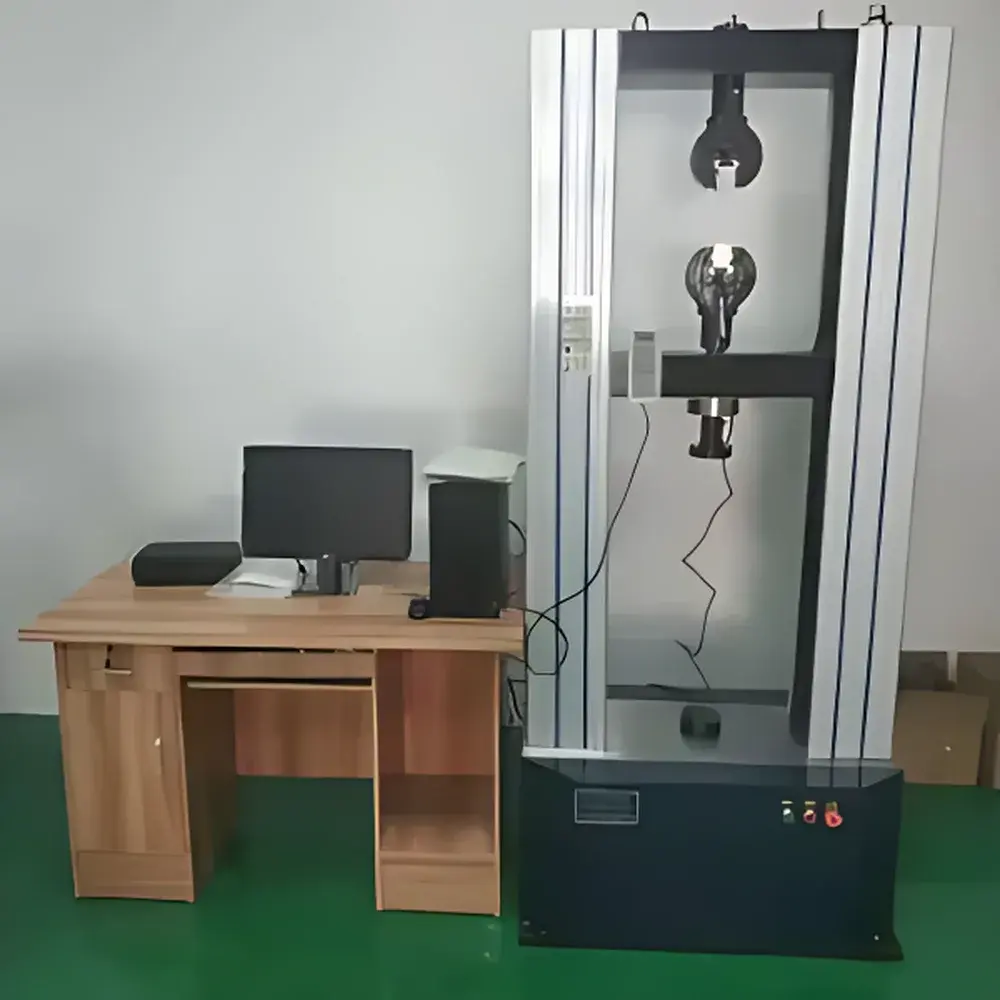
Jiubin JB-121 Hot-Melt Adhesive Peel Strength Tester
| Brand | Jiubin |
|---|---|
| Origin | Shanghai, China |
| Model | JB-121 |
| Instrument Type | Electronic Tensile Testing Machine |
| Maximum Test Force | Customizable (Standard Options: 5 kN, 10 kN, 20 kN, 50 kN) |
| Force Measurement Range | 0.4–100% FS (full scale), single-range |
| Force Accuracy | ±1% of reading (±0.5% optional for precision grade) |
| Displacement Resolution | 0.001 mm |
| Displacement Rate Range | 0.001–500 mm/min (higher rates available on request) |
| Peel Modes | Drum Peel, 90° Peel, 180° Peel |
| Strain Measurement Accuracy | ±1% of reading |
| Crosshead Travel | Standard 600 mm or 800 mm (extendable) |
| Vertical Test Space | 900–1200 mm (extendable) |
| Power Supply | 0.75 kW AC servo motor |
| Safety Protections | Mechanical limit switches, overload cutoff, overcurrent/overvoltage protection, emergency stop |
Overview
The Jiubin JB-121 Hot-Melt Adhesive Peel Strength Tester is an electronically controlled tensile testing system engineered for precise quantification of interfacial adhesion performance in thermoplastic hot-melt adhesives and related laminated assemblies. Based on the principle of controlled-force mechanical separation, the instrument applies uniaxial tension to bonded substrates under standardized peel geometries—specifically drum peel, 90° peel, and 180° peel configurations—as defined in ASTM D3330, ASTM D903, ISO 8510-2, and GB/T 2790. Its modular load frame, high-resolution displacement transduction, and closed-loop servo control architecture ensure repeatable force application across low-to-medium load ranges (5–50 kN), making it suitable for QC laboratories validating adhesive bond integrity in packaging, automotive trim bonding, medical device assembly, and flexible electronics lamination.
Key Features
- Full-digital AC servo drive system with torque-controlled motor and high-precision encoder feedback for stable, noise-free motion across the full speed range (0.001–500 mm/min).
- Single-range force sensor with 0.4–100% full-scale measurement capability and ≤±1% indication error (±0.5% optional); no manual range switching required.
- Three independent control modes—load, displacement, and strain—switchable during test execution to support multi-phase protocols (e.g., preload → dwell → peel ramp).
- Integrated safety architecture including mechanical end-stop limits, real-time overload detection (>110% FS), overcurrent/overvoltage monitoring, and hardware-triggered emergency stop circuitry compliant with IEC 61800-5-2.
- Modular fixture interface supporting rapid interchange of peel drums (standard 25.4 mm diameter), 90°/180° peel jigs, tensile grips, compression platens, and custom tooling per ISO 20413 and GB/T 228.1.
Sample Compatibility & Compliance
The JB-121 accommodates a broad spectrum of substrate-adhesive combinations, including but not limited to: PET/aluminum foil laminates, BOPP/PE film composites, nonwoven-to-foam bonds, textile-reinforced hot-melt tapes, and wire insulation-to-jacket interfaces. Its mechanical design conforms to structural requirements of ISO 7500-1 (Class 1 or Class 0.5 depending on sensor grade) and supports test method validation per ASTM D1876 (T-peel), ASTM D6862 (peel resistance of pressure-sensitive tapes), and ISO 11339 (adhesive peel strength). All firmware and control logic are structured to support GLP-compliant audit trails when paired with validated data acquisition software—meeting foundational traceability requirements aligned with FDA 21 CFR Part 11 Annex 11 principles.
Software & Data Management
Bundled PC-based testing software provides real-time synchronization of load, displacement, and time data at ≥1 kHz sampling rate. Users may define multi-step test profiles—including preloading, dwell periods, and variable-rate peel segments—and generate ASTM/ISO-formatted reports with automatic calculation of average peel force, peak load, energy-to-peel (area under curve), and coefficient of variation (CV%). Raw data exports as CSV or XLSX; metadata (operator ID, sample ID, environmental conditions, calibration date) are embedded and digitally signed. Optional software modules support statistical process control (SPC) charting, batch comparison, and automated pass/fail evaluation against user-defined specification limits.
Applications
- Quality assurance of hot-melt adhesive formulations during R&D and production release.
- Comparative evaluation of peel resistance between different adhesive chemistries (EVA, PO, APAO, polyamide) on identical substrates.
- Validation of aging effects (thermal cycling, humidity exposure) on bond durability per ISO 188 and ASTM D573.
- Testing of peel initiation and propagation behavior in multilayer flexible packaging structures (e.g., snack pouches, medical pouches).
- Supporting failure mode analysis (cohesive vs. adhesive failure) via synchronized video recording and force-displacement curve morphology assessment.
FAQ
What peel geometries does the JB-121 support?
It supports drum peel (rotating mandrel configuration), 90° peel, and 180° peel per ISO 8510-2 and ASTM D903.
Can the system be calibrated to ISO/IEC 17025-accredited standards?
Yes—when used with NIST-traceable force and displacement standards and operated under documented procedures, the JB-121 meets metrological requirements for in-house calibration verification.
Is the software compliant with FDA 21 CFR Part 11?
The base software includes electronic signature capability and audit trail logging; full Part 11 compliance requires site-specific validation documentation and role-based access configuration.
What is the minimum resolvable peel force increment?
With a 5 kN load cell, the system resolves forces down to 0.02 N (0.4% of 5 kN at 50 N full scale resolution).
Are custom fixtures available for non-standard substrates?
Jiubin offers engineering consultation and CNC-manufactured fixtures for specialized geometries—including curved-surface peel, micro-tape testing, and dual-anchor peel configurations—under NDA terms.
Related Products



