
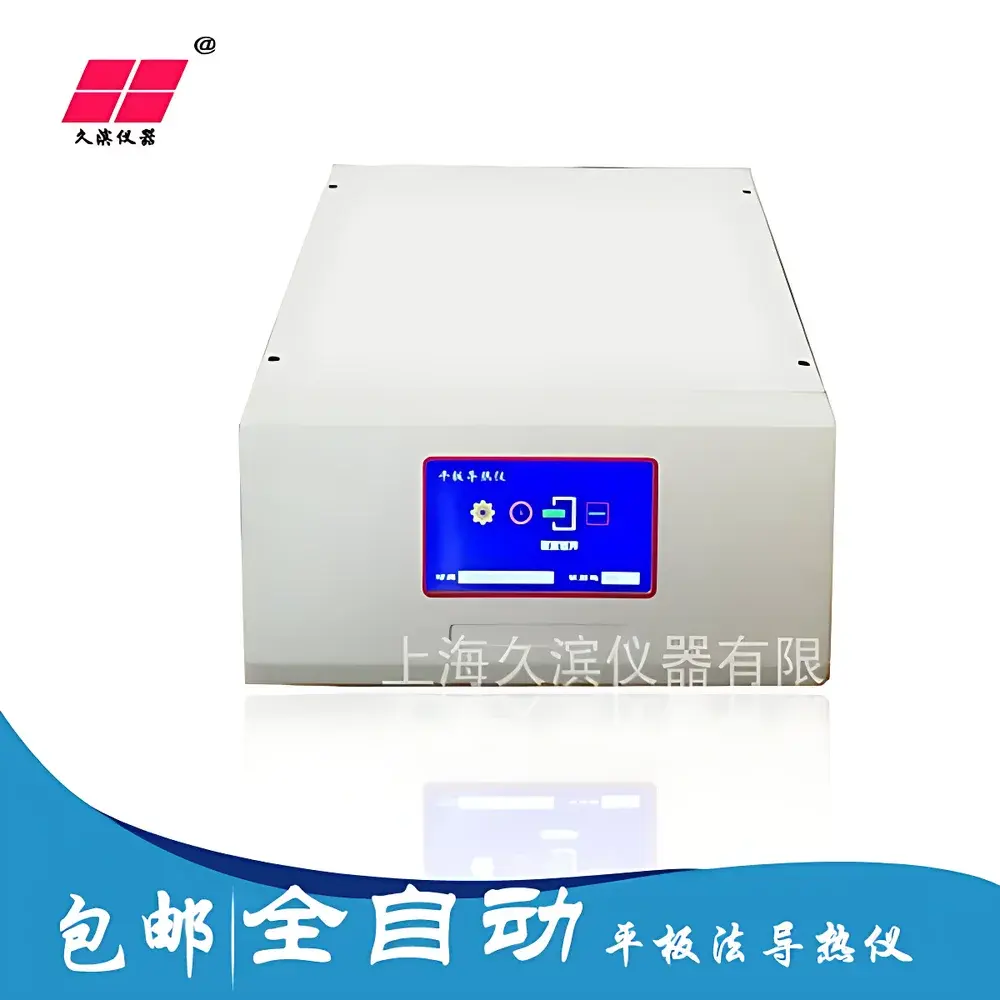
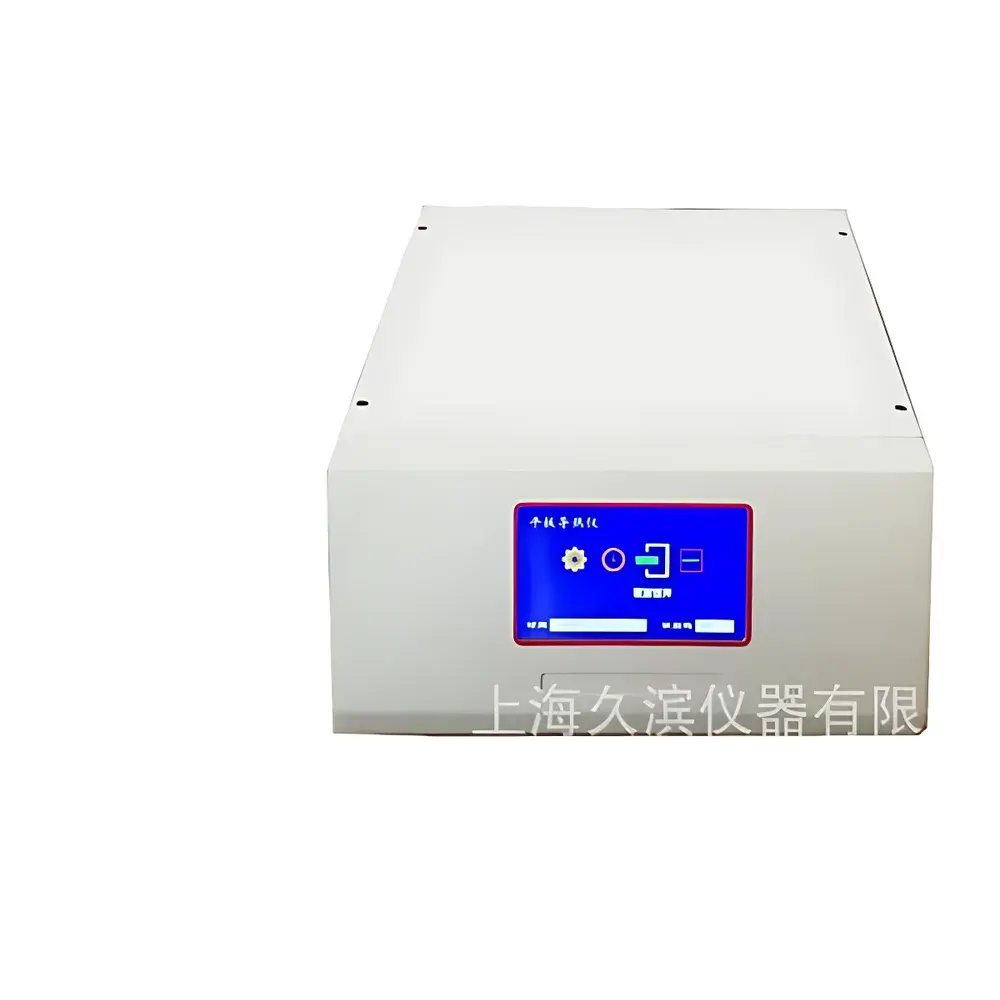
JB-PL Heat Flow Meter (HFM) Thermal Conductivity Analyzer
| Brand | Jiubin Instruments |
|---|---|
| Origin | Shanghai, China |
| Model | JB-PL |
| Measurement Principle | Guarded Hot Plate (Steady-State Heat Flow Method) |
| Test Standard Compliance | ASTM C177, ISO 8302, GB/T 10294 |
| Thermal Conductivity Range | 0.010–5.000 W/(m·K) |
| Accuracy | ±3% |
| Repeatability | ±3% |
| Dimensions (L×W×H) | 552 × 550 × 760 mm |
| Power Supply | 220 V AC, 50 Hz |
Overview
The JB-PL Heat Flow Meter (HFM) Thermal Conductivity Analyzer is a precision steady-state instrument engineered for reliable thermal conductivity characterization of low-to-moderate conductivity solid materials—including rigid and flexible foams, plastics, insulating boards, elastomers, and composite laminates. Based on the guarded hot plate method (ASTM C177 / ISO 8302), the system establishes a one-dimensional, steady-state heat flux across a centrally mounted test specimen sandwiched between a heated upper plate and a cooled lower plate. A precisely controlled guard ring surrounds the primary heating zone to eliminate lateral heat loss, ensuring high-fidelity boundary conditions essential for metrologically traceable measurements. Designed for laboratory-based quality control, R&D validation, and material certification workflows, the JB-PL delivers reproducible results under ambient temperature conditions (typically 15–30 °C), with no requirement for external climate chambers or cryogenic cooling.
Key Features
- Guarded hot plate architecture compliant with ASTM C177 and ISO 8302—enabling direct determination of thermal conductivity (λ) without calibration transfer assumptions.
- Integrated dual-plate temperature control system with PID-regulated heating and thermoelectric or liquid-cooled heat sink, maintaining ΔT stability within ±0.1 °C during measurement.
- High-resolution digital thermopile sensors (±0.05 °C resolution) embedded in both hot and cold plates for accurate mean temperature and heat flux calculation.
- Modular sample chamber accommodating standard specimen sizes up to 300 mm × 300 mm × 50 mm, with adjustable clamping force to ensure uniform interfacial contact and minimize contact resistance artifacts.
- Robust mechanical frame constructed from low-thermal-conductivity anodized aluminum and stainless steel, minimizing parasitic conduction paths and enhancing long-term dimensional stability.
- Front-panel 7-inch capacitive touchscreen interface with real-time graphical display of temperature gradients, power input, and convergence status.
Sample Compatibility & Compliance
The JB-PL is validated for homogeneous, isotropic, non-porous, and low-permeability solids exhibiting thermal conductivity between 0.010 and 5.000 W/(m·K). Typical applications include expanded polystyrene (EPS), extruded polystyrene (XPS), polyurethane (PU) foam, phenolic insulation, PVC sheets, silicone rubber, and fiber-reinforced polymer (FRP) panels. Specimens must be flat, parallel-faced, and free of surface contamination or moisture ingress prior to testing. The instrument supports compliance documentation generation aligned with ISO/IEC 17025 requirements, including full audit trails of calibration history, operator ID, environmental monitoring logs (optional external sensor integration), and raw thermocouple voltage data export. All firmware and software adhere to basic data integrity principles compatible with GLP environments; optional 21 CFR Part 11-compliant user access control and electronic signature modules are available upon request.
Software & Data Management
The proprietary JB-PL Control Suite (v3.2+) runs on embedded Linux and provides intuitive workflow-guided operation—from specimen setup and thermal equilibration monitoring to automated report generation. Real-time convergence diagnostics assess thermal steady-state attainment using slope analysis of temperature differentials over time (default threshold: <0.02 °C/h for ≥30 min). Measurement data—including calculated λ, thermal resistance (R-value), uncertainty budget components, and raw sensor voltages—is stored in encrypted SQLite databases with timestamped metadata. Export formats include CSV (for Excel or MATLAB post-processing), PDF (with company logo, test certificate template, and QA stamp), and XML (compatible with LIMS integration via REST API). Audit logs record all parameter changes, start/stop events, and user logins with immutable timestamps.
Applications
- Quality assurance of building insulation materials per EN 13162 and ASTM C518 (when used with auxiliary environmental chamber).
- Thermal property benchmarking of polymer formulations during new material development.
- Validation of thermal simulation inputs for finite element analysis (FEA) of packaging, electronics enclosures, or automotive components.
- Third-party certification testing for green building rating systems (e.g., LEED, BREEAM) requiring certified λ values.
- Educational laboratories conducting fundamental heat transfer experiments in mechanical engineering and materials science curricula.
FAQ
What standards does the JB-PL comply with for thermal conductivity measurement?
ASTM C177, ISO 8302, and GB/T 10294—covering guarded hot plate methodology for solid, homogeneous materials.
Can the JB-PL measure anisotropic or layered composites?
It is not recommended for strongly anisotropic or multi-layer specimens unless cross-sectional homogeneity and interfacial bonding are independently verified; directional conductivity requires specialized apparatus (e.g., transient plane source).
Is temperature-controlled environmental housing included?
No—the JB-PL operates at ambient laboratory temperature; optional integration with external temperature/humidity chambers is supported via analog I/O and Modbus RTU.
How is calibration traceability maintained?
Factory calibration uses NIST-traceable reference materials (e.g., SRM 1450c Fibrous Glass Board); users receive a calibration certificate with uncertainty statement and recommended recalibration interval (24 months under normal use).
Does the system support automated batch testing?
Yes—through scriptable measurement sequences and external trigger inputs, enabling unattended sequential testing of up to 12 specimens with configurable dwell times and pass/fail thresholds.



