
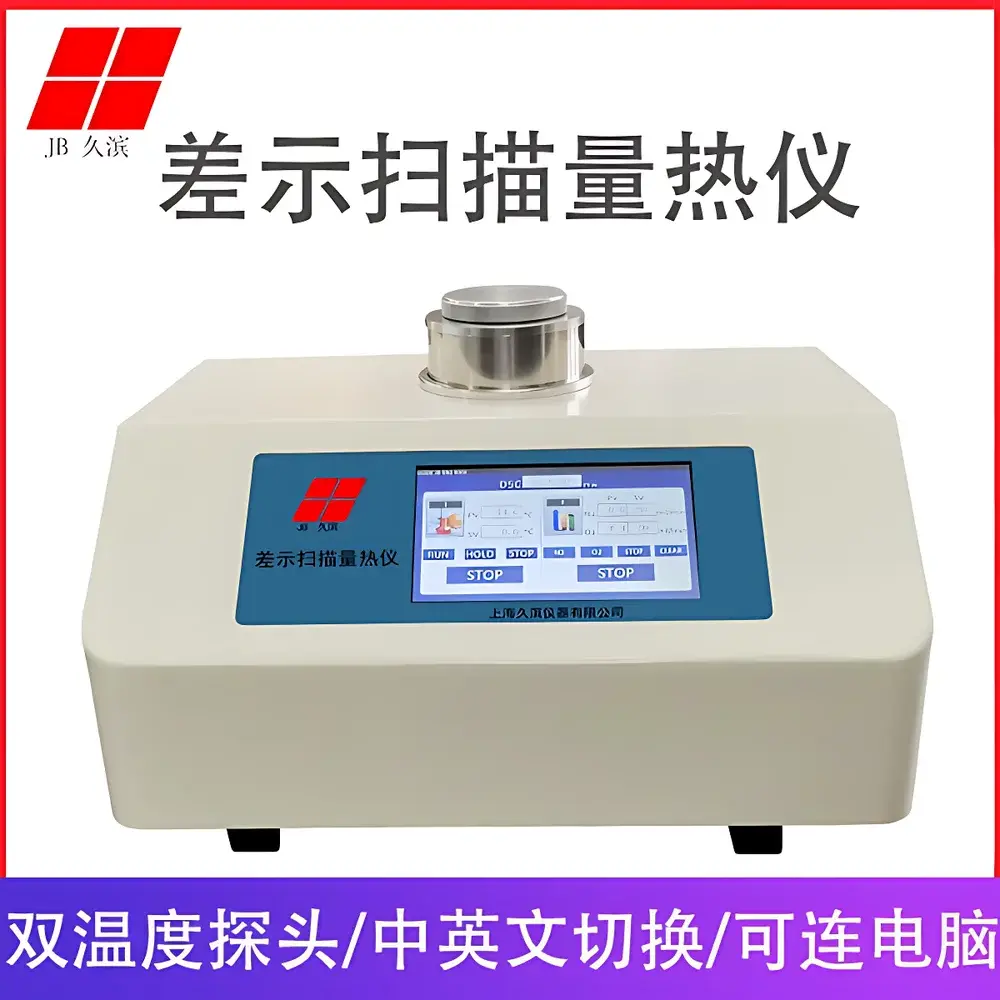
Jiubin JB-DSC-500B Differential Scanning Calorimeter for Oxidative Induction Time (OIT) Analysis
| Brand | Jiubin |
|---|---|
| Origin | Shanghai, China |
| Model | JB-DSC-500B |
| Sample Capacity | 1 |
| Instrument Type | DSC |
| Temperature Range | Ambient to 500 °C |
| Temperature Accuracy | ±0.1 °C |
| Heating/Cooling Rate | 0.1–100 K/min |
| DSC Heat Flow Range | ±600 mW |
| Compliance | GB/T 19466.2–2004, GB/T 19466.3–2004, GB/T 19466.6–2009, ISO 11357-2:1999, ISO 11357-3:1999 |
Overview
The Jiubin JB-DSC-500B is a high-stability differential scanning calorimeter engineered for precise thermal characterization of polymeric and organic materials under controlled inert or oxidative atmospheres. It operates on the principle of heat-flux DSC, measuring the difference in heat flow between a sample and an inert reference as both are subjected to identical temperature programs. This enables quantitative determination of endothermic and exothermic transitions—including glass transition (Tg), cold crystallization, melting enthalpy (ΔHm), crystallization onset and peak temperatures, solid-solid phase changes, and critically, oxidative induction time (OIT) and oxidative induction temperature (OITT). The instrument is specifically optimized for ASTM D3895 and ISO 11357-6 compliant OIT testing of thermoplastics, elastomers, and cured epoxy resins—where thermal stability under oxygen exposure directly correlates with long-term aging resistance and formulation robustness.
Key Features
- High-precision temperature control with ±0.1 °C accuracy across a full operating range from ambient to 500 °C, ensuring reproducible baseline stability for low-signal transitions such as Tg in highly crosslinked epoxies.
- Programmable heating and cooling rates from 0.1 to 100 K/min, supporting both standard dynamic scans and isothermal OIT protocols per ISO 11357-6.
- ±600 mW DSC signal range with low-noise sensor architecture, enabling high-resolution detection of weak exotherms associated with early-stage oxidation in stabilized polymer systems.
- Robust furnace design with symmetric alumina sensor geometry and active temperature gradient compensation, minimizing thermal lag and improving peak shape fidelity for kinetic analysis.
- Integrated gas switching module (N2/O2) with mass flow control, facilitating seamless transition between inert purging (for baseline stabilization) and oxidative atmosphere (for OIT measurement) without sample removal.
- Modular sample pan system compatible with hermetic aluminum, high-pressure stainless steel, and crucibles with lid vents—essential for pressure-controlled OIT and volatile-rich formulations.
Sample Compatibility & Compliance
The JB-DSC-500B accommodates solid, powder, and cured resin specimens weighing 1–15 mg in standard 40 µL aluminum pans. Its thermal platform supports direct analysis of epoxy formulations pre- and post-cure, filled composites, and aged degradation samples. All OIT measurements comply with ISO 11357-6:2016 and GB/T 19466.6–2009 for isothermal OIT (at fixed T, e.g., 200 °C under O2) and dynamic OIT (ramping under O2 until exothermic onset). Additional compliance includes ISO 11357-2 (Tg), ISO 11357-3 (melting/crystallization), and USP for thermal behavior assessment in pharmaceutical excipients where epoxy-based coatings are employed.
Software & Data Management
Controlled via Jiubin Thermal Analysis Suite (JTAS) v4.x, the system provides ISO/IEC 17025-aligned data acquisition with timestamped audit trails, user-level access controls, and electronic signature support. Raw DSC thermograms are exported in universal Q2000 (.q2d) and ASCII formats for third-party kinetic modeling (e.g., Ozawa-Flynn-Wall, ASTM E698). The software embeds automated OIT calculation algorithms per ISO 11357-6 Annex A, identifying onset intersection points using tangent extrapolation with configurable sensitivity thresholds. Full GLP/GMP documentation packages—including instrument qualification reports (IQ/OQ/PQ templates), calibration logs, and raw-data archiving—are exportable in PDF/A-1b format compliant with FDA 21 CFR Part 11 requirements.
Applications
- Quantification of antioxidant depletion kinetics in epoxy resin systems used in aerospace composites and wind turbine blade matrices.
- Comparative evaluation of OIT performance across amine- vs. anhydride-cured epoxies under accelerated thermal aging protocols.
- Determination of gel point and vitrification during in-situ cure monitoring (via step-isothermal DSC).
- Thermal stability screening of flame-retardant epoxy formulations containing phosphorus or nitrogen additives.
- Quality control of batch-to-batch consistency in industrial epoxy adhesives through Tg and ΔHcure fingerprinting.
- Regulatory submission support for medical device packaging materials requiring ISO 10993-12 thermal safety data.
FAQ
What atmosphere is required for OIT testing of epoxy resins?
OIT requires a pure oxygen environment (≥99.998% O2) at a regulated flow rate of 20–50 mL/min, following ISO 11357-6 Section 6.2. Pre-test stabilization under nitrogen is mandatory to establish thermal equilibrium.
Can the JB-DSC-500B perform modulated DSC (MDSC)?
No—the JB-DSC-500B is a conventional heat-flux DSC platform and does not support temperature-modulated scanning. For reversing/non-reversing heat flow separation, a dedicated MDSC-capable instrument is recommended.
Is calibration traceable to NIST standards?
Yes—temperature calibration uses high-purity indium (Tm = 156.598 °C), zinc (Tm = 419.527 °C), and tin (Tm = 231.928 °C) certified reference materials; enthalpy calibration employs certified KCl fusion (ΔH = 23.17 J/g), all traceable to NIST SRMs via accredited metrology labs.
How is baseline drift minimized during extended isothermal OIT holds?
The instrument employs dual-sensor symmetry compensation, real-time furnace temperature feedback, and auto-zero referencing at regular intervals—reducing baseline drift to <0.02 mW/h over 60-minute isothermal segments.



