
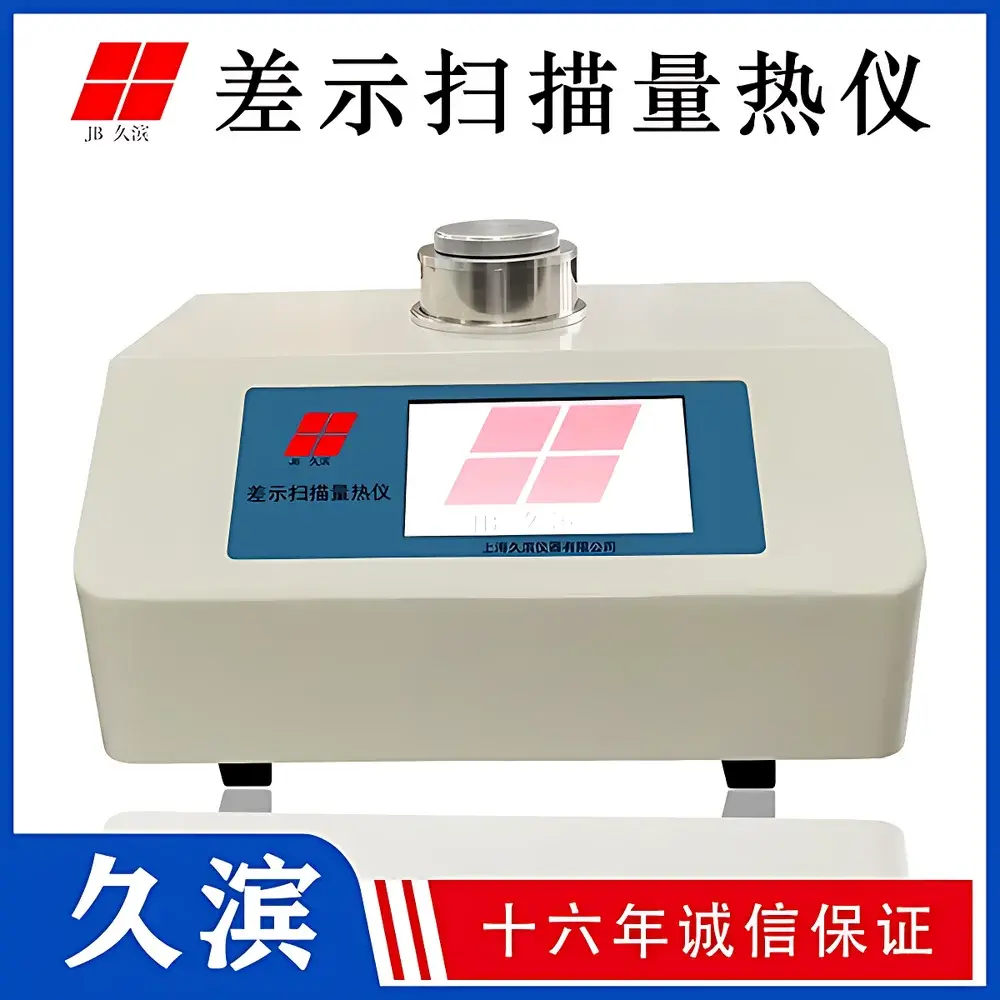
JB-DSC-500B Differential Scanning Calorimeter (DSC) by Jiubin Instruments
| Brand | Jiubin Instruments |
|---|---|
| Origin | Shanghai, China |
| Model | JB-DSC-500B |
| Sample Capacity | 1 |
| Instrument Type | Differential Scanning Calorimeter |
| Temperature Range | Ambient to 500 °C |
| Temperature Accuracy | ±0.01 °C |
| Heating/Cooling Rate | 0.1–100 K/min |
| DSC Heat Flow Range | ±600 mW |
Overview
The JB-DSC-500B Differential Scanning Calorimeter is a precision thermal analysis instrument engineered for quantitative measurement of heat flow differences between a sample and inert reference as a function of temperature or time. Based on the fundamental principle of power-compensated or heat-flux DSC (depending on sensor architecture), it delivers high reproducibility in detecting endothermic and exothermic transitions—including glass transition (Tg), cold crystallization, melting, recrystallization, solid-solid phase changes, crosslinking enthalpy, and oxidative degradation kinetics. Its primary application in polymer science—particularly for PVC and other thermoplastics—is the determination of Oxidation Induction Time (OIT) and Oxidation Induction Temperature (OITT) under controlled isothermal or dynamic heating conditions. These measurements are critical for evaluating antioxidant efficacy, thermal stability, and long-term aging resistance during material formulation and quality control.
Key Features
- High-stability furnace with dual-sensor thermal control architecture, enabling precise temperature regulation across the full operating range (ambient to 500 °C).
- Temperature accuracy of ±0.01 °C, verified via NIST-traceable calibration standards and supported by real-time sensor drift compensation algorithms.
- Programmable heating/cooling rates from 0.1 to 100 K/min, facilitating both slow-scan characterization (e.g., Tg resolution) and rapid screening protocols (e.g., OIT acceleration studies).
- ±600 mW DSC signal range with sub-microwatt sensitivity, optimized for low-mass polymer samples (typically 3–15 mg) while maintaining linearity over four orders of magnitude.
- Hermetically sealed sample chamber with programmable gas purging (N2, O2, air), essential for controlled-atmosphere OIT testing per ISO 11357-6.
- Modular crucible system compatible with standard aluminum, gold-plated aluminum, and high-pressure stainless-steel pans for diverse sample reactivity and pressure requirements.
Sample Compatibility & Compliance
The JB-DSC-500B supports solid, semi-crystalline, and powdered polymeric materials—including rigid and plasticized PVC formulations, polyolefins, engineering thermoplastics, and thermoset prepolymers. It is validated for compliance with key international standards governing thermal analysis of plastics: ISO 11357-2 (glass transition), ISO 11357-3 (melting/crystallization), and ISO 11357-6 (oxidative induction time/temperature). It also meets the technical requirements of GB/T 19466.2–2004, GB/T 19466.3–2004, and GB/T 19466.6–2009, ensuring data acceptability in domestic regulatory submissions and third-party certification workflows. The instrument’s thermal history management and baseline reproducibility support GLP-compliant operation when integrated with audit-trail-enabled software.
Software & Data Management
Equipped with proprietary thermal analysis software compliant with FDA 21 CFR Part 11 requirements, the JB-DSC-500B provides secure user authentication, electronic signatures, and immutable audit trails for all method creation, run execution, and data processing events. Raw DSC thermograms are stored in vendor-neutral ASCII format, enabling interoperability with third-party data analysis platforms (e.g., TA Universal Analysis, Netzsch Proteus). Peak identification, baseline correction, enthalpy integration, and kinetic modeling (e.g., Ozawa-Flynn-Wall for activation energy estimation) are performed using validated numerical algorithms. All reports include metadata such as calibration date, operator ID, purge gas flow rate, and atmospheric conditions—critical for traceability in QC laboratories.
Applications
- Oxidation Induction Time (OIT) determination for PVC stabilizer package evaluation under isothermal conditions at 190–220 °C in oxygen atmosphere.
- Dynamic OIT assessment via ramped oxidation onset detection during linear heating in air or O2.
- Quantification of glass transition breadth and midpoint (Tg) for PVC blends and copolymers, supporting formulation optimization.
- Melting point, crystallinity %, and cold crystallization behavior analysis of unplasticized PVC (uPVC) and chlorinated polyvinyl chloride (CPVC).
- Thermal stability profiling of recycled PVC streams to assess cumulative degradation and residual antioxidant depletion.
- Quality control release testing per internal specifications aligned with ASTM D3418 and ISO 11357 series standards.
FAQ
What is the difference between isothermal OIT and dynamic OIT?
Isothermal OIT measures the time elapsed from oxygen introduction until onset of exothermic oxidation at constant temperature; dynamic OIT identifies the temperature at which oxidation initiates during continuous heating under oxygen flow.
Can the JB-DSC-500B perform modulated DSC (MDSC)?
No—the JB-DSC-500B is a conventional single-heater DSC platform and does not support temperature-modulation functionality.
Is calibration verification traceable to national standards?
Yes—temperature and enthalpy calibration are performed using certified reference materials (e.g., high-purity indium, tin, zinc) with NIST-traceable certificates included in the delivery package.
What sample mass is recommended for PVC OIT testing?
For optimal signal-to-noise ratio and oxidation kinetics representation, 8–12 mg of homogenized PVC powder or granule is recommended, loaded into a standard 40 µL aluminum pan with hermetic lid.
Does the system support automated sample loading?
No—the JB-DSC-500B operates with manual sample insertion; however, its compact footprint and intuitive interface enable high-throughput batch processing when paired with standardized SOPs.
Related Products



