
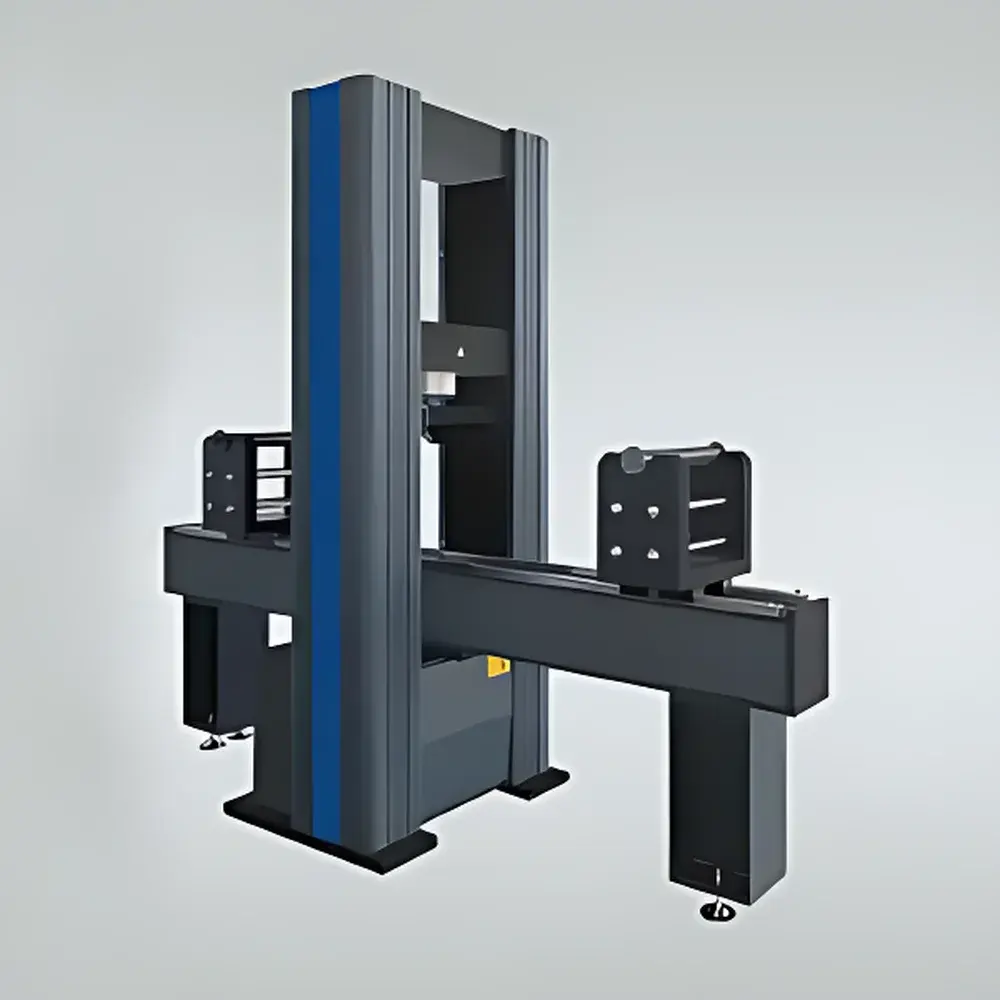
Jiubin JB Microcomputer-Controlled Disc Spring Compression Testing Machine
| Key | Max Test Force: 300 kN |
|---|---|
| Force Accuracy | ±0.5% FS |
| Measurable Force Range | 2–100% FS |
| Maximum Span | 2300 mm |
| Compression Clearance | 400 mm |
| Test Bench Length | 2800 mm |
| Overall Dimensions (W×L×H) | ≈850 × 2800 × 2300 mm |
| Approx. Weight | 1300 kg |
| Compliance | GB/T 228-2021, GB/T 7314-2005, GB/T 19844-2018, ISO 6892, ASTM E8/E9, DIN 50125 |
Overview
The Jiubin JB Microcomputer-Controlled Disc Spring Compression Testing Machine is a high-capacity, vertically oriented electromechanical testing system engineered for precise static compression characterization of conical disc springs (Belleville washers), laminated spring stacks, and other high-stiffness elastic components. It operates on the principle of controlled displacement-driven loading, where a servo-controlled actuator applies axial compressive force to the specimen while synchronized load cells and position encoders capture real-time force–displacement data. Designed for industrial R&D labs and quality assurance departments, this machine delivers traceable, repeatable mechanical performance evaluation under ambient conditions—supporting critical validation of load-deflection linearity, relaxation behavior, permanent set, and fatigue pre-conditioning protocols. Its rigid C-frame architecture and reinforced base plate ensure minimal frame deflection (<0.02% of full-scale stroke), essential for maintaining measurement integrity at loads up to 300 kN.
Key Features
- High-force capacity (300 kN) with dual-range load cell configuration enabling accurate measurement from 2% to 100% of full scale (FS), meeting ISO 7500-1 Class 0.5 requirements.
- Adjustable span fixture system accommodating disc spring stacks up to 2300 mm in effective test length, compatible with multi-diameter washer assemblies per DIN 2092 and ISO 4014 standards.
- Fixed compression clearance of 400 mm between upper compression platen and lower test table—optimized for standard disc spring geometries and stack height variations.
- Integrated RS232 serial interface compliant with ANSI/TIA-232-F, enabling bidirectional communication with external PCs for automated test sequencing, real-time data streaming, and post-test analysis using third-party software (e.g., MATLAB, Python-based custom scripts).
- Robust structural design featuring welded steel frame, hardened guide columns, and precision-ground platens—engineered for long-term dimensional stability and resistance to thermal drift during extended testing cycles.
- Microcomputer-based control unit with embedded PID loop regulation ensures smooth ramp-hold-relax profiles, programmable dwell times, and overload protection thresholds configurable via front-panel keypad or remote host command.
Sample Compatibility & Compliance
This system is validated for testing metallic disc springs manufactured from alloy steels (e.g., 60Si2MnA, 50CrV4), stainless grades (1.4310, 1.4122), and nickel-based superalloys used in aerospace actuation systems. It supports specimens conforming to EN 16983, DIN 2093, and JIS B2704 specifications—including single washers, stacked series/parallel configurations, and pre-assembled spring packs with intermediate shims. The machine satisfies metrological traceability requirements outlined in ISO/IEC 17025:2017 for testing laboratories and supports audit-ready documentation aligned with GLP and GMP environments. All firmware and calibration records adhere to NIST-traceable procedures; optional factory calibration certificates include uncertainty budgets per ISO/IEC 17025 Annex A.3.
Software & Data Management
The embedded microcontroller firmware supports ASCII-formatted data export (CSV/TXT) via RS232, including timestamped force (kN), displacement (mm), strain rate (mm/min), and event markers (yield onset, peak load, fracture detection). No proprietary software license is required—raw output files are directly importable into Excel, OriginLab, or statistical process control (SPC) platforms. For regulated environments, optional Windows-based PC software provides 21 CFR Part 11-compliant user authentication, electronic signatures, audit trail logging, and report generation templates pre-formatted to meet ASTM E2928 and ISO 14253-1 reporting conventions. All test parameters—including test speed, hold duration, and limit triggers—are stored in non-volatile memory with version-stamped firmware updates.
Applications
- Validation of load-deflection curves for automotive clutch release bearings and valve train components.
- Verification of residual stress relaxation in nuclear reactor control rod assemblies after thermal cycling.
- Quality conformance testing of railway bogie suspension springs against UIC 512 and EN 13261 requirements.
- Material qualification of high-temperature disc springs used in turbine exhaust gas recirculation (EGR) valves.
- Educational use in mechanical engineering curricula for hands-on demonstration of Hookean/nonlinear elasticity, buckling instability, and energy absorption metrics.
- Third-party certification testing per CE marking directives (PED 2014/68/EU) and ASME Section VIII Div. 1 Appendix 27.
FAQ
What standards does the JB testing machine support for disc spring evaluation?
It natively complies with GB/T 228-2021, GB/T 7314-2005, and GB/T 19844-2018, and its force and displacement metrology meets ISO 7500-1 Class 0.5 and ISO 4287 surface finish referencing requirements for test fixture interfaces.
Can the system perform cyclic compression testing?
Yes—the controller supports programmable load-controlled or displacement-controlled cycling (up to 10,000 cycles) with configurable ramp rates, dwell periods, and reversal thresholds; however, dedicated high-cycle fatigue modules require optional hydraulic actuation upgrades.
Is the 400 mm compression clearance adjustable?
No—the clearance is fixed to maintain structural rigidity and alignment repeatability; users select appropriate spacer sets or custom platens to accommodate varying specimen heights within this envelope.
Does the machine include calibration documentation?
Each unit ships with a factory calibration certificate covering load cell, encoder, and system-level verification at three points (20%, 60%, and 100% FS), traceable to CNAS-accredited national standards.
What maintenance intervals are recommended?
Lubrication of guide columns and inspection of load cell mounting bolts are advised every 500 operational hours; annual recalibration is recommended for ISO/IEC 17025-certified operations.



