
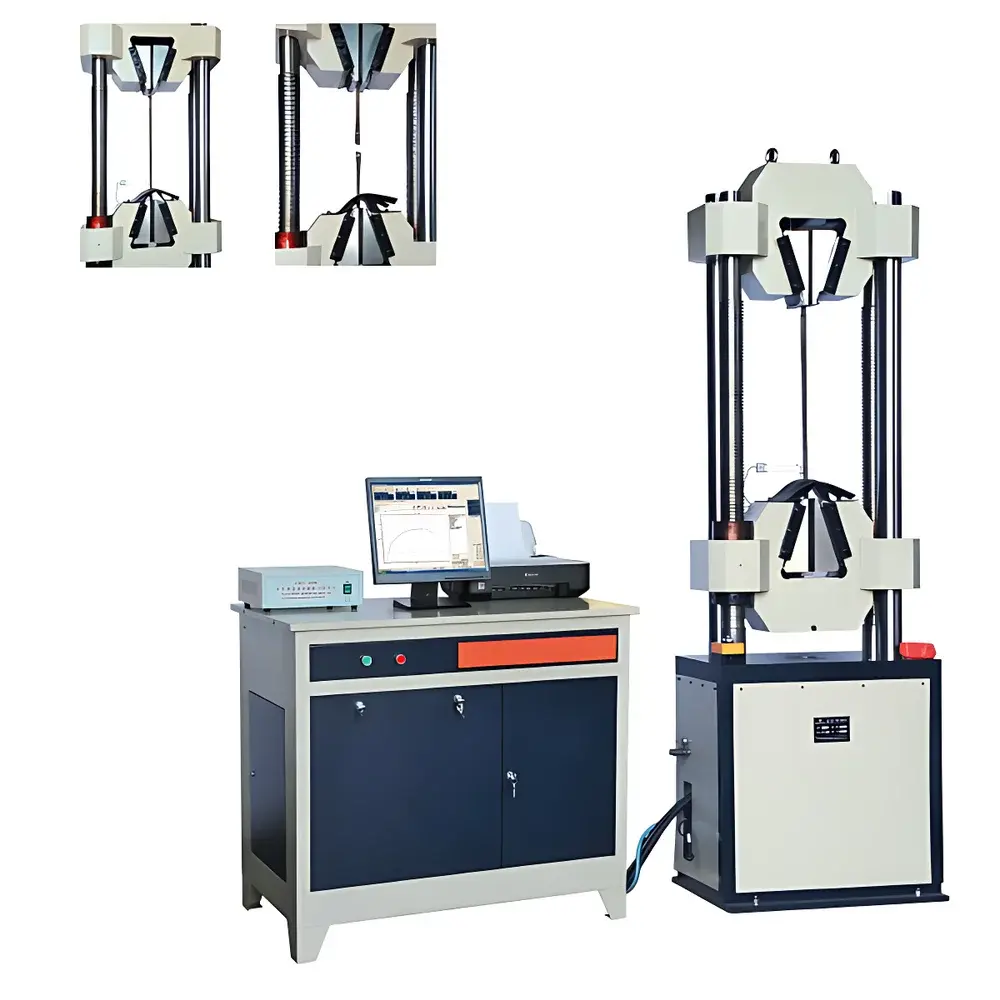
JB/GWE-1000B Screen-Displayed Hydraulic Universal Testing Machine for Prestressed Steel Strands
| Brand | Jiubin Instruments |
|---|---|
| Origin | Shanghai, China |
| Model | JB/GWE-1000B |
| Type | Hydraulic Universal Testing Machine |
| Max. Test Force | 1000 kN |
| Force Measurement Range | 50–1000 kN |
| Force Accuracy | ≤ ±1% of reading |
| Force Resolution | 0.01 kN |
| Displacement Resolution | 0.01 mm |
| Deformation Measurement Accuracy | 0.01 mm |
| Tensile Test Space | 1000 mm |
| Compression Space | 600 mm |
| Piston Stroke | 150 mm |
| Clamp Jaw Capacity (Round Specimen) | Φ15.20 mm |
| Piston Speed | 50 mm/min |
| Clamping Method | Automatic Hydraulic Clamping |
| Host Dimensions (W×D×H) | 890×660×2500 mm |
| Control Console Dimensions (W×D×H) | 1000×700×1400 mm |
Overview
The JB/GWE-1000B Screen-Displayed Hydraulic Universal Testing Machine is a dedicated high-capacity mechanical testing system engineered for the precise tensile evaluation of prestressed steel strands used in post-tensioned concrete structures, bridge cables, and precast infrastructure applications. Designed in accordance with core principles of hydraulic load application and closed-loop servo-controlled displacement actuation, the system delivers stable, repeatable force generation across its full 1000 kN capacity range. Its structural architecture—featuring a bottom-mounted oil cylinder, rigid four-column frame, and reinforced loading train—ensures minimal deflection under maximum load, thereby preserving measurement integrity during high-force elongation and yield characterization. The machine complies with fundamental mechanical testing requirements outlined in ISO 6892-1 (Metallic materials — Tensile testing — Part 1: Method of test at room temperature), ASTM A416/A416M (Standard Specification for Steel Strand, Uncoated Seven-Wire for Prestressed Concrete), and GB/T 5224 (Chinese national standard for prestressed concrete steel strands). It is not intended for dynamic or fatigue testing, nor for high-temperature or environmental chamber integration.
Key Features
- Hydraulic actuation system with automatic pressure-controlled clamping, eliminating manual tightening variability and ensuring uniform jaw contact pressure on high-strength steel strand specimens.
- Dedicated extended-length jaw sets optimized for Φ15.20 mm seven-wire prestressed strands, engineered to promote fracture within the gauge length—critical for valid measurement of ultimate tensile strength (Rm) and fracture elongation (A).
- Integrated high-resolution measurement subsystems: 0.01 kN force resolution via calibrated load cell (Ningbo Zhenhai), 0.01 mm displacement resolution via optical encoder, and 0.01 mm deformation accuracy via YYU-15/200 clip-on extensometer (Beijing Iron and Steel Research Institute).
- Real-time screen-display interface with dual-channel data acquisition—simultaneously capturing load, displacement, and strain—enabling synchronized generation of six standardized curve types: Force–Displacement, Force–Deformation, Stress–Displacement, Stress–Deformation, Force–Time, and Deformation–Time.
- Modular software architecture supporting user-defined test procedures, editable ASTM/ISO/GB-compliant test steps, hierarchical user permissions (administrator & operator levels), and built-in self-diagnostic routines for hardware status verification.
Sample Compatibility & Compliance
The JB/GWE-1000B is validated for static uniaxial tensile testing of cold-drawn, stress-relieved, or low-relaxation 7-wire steel strands conforming to nominal diameters of 15.20 mm. Optional jaw inserts accommodate alternative strand geometries (e.g., 12.7 mm, 15.7 mm) upon request. Compression testing is supported for cylindrical concrete or metal specimens up to Φ160 mm using standard platens. All force and displacement measurements meet Class 1 accuracy per ISO 7500-1:2018 (Static uniaxial testing machines — Verification of the force measuring system). While the system does not include FDA 21 CFR Part 11-compliant audit trails or electronic signature modules by default, its software export functionality supports CSV and Excel-based data archival compatible with GLP/GMP documentation workflows when deployed in regulated QA/QC environments.
Software & Data Management
The embedded Windows-based control software provides native Excel-reporting capability: users define custom templates for result output—including specimen ID, batch number, test date, Rm, Rp0.2, E-modulus, Agt, and A80—without requiring third-party add-ins. Raw data streams are saved in binary format with timestamped metadata; ASCII exports support traceability in LIMS integration. Software permits multi-specimen batch processing, statistical summarization (mean, SD, CV%), and comparative overlay of up to eight curves per plot. All calibration coefficients, system offsets, and user-defined standards are stored in encrypted configuration files with version logging. Firmware updates are delivered via USB media; no cloud connectivity or remote telemetry is implemented.
Applications
This system serves as a primary verification tool in quality assurance laboratories of prestressed concrete product manufacturers, bridge construction contractors, and national highway material testing centers. Typical use cases include: verification of tensile strength compliance for ASTM A416 Grade 270 strands; determination of non-proportional extension strength (Rp0.2) in accordance with ISO 6892-1 Annex G; elastic modulus derivation from linear-elastic region slope analysis; and assessment of total elongation at maximum force (Agt) for ductility validation. It is routinely employed during factory production certification, third-party type testing, and routine batch release testing per EN 10080 or JTG/T F81-01.
FAQ
Is the JB/GWE-1000B suitable for testing stranded cables beyond 15.20 mm diameter?
Yes—custom jaw inserts for 12.7 mm, 15.7 mm, and 17.8 mm strand diameters are available as optional accessories; contact technical support for mechanical compatibility verification.
Does the system support automatic yield point detection per ASTM E8/E8M?
The software includes programmable offset methods (0.2% strain offset) and gradient-based upper/lower yield identification algorithms, configurable per test standard.
Can test data be exported directly to a laboratory information management system (LIMS)?
Yes—CSV and XLSX exports contain all raw and processed parameters with ISO 8601 timestamps; schema mapping is performed externally by the LIMS vendor.
What maintenance intervals are recommended for hydraulic components?
Oil filtration and system pressure calibration are advised every 12 months or after 2,000 test cycles; hydraulic oil replacement is required every 24 months under continuous operation.
Is third-party calibration certification included with delivery?
A factory-issued calibration certificate traceable to CNAS-accredited reference standards is provided; on-site ISO/IEC 17025 calibration by an accredited body may be arranged separately.



