
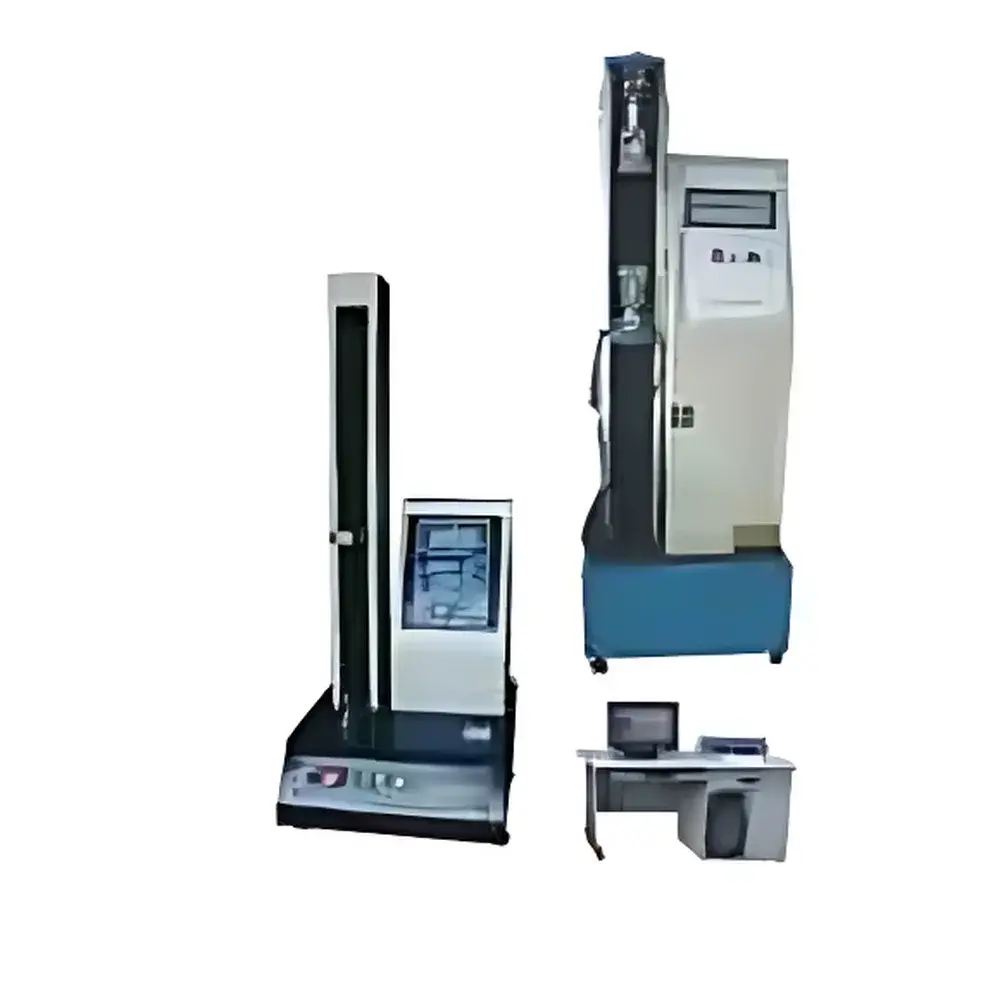
Jiubin JB-126A Universal Testing Machine (UTM) – Electromechanical Tensile, Compression & Flexural Tester
| Brand | Jiubin Instruments |
|---|---|
| Origin | Taiwan |
| Manufacturer Type | Authorized Distributor |
| Instrument Type | Electromechanical Universal Testing Machine |
| Model | JB-126A |
| Load Capacity | 0–200 kg (user-selectable) |
| Load Cell | High-precision U.S.-made load cell |
| Load Accuracy | ±0.5% of full scale |
| Effective Test Width | 380 mm |
| Max. Travel Distance | 1000 mm |
| Drive System | Japanese servo motor |
| Mechanical Transmission | Taiwan-made precision ball screw |
| Test Speed Range | 0.001–500 mm/min (infinitely variable, constant-rate mode) |
| Displacement Resolution | 1/200,000 |
| Displacement Accuracy | ±0.005% |
| Units Supported | g, kg, N, kN, lb |
| Safety Features | Upper/lower mechanical limit switches, emergency stop button |
| Display | Dual-mode — embedded microcomputer + PC interface |
| Optional Accessories | PC workstation, thermal/inkjet printer, extensometer (two-point), proprietary testing software |
| Power Supply | 220 V AC, 50 Hz |
| Net Weight | 160 kg |
| Dimensions (W×D×H) | 450 × 450 × 900 mm |
Overview
The Jiubin JB-126A Universal Testing Machine is an electromechanical static materials tester engineered for precision mechanical property evaluation under controlled uniaxial loading conditions. Based on the fundamental principles of Hooke’s law and standardized force-displacement transduction, it delivers repeatable tensile, compression, flexural (three-point bending), and shear measurements across a broad spectrum of solid materials—including metals, polymers, elastomers, textiles, composites, leather, footwear components, electrical insulation, and wire-and-cable assemblies. Its modular architecture integrates a high-stiffness frame, a calibrated load cell, a closed-loop servo-controlled actuation system, and synchronized displacement sensing to ensure traceable mechanical data acquisition in accordance with ASTM E4, ASTM E8/E8M, ISO 6892-1, ISO 7500-1, and GB/T 228.1 standards. Designed as a floor-standing unit, the JB-126A prioritizes structural rigidity, operator safety, and long-term metrological stability—making it suitable for routine QC labs, R&D centers, and third-party certification facilities operating under GLP or ISO/IEC 17025 frameworks.
Key Features
- High-fidelity load measurement using a U.S.-sourced, temperature-compensated load cell with ±0.5% full-scale accuracy and 1/200,000 internal resolution.
- Precision motion control via a Japanese servo motor coupled to a Taiwan-manufactured ground ball screw, enabling smooth, backlash-free displacement at speeds from 0.001 to 500 mm/min.
- Dual-display architecture: real-time test monitoring via embedded microcontroller interface and comprehensive post-processing via Windows-based software with curve overlay, statistical batch analysis, and customizable reporting.
- Modular fixture compatibility—standard clamping configurations support flat tensile specimens, cylindrical compression samples, and three-point bending fixtures; custom grips (e.g., pneumatic, wedge, peel, shear) are available upon specification.
- Integrated safety subsystem including dual mechanical end-limit switches, redundant emergency stop circuitry, and programmable overload protection to prevent over-travel or over-force events.
- Compliance-ready data handling: audit trail logging, user-access levels, electronic signature support, and export formats compatible with LIMS integration (CSV, XML, PDF).
Sample Compatibility & Compliance
The JB-126A accommodates specimens up to 380 mm wide and 1000 mm in active travel length, supporting standardized test geometries per ASTM D638 (plastics tensile), ASTM D790 (flexural), ASTM D3410 (composite compression), ISO 178 (rigidity), and ISO 1133 (melt flow index auxiliary setup). Its mechanical design conforms to ISO 7500-1 Class 1 accuracy requirements for force measurement systems. The system supports calibration traceability to national metrology institutes (NMI) through documented uncertainty budgets and periodic verification protocols. All software modules comply with FDA 21 CFR Part 11 requirements for electronic records and signatures when configured with password-protected user roles and immutable audit logs.
Software & Data Management
The proprietary testing software provides full lifecycle test management—from method definition (predefined templates for tensile, compression, bend, and shear) to real-time curve visualization, automatic yield point detection (0.2% offset method), modulus calculation (tangent/secant), and fracture energy integration. Raw data files include timestamped metadata (operator ID, environmental conditions, calibration status). Reporting supports multi-language output, configurable headers/footers, and automated pass/fail flagging against user-defined limits. Data export options include Excel-compatible CSV, vector-based PDF plots, and structured XML for enterprise-level quality databases. Optional extensions enable SPC charting, Weibull reliability analysis, and integration with MES platforms via OPC UA or RESTful API.
Applications
Typical use cases include: tensile strength and elongation-at-break assessment of thermoplastic films and molded parts; compressive yield stress determination of foams and elastomeric gaskets; three-point flexural modulus and deflection testing of PCB substrates and fiber-reinforced laminates; peel adhesion quantification of pressure-sensitive tapes and medical device laminates; and shear strength validation of riveted joints and adhesive bonds. In textile QA, the system measures breaking load of yarns and seam slippage resistance; in footwear labs, it evaluates sole bonding integrity and upper material tear resistance per ISO 20344.
FAQ
What standards does the JB-126A comply with for force calibration?
It meets ISO 7500-1 Class 1 and ASTM E4 requirements, with optional NIST-traceable calibration certificates available.
Can the system perform cyclic or fatigue testing?
No—the JB-126A is designed exclusively for static monotonic tests; dynamic or high-cycle fatigue requires a dedicated servo-hydraulic or electrodynamic system.
Is the software validated for regulated environments?
Yes—when deployed with audit trail, electronic signature, and role-based access controls enabled, it satisfies 21 CFR Part 11 and EU Annex 11 expectations.
What is the recommended recalibration interval?
Annual calibration is advised; however, frequency may increase based on usage intensity, environmental conditions, or internal quality policy.
Does the machine support extensometry for strain measurement?
Yes—optional two-point clip-on extensometers (with analog or digital output) can be integrated for direct strain acquisition independent of crosshead displacement.



