
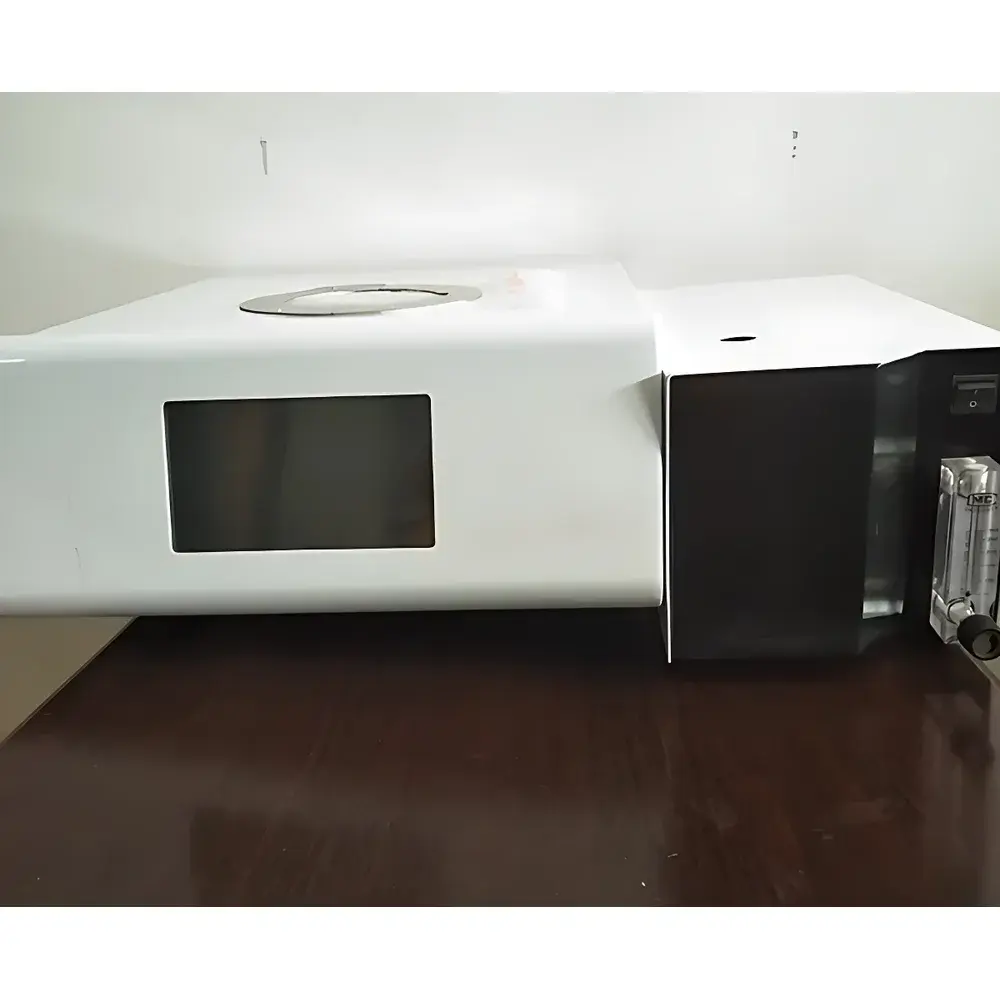
Jiubin JB-STA-200 Simultaneous Thermal Analyzer (STA)
| Brand | Jiubin |
|---|---|
| Origin | Shanghai, China |
| Model | JB-STA-200 |
| Heating Rate | 1–80 °C/min |
| Temperature Range | Ambient to 1150 °C (extendable to 1350 °C) |
| Temperature Stability | ±0.1 °C |
| Atmosphere Options | Inert, Oxidizing, Reducing |
| Sample Capacity | Determined by Crucible Size |
| Vendor Type | Authorized Distributor |
Overview
The Jiubin JB-STA-200 Simultaneous Thermal Analyzer is an integrated thermoanalytical instrument engineered for concurrent measurement of thermogravimetric (TGA) and differential scanning calorimetry (DSC) signals under precisely controlled temperature and atmospheric conditions. Based on the principle of simultaneous dual-sensor detection—employing a high-stability microbalance for mass change quantification and a symmetric heat-flux DSC sensor for enthalpy transition analysis—the JB-STA-200 enables real-time correlation of weight loss, decomposition onset, phase transitions, oxidation/reduction kinetics, and specific heat capacity changes within a single experiment. Its operational range spans from ambient temperature up to 1150 °C (optionally extended to 1350 °C), with programmable heating rates from 1 to 80 °C/min and thermal stability maintained within ±0.1 °C over extended dwell periods. Designed for rigorous laboratory environments, the system supports atmosphere flexibility—including inert (N₂, Ar), oxidizing (air, O₂), and reducing (H₂, CO, forming gas) gases—under both static and dynamic flow configurations, ensuring compatibility with ISO 11358, ASTM E1131, and ASTM E1641 methodologies.
Key Features
- Simultaneous TGA-DSC measurement architecture with independent signal acquisition channels for high-fidelity data deconvolution
- High-resolution microbalance with sub-microgram mass sensitivity and active buoyancy compensation
- Modular furnace design enabling rapid thermal equilibration and uniform temperature distribution across sample zone
- Dual-gas inlet system with mass flow controllers (MFCs) for precise, reproducible atmosphere switching and blending
- Robust ceramic sensor platform resistant to thermal shock and chemical corrosion in aggressive atmospheres
- Integrated cooling module supporting rapid quenching and sub-ambient baseline stabilization (optional)
Sample Compatibility & Compliance
The JB-STA-200 accommodates standard alumina, platinum, and graphite crucibles (including hermetic and vented variants), supporting sample masses ranging from 0.1 mg to 1000 mg depending on crucible geometry and application requirements. It complies with key regulatory frameworks governing materials characterization in R&D and quality control settings: data integrity aligns with ALCOA+ principles; audit trail functionality satisfies FDA 21 CFR Part 11 requirements when paired with validated software; and thermal calibration protocols conform to ISO/IEC 17025–accredited practices. The instrument meets electromagnetic compatibility (EMC) standards per IEC 61326-1 and safety requirements under IEC 61010-1, making it suitable for GLP/GMP-compliant laboratories in pharmaceuticals, advanced ceramics, battery materials, and polymer development.
Software & Data Management
Controlled via Jiubin’s proprietary STAControl™ software suite (Windows-based, English-language interface), the JB-STA-200 provides full experimental setup, real-time visualization, and post-run analysis including derivative thermogravimetry (DTG), peak deconvolution, kinetic modeling (e.g., Kissinger, Ozawa-Flynn-Wall), and multi-curve comparison. All raw and processed data are stored in vendor-neutral ASCII and universal .tdf formats, facilitating third-party integration with MATLAB, OriginLab, or Python-based analytical pipelines. Audit trails record user actions, parameter modifications, calibration events, and instrument status logs with time-stamped, non-erasable entries—critical for regulatory submissions and internal QA documentation.
Applications
- Decomposition behavior and residue quantification of polymers, composites, and pharmaceutical excipients
- Oxidation onset temperature and activation energy determination for metal alloys and battery cathode materials
- Hydration/dehydration kinetics in clays, zeolites, and MOFs
- Thermal stability assessment of catalysts under simulated reaction atmospheres
- Phase transition mapping (glass transition, crystallization, melting) coupled with mass loss events
- Residue ash content analysis per ASTM D3174 and ISO 1171 for coal, biomass, and carbonaceous feedstocks
FAQ
What is the maximum recommended sample mass for quantitative TGA-DSC coupling?
For optimal signal-to-noise ratio and thermal homogeneity, we recommend ≤50 mg for most solid powders and ≤10 mg for highly reactive or volatile samples.
Can the JB-STA-200 perform evolved gas analysis (EGA) integration?
Yes—when equipped with optional FTIR or QMS coupling ports, the system supports hyphenated EGA-STA workflows with synchronized gas-phase spectral acquisition.
Is calibration traceable to NIST standards?
Yes—temperature calibration uses certified reference materials (e.g., Ni, In, Sn, Zn, Al) with NIST-traceable certificates; mass calibration employs Class S1 weights accredited to ISO/IEC 17025.
Does the system support automated sample changers?
An optional 16-position auto-sampler is available, compatible with standard crucible types and fully integrated into STAControl™ scheduling logic.
What maintenance intervals are recommended for long-term operational reliability?
We advise quarterly inspection of furnace insulation integrity, annual recalibration of thermocouple and balance subsystems, and routine cleaning of gas lines and crucible holder contacts per the maintenance logbook included with shipment.



