
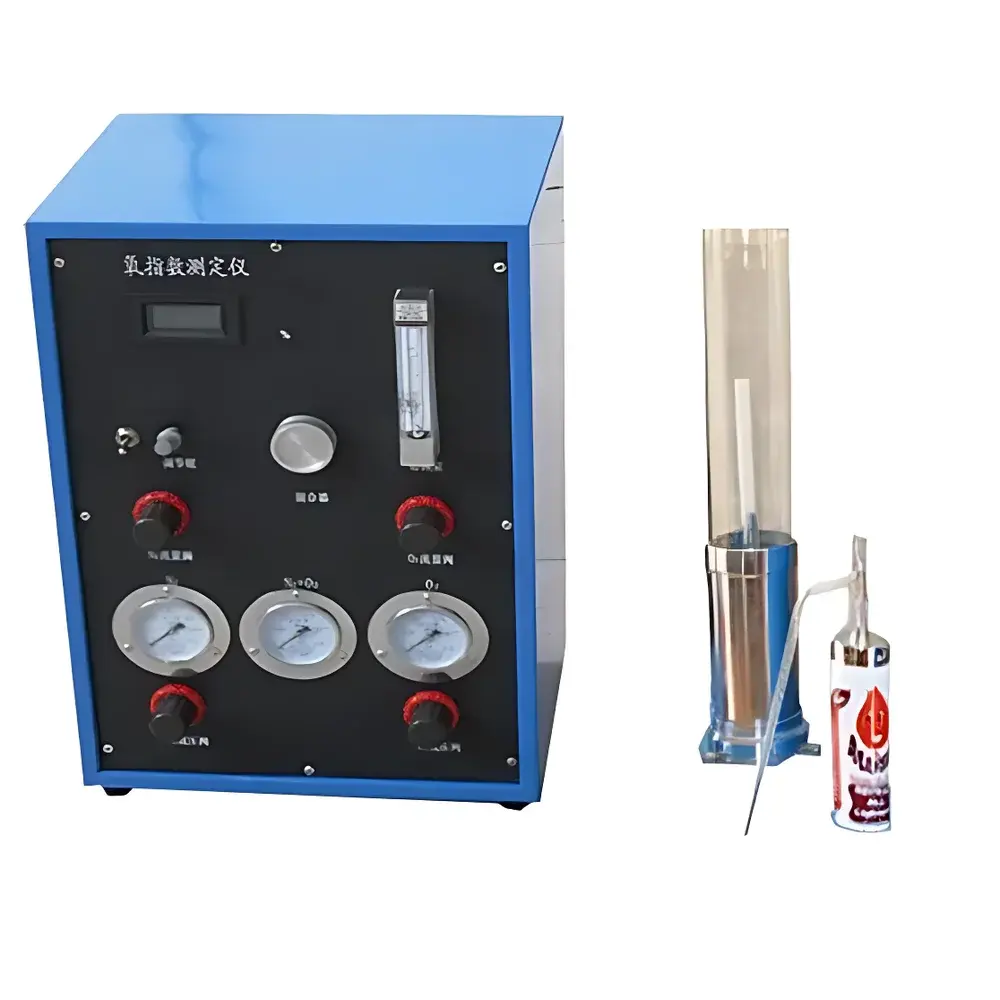
Jiubin Instruments JB-3 Digital Oxygen Index Tester
| Brand | Jiubin Instruments |
|---|---|
| Origin | Shanghai, China |
| Model | JB-3 |
| Oxygen Measurement Range | 0–100% O₂ |
| Resolution | 0.1% O₂ |
| Accuracy | ±0.4% O₂ |
| Response Time | <10 s |
| Display Precision | 0.1% |
| Operating Temperature | 10–35 °C |
| Relative Humidity | 45–75% RH |
| Power Supply | 220 V ±15%, 50 Hz, 100 W |
| Gas Supply | Industrial-grade oxygen (GB/T 3863) and nitrogen (GB/T 3864) |
| Input Pressure | 0.25 MPa |
| Working Pressure | 0.1 MPa |
| Sample Types | Self-supporting solid specimens (e.g., plastics, rubber, textiles, films, cables, wood) |
Overview
The Jiubin Instruments JB-3 Digital Oxygen Index Tester is a precision benchtop instrument engineered for the quantitative determination of the Limiting Oxygen Index (LOI) of solid polymeric materials according to internationally harmonized test standards—including GB/T 2406.2–2009 (equivalent to ISO 4589-2), GB/T 5454–1997 (for textiles), ASTM D2863, and UL 94 Annex A. LOI is defined as the minimum volume fraction of oxygen in an oxygen–nitrogen mixture, expressed as a percentage, required to support candle-like combustion of a vertically oriented specimen under specified laboratory conditions. This value serves as a fundamental metric for comparative flammability assessment and material classification in fire safety engineering, quality control, and regulatory compliance workflows.
Key Features
- Digital microprocessor-controlled gas blending system with dual mass flow regulation for precise O₂/N₂ mixing across the full 0–100% O₂ range
- High-stability electrochemical oxygen sensor with <10-second response time and ±0.4% O₂ accuracy at 23 °C, calibrated traceable to national metrological standards
- Integrated digital display panel showing real-time O₂ concentration, flow rate, and elapsed test time—resolution 0.1% O₂
- Modular vertical combustion chamber with standardized 100 mm × 10 mm × 4 mm glass tube assembly, compliant with GB/T 2406 geometry requirements
- Self-supporting specimen holder with adjustable height and flame-positioning guide, enabling repeatable ignition and burn-length measurement
- Robust stainless-steel and borosilicate glass construction; front-access design for rapid sample insertion and residue removal
- Low-power operation (100 W) and built-in pressure regulation (0.1 MPa working pressure) ensuring safe, stable gas delivery using industrial-grade O₂ (GB/T 3863) and N₂ (GB/T 3864)
Sample Compatibility & Compliance
The JB-3 supports standardized testing of self-supporting rigid or semi-rigid materials up to 150 mm in length, including thermoplastics, thermosets, elastomers, textile fabrics, insulated wires and cables, foams, laminates, and thin wooden substrates. Specimen preparation follows strict dimensional tolerances per GB/T 2406.2: thickness 4.0 ± 0.2 mm, width 10.0 ± 0.2 mm, length ≥ 150 mm. All operational parameters—including ambient temperature (10–35 °C), relative humidity (45–75% RH), and atmospheric pressure—are monitored and documented to satisfy GLP-aligned test reporting requirements. The instrument’s measurement methodology is directly referenced in China’s mandatory CCC certification protocols for wire & cable flame retardancy and aligns with IEC 60332-1-2 pre-screening criteria.
Software & Data Management
The JB-3 operates as a standalone hardware platform without embedded software or PC connectivity. All measurements are recorded manually in accordance with standard test report templates (e.g., GB/T 2406.2 Annex B). For laboratories requiring audit-trail capability, users may integrate external digital loggers or LIMS-compatible data entry systems. The instrument’s calibration certificate includes sensor linearity verification across five points (10%, 30%, 50%, 70%, 90% O₂), with traceability to CNAS-accredited reference gas standards. Routine user verification—performed before each test session using certified 21% O₂ air—ensures ongoing metrological integrity under ISO/IEC 17025 Clause 6.5.2.
Applications
- QC/QA screening of flame-retardant additives in PVC, PE, PP, and PET compounds used in building wiring and transportation interiors
- Comparative LOI benchmarking during polymer formulation development for UL 94 V-0/V-1/V-2 qualification pathways
- Regulatory submission support for CCC, CE (EN 13501-1), and RoHS-compliant material declarations
- Research into char-forming mechanisms and synergistic effects of phosphorus–halogen flame retardants
- Pre-testing evaluation prior to full-scale vertical burn (UL 94) or horizontal burn (ASTM D635) certification campaigns
- Technical due diligence for procurement of low-smoke zero-halogen (LSZH) cable jackets and insulation materials
FAQ
What standards does the JB-3 comply with?
It is fully configured to execute GB/T 2406.2–2009, GB/T 5454–1997, ASTM D2863–22, and ISO 4589-2:2017 test protocols.
Can the JB-3 test non-self-supporting materials such as foams or films?
No—the instrument is designed exclusively for self-supporting specimens per GB/T 2406.2. Non-rigid samples require auxiliary support fixtures not supplied with the base configuration.
Is calibration gas included with shipment?
No. Users must procure certified reference gases (e.g., 21.0% O₂ in N₂, ±0.1% uncertainty) from accredited suppliers for initial verification and periodic recalibration.
What maintenance is required for long-term accuracy?
The electrochemical O₂ sensor has a typical service life of 24 months under continuous use; replacement is recommended annually for QC-critical environments. Glass tubes and metal mesh components should be inspected for thermal degradation before each test series.
Does the JB-3 meet FDA 21 CFR Part 11 requirements?
As a non-networked, non-auditable analog-digital hybrid instrument, it does not implement electronic signatures or audit trails. Data recording remains manual, consistent with traditional LOI testing practice in ISO 17025-accredited labs.



