
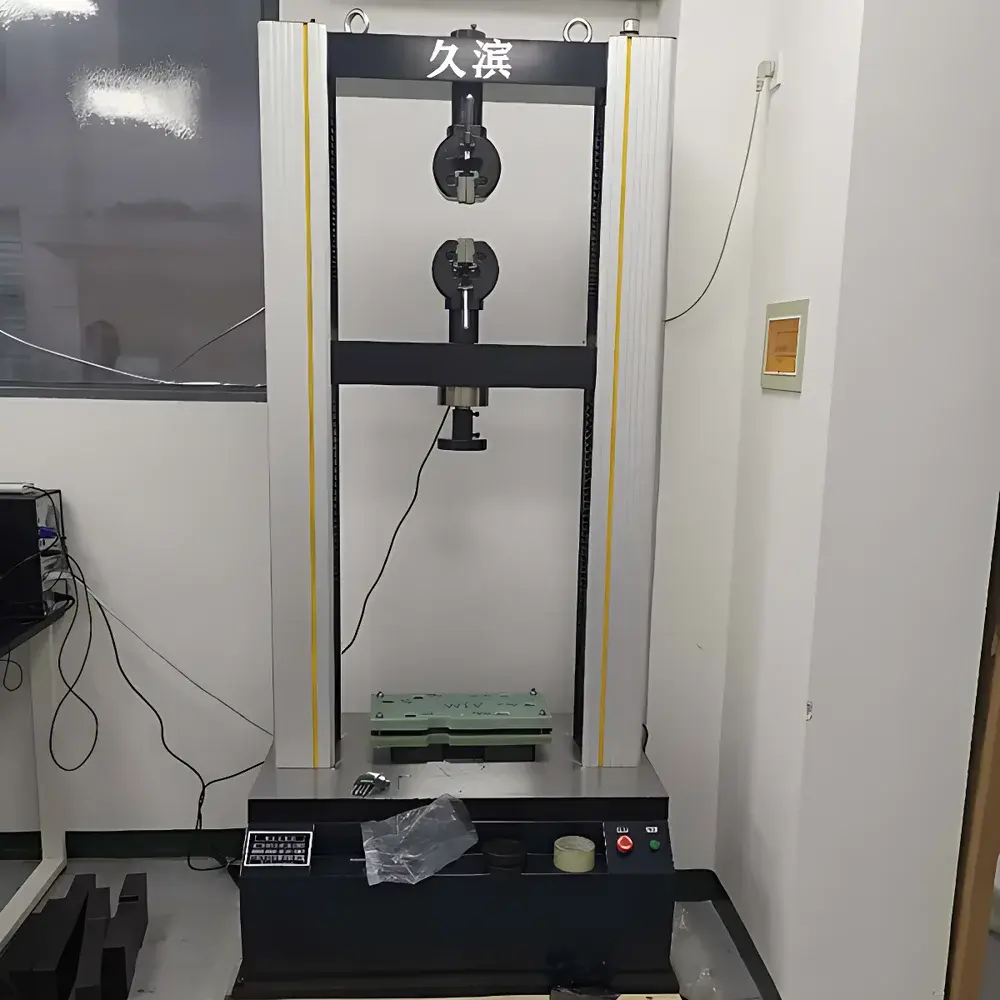
Jiubin JB-119 Series Universal Electromechanical Tensile Testing Machine
| Brand | Jiubin Instruments |
|---|---|
| Origin | Shanghai, China |
| Model | JB-119A / JB-119B |
| Maximum Test Load | Customizable up to 50 kN |
| Load Cell Accuracy | ±0.5% of full scale |
| Effective Test Width | 380 mm |
| Max. Travel Distance | 1000 mm |
| Test Speed Range | 0.001–500 mm/min (infinitely variable) |
| Displacement Resolution | 1/200,000 full scale |
| Displacement Accuracy | ±0.005% of reading |
| Control System | Servo motor (Japan-made) + AC motor (Taiwan-made) |
| Mechanical Drive | Precision ball screw (Taiwan-made) + high-strength zero-backlash lead screw (Korea-made) |
| Safety Features | Upper/lower mechanical limits, emergency stop button |
| Power Supply | 220 V / 380 V, 50 Hz |
| Net Weight | 1080–1180 kg |
| Dimensions (W×D×H) | 1280 × 950 × 1800 mm |
| Data Output | PC-based display + microcomputer display |
| Optional Accessories | PC host, thermal/inkjet printer, extensometer, proprietary test software |
Overview
The Jiubin JB-119 Series Universal Electromechanical Tensile Testing Machine is a modular, servo-controlled static materials testing system engineered for precision mechanical property evaluation across R&D, quality control, and production environments. Based on ASTM E4, ISO 7500-1, and GB/T 16491 standards, it applies controlled uniaxial force to specimens while measuring load, displacement, and strain in real time. Its electromechanical architecture—comprising high-fidelity load cells (U.S.-sourced), dual-stage motion control (servo + AC drive), and dual-screw transmission—ensures repeatable force application and minimal hysteresis. Designed as a floor-standing unit with industrial-grade structural rigidity, the JB-119 accommodates both standard and non-standard test configurations, supporting tensile, compression, flexural, peel, tear, and shear evaluations per ASTM D638, D790, D903, D1876, and ISO 527, 178, 8510 protocols.
Key Features
- Modular load capacity configuration: Standard models support up to 50 kN; fully customizable load frames available upon request for higher-force applications.
- Dual-resolution motion control: Independent speed selection modes—including ultra-low-speed creep testing (0.001 mm/min) and high-speed rupture analysis (500 mm/min)—with closed-loop feedback ensuring velocity stability within ±0.2%.
- Multi-source precision mechanics: Taiwan-sourced ground ball screws and Korea-sourced zero-backlash lead screws minimize axial play and ensure long-term dimensional repeatability over >500,000 cycles.
- Redundant safety architecture: Dual mechanical end stops, hardware-level emergency cutoff, and software-enforced overload protection prevent over-travel and specimen ejection.
- Hybrid display interface: Simultaneous real-time monitoring via embedded microcomputer (LCD panel) and Windows-based host PC—enabling offline calibration verification and on-the-fly parameter adjustment without interrupting active tests.
- High-fidelity signal acquisition: 200,000-count A/D resolution, 0.5% load cell accuracy (per ISO 376 Class 0.5), and sub-micron displacement detection capability support GLP-compliant data integrity.
Sample Compatibility & Compliance
The JB-119 accommodates diverse material geometries—from thin polymer films (≥0.05 mm thick) and textile yarns to metallic rods (≤25 mm diameter) and composite laminates. Standardized grips include wedge-action tensile jaws, compression platens, three-point bend fixtures, and pneumatic peel clamps; custom fixtures (e.g., wire rope grips, medical suture holders) are fabricated per ISO 11472 or ASTM F2193 specifications. All mechanical components comply with CE Machinery Directive 2006/42/EC and RoHS 2011/65/EU. Software output meets FDA 21 CFR Part 11 requirements for electronic records and signatures when configured with audit trail, user authentication, and data encryption modules.
Software & Data Management
The proprietary Jiubin TestSuite v4.2 software provides ISO 17025-aligned test method templates, automated curve fitting (Young’s modulus, yield point, elongation at break), and statistical batch reporting (X-bar/R charts, Cp/Cpk). Raw data exports in CSV, XML, and PDF formats preserve metadata (operator ID, calibration date, environmental conditions). Multi-user role management supports administrator, technician, and reviewer permissions. Audit logs record all parameter changes, test starts/stops, and report modifications—traceable to individual login credentials and timestamped to the millisecond. Integration with LIMS platforms is supported via OPC UA and RESTful API interfaces.
Applications
- Metals & Alloys: Tensile strength, proof stress (0.2% offset), reduction of area, and fracture toughness assessment per ASTM E8/E21.
- Polymers & Elastomers: Stress–strain profiling, creep compliance (ISO 899-1), and environmental stress cracking resistance (ASTM D1693).
- Textiles & Nonwovens: Burst strength (ASTM D3786), seam slippage (ASTM D434), and loop pile pull (ASTM D6828).
- Electrical Components: Wire bond pull strength (JEDEC JESD22-B108), terminal crimp validation (USCAR-21), and insulation compression set (UL 1581).
- Biomedical Materials: Suture tensile performance (ISO 10555-1), hydrogel swelling modulus, and orthopedic implant fixation testing (ISO 7206-4).
FAQ
Does the JB-119 support ASTM E23 standard impact testing?
No—this is a quasi-static electromechanical tester optimized for tension, compression, and flexure. Impact testing requires pendulum or drop-weight systems (e.g., Charpy/Izod configurations).
Can the system be calibrated in-house using NIST-traceable standards?
Yes—load cell calibration is performed using certified deadweight standards (Class E2, ±0.01% uncertainty); displacement verification uses laser interferometry. Calibration certificates include uncertainty budgets per ISO/IEC 17025.
Is third-party ISO 17025 accreditation available for factory calibration?
Yes—Jiubin partners with CNAS-accredited labs in Shanghai and Singapore to provide accredited calibration reports with full measurement uncertainty statements.
What is the maximum specimen height accommodated in compression mode?
With standard platens, the usable compression height is 950 mm; extended crosshead travel options increase this to 1200 mm upon request.
Does the software support multi-curve overlay for comparative analysis?
Yes—up to 32 test curves can be overlaid with synchronized X/Y scaling, statistical deviation bands, and derivative plots (dF/dx, d²F/dx²) for failure onset detection.



