
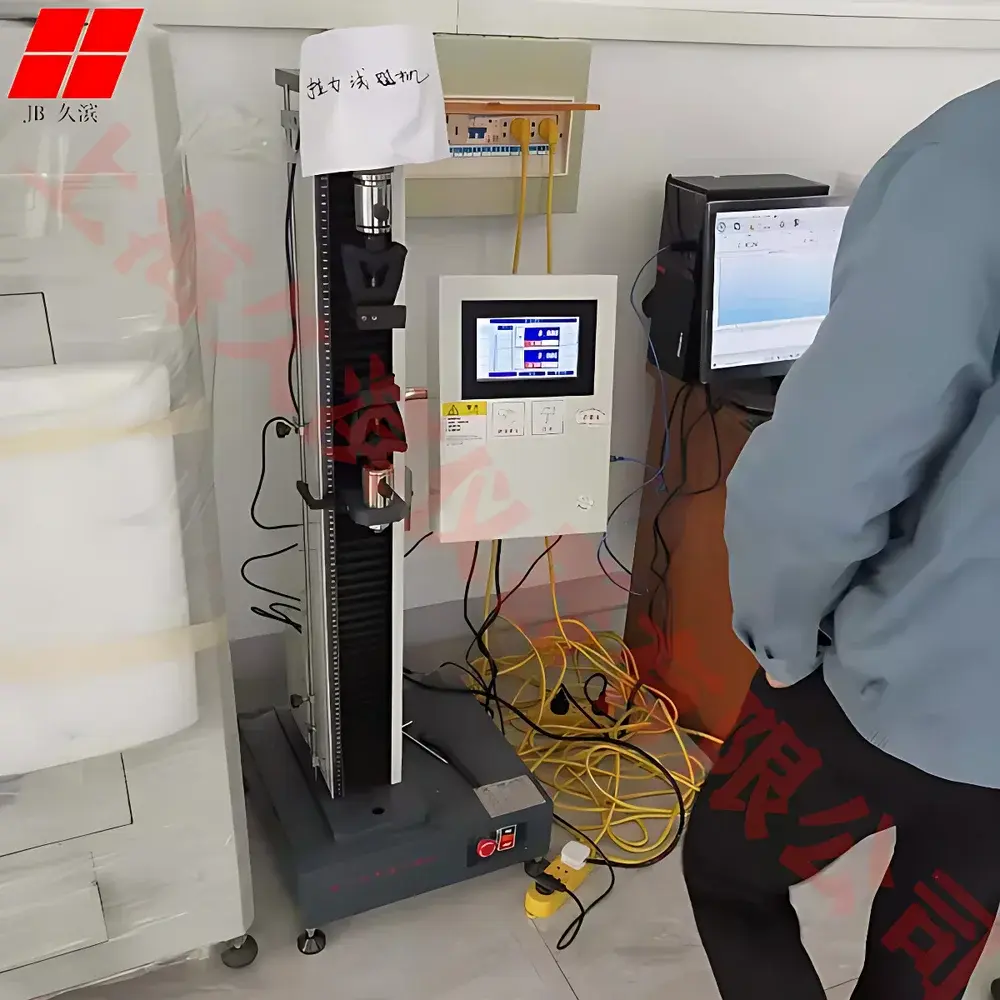
JB–117A Wire Winding Tester (Jiubin Instruments)
| Brand | Jiubin Instruments |
|---|---|
| Origin | Shanghai, China |
| Model | JB–117A |
| Type | Electronic Universal Testing Machine |
| Category | Physical Property Testing Instrument |
| Application Focus | Tensile Strength, Winding Uniformity, and Mechanical Integrity Assessment of Filamentous Materials (e.g., Fishing Line, Copper Wire, Silk Thread) |
| Compliance Context | Designed for laboratory- and QC-lab–based mechanical characterization per ISO 204, ASTM D2256, and GB/T 228.1–2021 frameworks |
Overview
The JB–117A Wire Winding Tester is an electronically controlled universal testing instrument engineered for the precise mechanical evaluation of slender, high-aspect-ratio filamentous materials—including monofilament fishing line, annealed copper wire, synthetic textile thread, and natural silk. Unlike general-purpose tensile testers, the JB–117A integrates a dedicated winding module with programmable angular displacement control, enabling standardized assessment of winding behavior under defined torque, tension, and rotational speed profiles. Its measurement architecture conforms to fundamental principles of axial force transduction and angular kinematic synchronization, supporting both static winding integrity tests (e.g., coil formation stability, layer uniformity) and dynamic winding fatigue cycles. The system operates within a calibrated force range typical of sub-kN electronic UTM platforms and is optimized for specimens with diameters between 0.05 mm and 1.2 mm—covering common industrial wire gauges and specialty filaments used in biomedical sutures, microelectronics interconnects, and precision textile manufacturing.
Key Features
- Programmable winding axis with adjustable rotational speed (0.1–30 rpm), torque limit (0.01–5 N·m), and turn count precision (±1 revolution)
- Integrated load cell with real-time tension monitoring (range: 0.1–500 N; resolution: 0.01 N) synchronized to angular position feedback
- Dual-mode operation: manual jog control for setup verification and automated sequence execution with pre-defined winding protocols
- Modular specimen holder accommodating spool-based, reel-mounted, or free-hanging configurations with quick-release collet interface
- Robust aluminum alloy frame with vibration-damped base plate, ensuring mechanical stability during high-cycle winding tests
- Compliance-ready firmware architecture supporting audit trails, user-level access control, and timestamped test log export (CSV/Excel)
Sample Compatibility & Compliance
The JB–117A is validated for use with non-ferrous metallic wires (e.g., OFHC copper, phosphor bronze), polymer monofilaments (nylon, fluorocarbon, PE), natural fibers (silk, gut), and hybrid composite threads. Specimen preparation follows ISO 204 (metallic wires) and ASTM D2256 (textile yarns) guidelines for gauge length definition, clamping geometry, and environmental conditioning (23 °C ±2 °C, 50% RH ±5%). Test reports generated by the system support traceability requirements under GLP and GMP environments—particularly relevant for QC labs serving medical device component suppliers, automotive harness manufacturers, and pharmaceutical packaging vendors. While not certified to IEC 61000–4 series EMC standards out-of-the-box, the unit meets Class B emission limits per CISPR 11 when operated in shielded laboratory settings.
Software & Data Management
The proprietary Jiubin TestSuite v3.2 software provides intuitive workflow configuration for winding protocols—including multi-stage ramped-torque sequences, dwell intervals, and reversal cycles. All raw data streams (tension vs. angle, torque vs. time, revolutions vs. load) are captured at ≥100 Hz sampling rate and stored with embedded metadata (operator ID, calibration certificate ID, ambient conditions). Export options include ASCII-delimited files compatible with MATLAB, Python pandas, and JMP for statistical process control (SPC) analysis. Audit trail functionality complies with FDA 21 CFR Part 11 requirements when deployed with Windows domain authentication and digital signature modules enabled. Remote diagnostics and firmware updates are supported via secure HTTPS endpoint with TLS 1.2 encryption.
Applications
- Quantifying winding-induced plastic deformation in copper magnet wire prior to varnish coating
- Evaluating knot retention strength and loop stability in premium fishing line grades under simulated reel drag conditions
- Assessing inter-layer slippage resistance in braided surgical suture packaging configurations
- Validating torsional resilience of textile filaments used in high-speed embroidery machines
- Supporting R&D validation for ISO 10993–5 cytotoxicity sample preparation where consistent winding tension affects extract volume uniformity
- Performing incoming inspection of wire feedstock for additive manufacturing (e.g., metal FFF, wire-arc DED) per ASTM F3184–16
FAQ
What standard test methods does the JB–117A directly support?
It facilitates implementation of ASTM D2256 (tensile properties of yarns), ISO 204 (tensile testing of metallic wires), and GB/T 228.1–2021 (metallic materials tensile testing), with custom protocol templates available for winding-specific derivations.
Can the system be integrated into an existing LIMS environment?
Yes—via ODBC-compliant database connectors and RESTful API endpoints for test result ingestion, subject to site-specific IT security review.
Is third-party calibration certification included with purchase?
Factory calibration is performed using NIST-traceable deadweight standards; optional UKAS-accredited calibration certificates are available upon request at additional cost.
Does the JB–117A meet electromagnetic compatibility requirements for EU laboratories?
CE marking applies to the base unit; full EMC compliance (EN 61326–1) requires installation-specific shielding and grounding verification by a qualified electrical safety engineer.
What is the recommended maintenance interval for the winding drive mechanism?
Lubrication and backlash verification are advised every 500 operational hours or annually—whichever occurs first—using manufacturer-specified grease (ISO VG 68 synthetic EP).



