
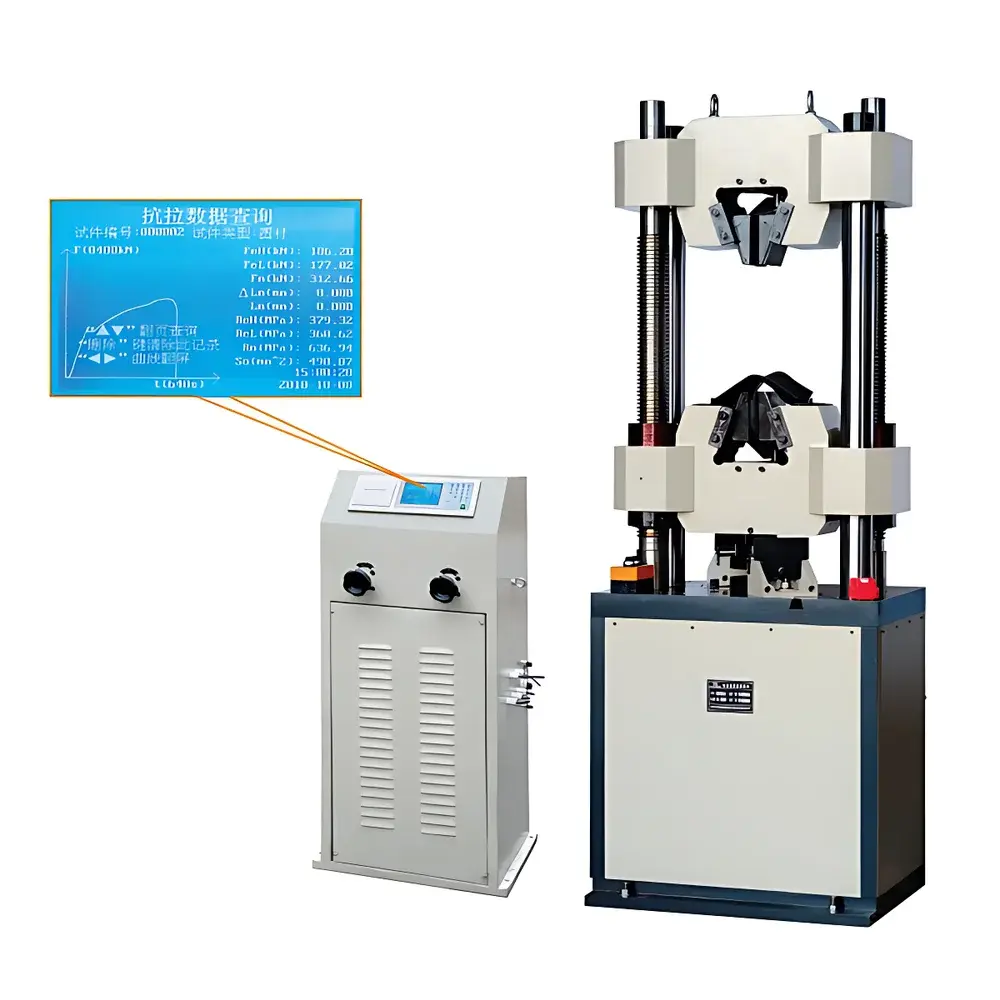
Jiubin JB/WE-600B Digital Display Hydraulic Universal Testing Machine
| Brand | Jiubin |
|---|---|
| Origin | Shanghai, China |
| Model | JB/WE-600B |
| Type | Hydraulic Universal Testing Machine |
| Max Test Force | 600 kN |
| Force Measurement Range | 24–600 kN |
| Force Accuracy | ≤ ±1% of reading |
| Force Resolution | 0.01 kN |
| Tensile Space | 650 mm |
| Compression Space | 380 mm |
| Piston Stroke | 150 mm |
| Round Specimen Grip Range | Φ13–Φ40 mm |
| Flat Specimen Grip Thickness | 0–15 mm |
| Flat Specimen Grip Width | 75 mm |
| Compression Platen Diameter | φ160 mm |
| Bend Span (Two-Point) | 450 mm |
| Bend Support Roller Width | 120 mm |
| Bend Support Roller Diameter | Φ30 mm |
| Piston Speed | 50 mm/min |
| Clamping Method | Manual |
| Host Dimensions (W×D×H) | 720×580×2100 mm |
| Control Console Dimensions (W×D×H) | 1000×700×1400 mm |
| Sensor Manufacturer | Ningbo Zhenhai |
| Control System | Proprietary Jiubin Electronics |
Overview
The Jiubin JB/WE-600B Digital Display Hydraulic Universal Testing Machine is a robust, oil-cylinder-underneath configured mechanical testing system engineered for precision static mechanical property evaluation of metallic and non-metallic materials under tension, compression, bending, and shear loading conditions. Based on classical hydraulic actuation principles with load-cell transduction and real-time digital signal processing, the JB/WE-600B complies with fundamental mechanical testing methodologies defined in ISO 6892-1 (metallic tensile testing), ISO 7500-1 (static uniaxial testing machine verification), ASTM E4 (force verification of testing machines), and ASTM E8/E8M (tension testing of metallic materials). Its low-profile structural design—featuring a downward-mounted main cylinder—enhances spatial efficiency and operational stability, making it especially suitable for field laboratories, construction material quality control units, and prefabrication QA/QC environments where floor height constraints or mobile deployment are critical.
Key Features
- Hydraulic actuation system delivering consistent, controllable loading up to 600 kN nominal capacity, with verified force accuracy better than ±1% of reading across 4%–100% of full scale (per ISO 7500-1 Class 1 requirements)
- Digital force measurement via high-stability load cell (supplied by Ningbo Zhenhai), offering 0.01 kN resolution and real-time display of test force vs. time curves on integrated LCD interface
- Manually operated wedge-type gripping mechanism optimized for rapid specimen setup; accommodates round specimens from Φ13 mm to Φ40 mm and flat specimens up to 15 mm thick and 75 mm wide
- Dedicated compression platen (φ160 mm) and two-point bending fixture (span adjustable to 450 mm, rollers Φ30 mm × 120 mm width) enabling compliant execution of ISO 7438 (bend testing) and ISO 7500-1 compression verification protocols
- Integrated micro-printer for immediate hardcopy output of test parameters—including specimen ID, cross-sectional area input, ultimate tensile strength (Rm), yield strength (ReH/ReL), and modulus approximations—without external software dependency
- Proprietary electronic control unit developed by Jiubin, supporting manual parameter entry (e.g., specimen geometry), peak force capture, and post-test data recall for traceable recordkeeping
Sample Compatibility & Compliance
The JB/WE-600B supports standardized mechanical testing of ferrous and non-ferrous metals (e.g., structural steel, aluminum alloys, stainless grades), concrete cylinders, cementitious mortars, polymer composites, rubber compounds, and rigid plastics per applicable national and international standards. With appropriate auxiliary fixtures—including optional shear adapters, chain/guide wire holders, and tile/brick support frames—it extends compliance to GB/T 228.1, GB/T 7314, GB/T 232, as well as EN 10002-1 and JIS Z 2241. All force measurements are traceable to national metrological standards through factory calibration certificates issued per ISO/IEC 17025 requirements. The system architecture meets basic GLP documentation expectations for raw data integrity, including timestamped force readings and operator-logged specimen identifiers.
Software & Data Management
While the JB/WE-600B operates primarily via embedded firmware without PC-dependent software, its control console enables full local data handling: specimen identification numbers, nominal cross-sections, and test mode selection (tension/compression/bend) are entered via membrane keypad. Test results—including maximum load, yield point detection (for materials exhibiting distinct yielding), and displacement at break—are stored in non-volatile memory for retrieval and printed output. Audit-ready records include date/time stamps, operator ID fields (manually entered), and calibration validity indicators. For facilities requiring 21 CFR Part 11–compliant electronic records, third-party data acquisition modules may be interfaced via RS232 serial port (standard configuration), enabling integration into validated LIMS or QMS platforms with appropriate validation protocols.
Applications
- Mechanical certification of reinforcing bars (rebar), structural bolts, and welded joints in civil infrastructure projects
- Compressive strength verification of precast concrete elements, grout samples, and masonry units per ASTM C39/C109
- Tensile property characterization of sheet metal, extruded profiles, and cold-formed steel sections during incoming inspection
- Bending performance assessment of roofing tiles, ceramic panels, and fiber-cement boards per ISO 10545-4
- Quality conformance testing of lifting chains, anchor cables, and conveyor belt fasteners in industrial safety programs
- Educational laboratory use for undergraduate mechanics of materials courses, supporting hands-on demonstration of stress–strain behavior, necking phenomena, and ductile-to-brittle transitions
FAQ
What standards does the JB/WE-600B comply with for force measurement verification?
It conforms to ISO 7500-1 Class 1 requirements for static uniaxial testing machines, with factory calibration certified against national primary standards.
Can the machine perform tests requiring closed-loop strain or displacement control?
No—the JB/WE-600B operates in open-loop hydraulic pressure control mode with manual clamping and fixed-speed piston actuation (50 mm/min); it does not feature servo-valve or digital feedback control for strain-controlled ramping.
Is the load cell replaceable, and what is its typical service life?
Yes—the Ningbo Zhenhai load cell is modular and field-replaceable; under normal usage and periodic recalibration (recommended annually), service life exceeds 5 years with maintained metrological integrity.
Does the system support automatic calculation of Young’s modulus?
Not directly—the console displays force and displacement but lacks built-in slope analysis; modulus must be derived manually from linear-region stress/strain points using recorded data.
What maintenance is required for long-term reliability?
Routine tasks include hydraulic oil level checks, filter replacement every 1,000 operating hours, annual torque verification of grip assemblies, and biannual calibration of the load cell and displacement indicator per ISO 7500-1 Annex B.



