
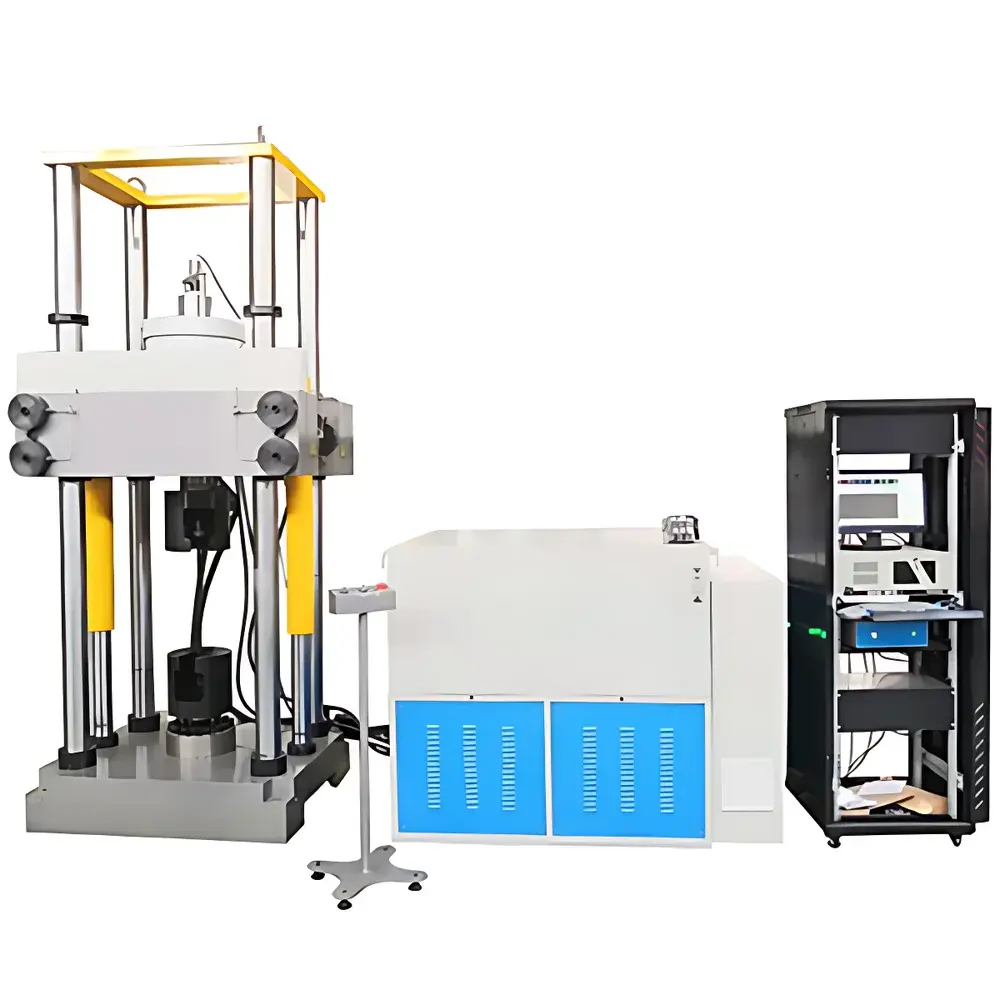
Jiubin JBWPW-200D Computer-Controlled Electro-Hydraulic Servo Fatigue Testing Machine
| Brand | Jiubin |
|---|---|
| Origin | Shanghai, China |
| Model | JBWPW-200D |
| Type | Electro-hydraulic Servo Fatigue Testing Machine |
| Max Test Force | ≥200 kN |
| Force Measurement Range | 2–100% FS |
| Force Accuracy | ±0.5% of reading |
| Actuator Stroke | ≥155 mm |
| Displacement Accuracy | ±0.5% FS, Resolution: 0.001 mm |
| Frequency Range | 0.01–52 Hz |
| Waveform Options | Sinusoidal, Triangular, Ramp, and Composite |
| Test Height Adjustment Range | 200–1200 mm |
| Effective Test Width | ≥620 mm |
| Amplitude-Frequency Performance | 3 Hz at ±1 mm peak-to-peak displacement |
Overview
The Jiubin JBWPW-200D Computer-Controlled Electro-Hydraulic Servo Fatigue Testing Machine is a high-stiffness, closed-loop dynamic testing system engineered for precision-controlled axial fatigue evaluation of structural components and engineering materials under cyclic loading conditions. Based on electro-hydraulic servo actuation technology, it delivers stable force and displacement control across a broad frequency spectrum (0.01–52 Hz), enabling rigorous simulation of service-life loading profiles in civil infrastructure, rail transit, aerospace fastening systems, and energy-sector anchoring assemblies. Its architecture complies with fundamental principles of linear elastic fracture mechanics (LEFM) and strain-controlled low-cycle fatigue (LCF) testing methodologies. The machine supports both force-controlled and displacement-controlled test modes, making it suitable for standardized axial fatigue tests per GB/T 3075–2008 (equivalent to ISO 1099) and specialized railway component validation per TB/T 3329–2013 — particularly for tunnel pre-embedded channel fatigue characterization (Clause 5.5.6) and integrated anchor-bolt–T-bolt assembly endurance assessment (Clause 5.5.7).
Key Features
- High-capacity electro-hydraulic servo actuator delivering ≥200 kN static and dynamic force output with dual-range load cell integration for optimal signal fidelity across 2–100% full scale.
- Robust twin-column frame with adjustable crosshead height (200–1200 mm) and ≥620 mm clear test width, accommodating large-scale structural specimens including steel tendons, anchor assemblies, and prefabricated composite joints.
- Precision displacement measurement via non-contact LVDT or high-resolution potentiometric transducer, achieving ±0.5% FS accuracy and 1 µm resolution over ≥155 mm stroke.
- Real-time waveform generation and closed-loop control supporting sinusoidal, triangular, ramp, and user-defined composite waveforms — essential for simulating complex in-service stress histories.
- Modular environmental integration capability: compatible with commercially available climatic chambers (-70°C to +300°C) for thermomechanical fatigue studies under ISO 12106 or ASTM E606 conditions.
- Integrated safety architecture including overload protection, emergency stop circuitry compliant with IEC 60204-1, and hydraulic pressure monitoring with automatic shutdown at threshold deviation.
Sample Compatibility & Compliance
The JBWPW-200D is validated for mechanical testing of metallic fasteners (e.g., high-strength bolts, post-tensioning anchorages), prestressed concrete reinforcement systems (including 7-wire steel strands), and railway infrastructure components such as embedded slot channels and T-bolt–anchor assemblies. Specimen geometries range from standard dog-bone coupons (per ASTM E8/E21) to full-scale field-representative assemblies requiring custom fixtures. All hardware and software functions adhere to metrological traceability requirements outlined in ISO/IEC 17025. Test procedures align with national standards GB/T 3075–2008 (metal fatigue, axial force control), TB/T 3329–2013 (railway contact network components), and international references including ISO 1099, ASTM E466, and EN 6072. Optional configuration supports GLP-compliant audit trails when paired with validated data acquisition modules.
Software & Data Management
The system operates under Jiubin’s proprietary FatigueTest Pro v4.x control and analysis platform, built on a deterministic real-time OS kernel for sub-millisecond command execution and synchronized multi-channel sampling (up to 10 kHz). Software features include automated test sequence scripting, live FFT-based spectral analysis, hysteresis loop plotting, and ΔK-driven crack growth rate calculation (da/dN) when interfaced with compliance-calibrated crack-mouth-opening-displacement (CMOD) sensors. Raw data export is supported in ASCII (.txt), CSV, and universal HDF5 formats. Audit-ready reporting includes operator ID, calibration certificate IDs, environmental chamber logs (if active), and digital signatures compliant with FDA 21 CFR Part 11 requirements upon optional electronic signature module activation.
Applications
- Dynamic fatigue life assessment of high-strength anchor systems used in bridge cable stays and wind turbine foundations.
- Validation of fatigue resistance in pre-embedded galvanized steel channels installed in high-speed rail tunnel linings.
- Low-cycle fatigue (LCF) characterization of welded joints and bolted connections under seismic loading spectra.
- Crack initiation and propagation testing using compact tension (CT) or single-edge notched bend (SENB) specimens per ASTM E399 and E647.
- Combined thermo-mechanical fatigue (TMF) studies when integrated with programmable environmental chambers.
- Quality assurance testing for OEM suppliers to rail infrastructure manufacturers requiring TB/T 3329–2013 certification.
FAQ
What standards does the JBWPW-200D support for railway component testing?
It fully implements TB/T 3329–2013 Clauses 5.5.6 and 5.5.7 for fatigue evaluation of embedded slot channels and integrated anchor–T-bolt assemblies.
Can the system perform crack growth rate measurements?
Yes — when equipped with CMOD or clip-gauge sensors and calibrated compliance functions, it calculates da/dN per ASTM E647 using load vs. displacement hysteresis integration.
Is the controller capable of arbitrary waveform synthesis?
Yes — the real-time control engine supports user-defined time-domain waveforms, including multi-step block cycles and transient overloads mimicking operational shock events.
What is the minimum resolvable displacement increment?
The system achieves 1 µm displacement resolution across its full 155 mm stroke range, verified per ISO 23718 calibration protocols.
Does the software meet regulatory data integrity requirements?
With optional 21 CFR Part 11 module enabled, it provides role-based access control, electronic signatures, and immutable audit trails for regulated QA/QC environments.



