
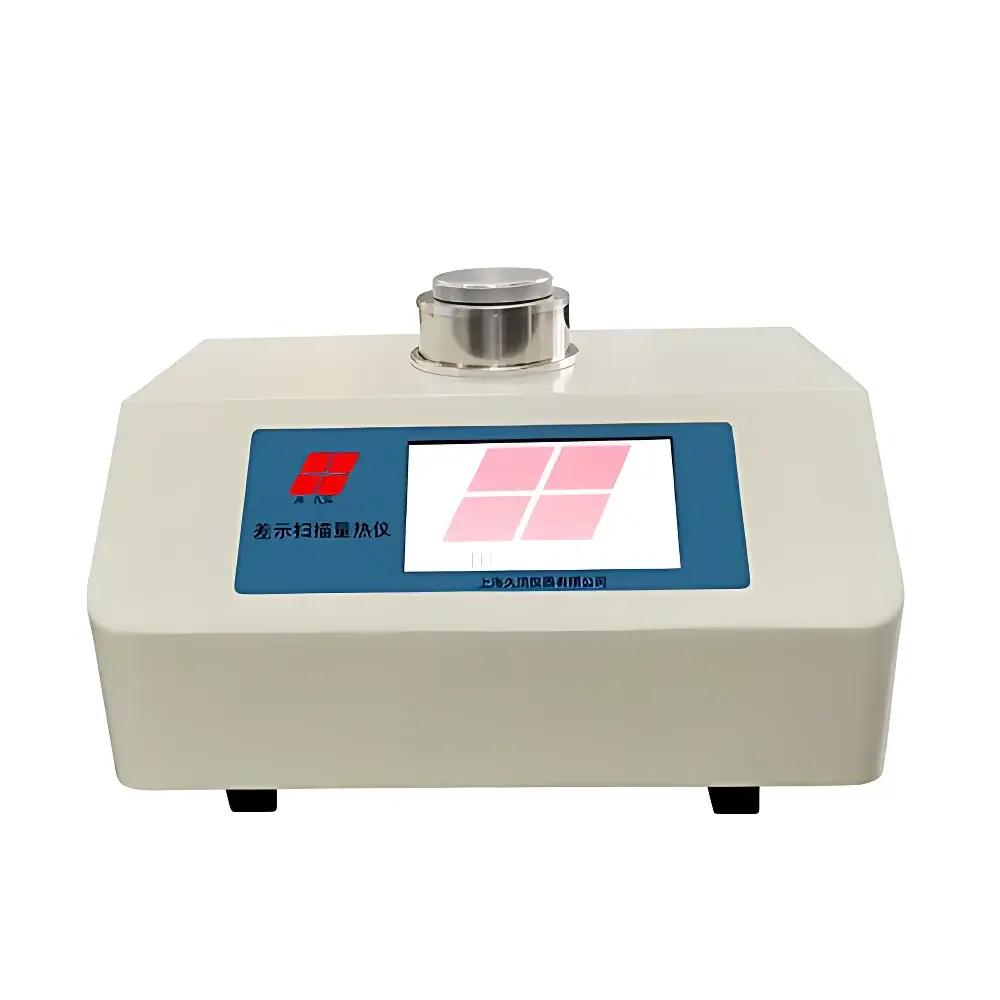
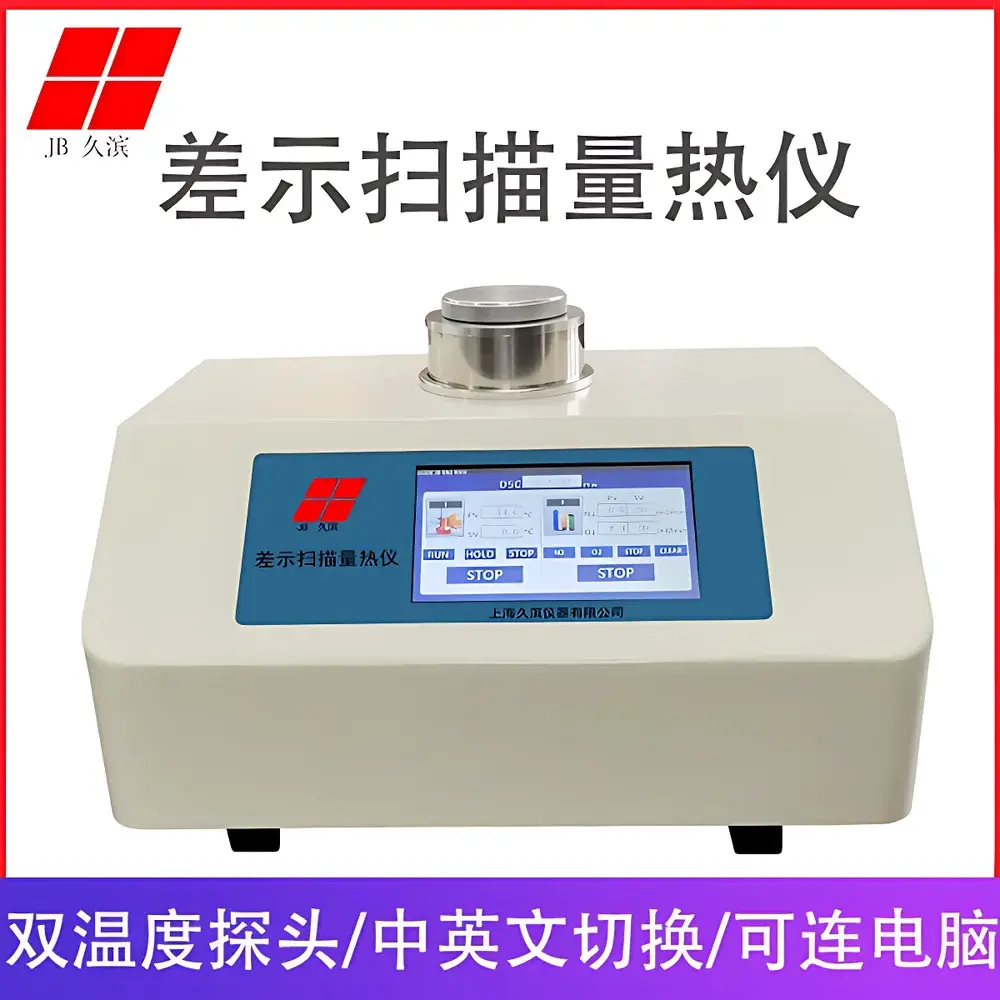
JB-DSC-350L Differential Scanning Calorimeter (–30 °C to 350 °C)
| Brand | Jiubin Instruments |
|---|---|
| Origin | Shanghai, China |
| Model | JB-DSC-350L |
| Sample Capacity | Single |
| Instrument Type | Heat-Flux DSC |
| Temperature Range | –30 °C to 350 °C (Peltier-cooled) |
| Temperature Accuracy | ±0.01 °C |
| Heating/Cooling Rate | 0.1–50 K/min |
| DSC Sensitivity Range | 0–600 mW |
| Display | 7-inch TFT LCD |
| Gas Control | Dual-channel mass flow controller with automatic switching |
| Thermal Control Mode | Linear heating and linear cooling |
| Optional Integration | External recirculating chiller for enhanced low-temperature stability |
Overview
The JB-DSC-350L is a precision heat-flux differential scanning calorimeter engineered for reliable thermal transition analysis across a broad operational range from –30 °C to 350 °C. Based on the fundamental principle of measuring differential heat flow between a sample and an inert reference under controlled temperature programs, this instrument delivers quantitative data on endothermic and exothermic events—including glass transitions (Tg), melting points (Tm), crystallization onset (Tc), phase changes, and reaction enthalpies. Its integrated Peltier-based semiconductor cooling system enables rapid, stable sub-ambient operation without liquid nitrogen dependency—ideal for routine QA/QC labs, polymer R&D, pharmaceutical solid-state characterization, and materials science applications where reproducibility and traceable thermal control are essential.
Key Features
- High-accuracy dual platinum resistance temperature detectors (RTDs) mounted directly on the sensor platform ensure ±0.01 °C temperature accuracy and exceptional run-to-run repeatability.
- Linear heating and cooling capability across the full temperature range supports standardized protocols per ASTM E794, ISO 11357, and USP <1163> for thermal behavior assessment.
- Automated dual-gas mass flow control allows seamless switching between purge gases (e.g., N2, O2, synthetic air) during a single experiment—critical for oxidative stability testing (e.g., OIT, OOT) and inert-atmosphere measurements.
- 7-inch high-resolution TFT LCD touchscreen provides real-time visualization of thermograms, baseline stability, and dynamic parameter feedback—eliminating reliance on external PCs during method setup or routine operation.
- Modular thermal design permits optional integration with external recirculating chillers for improved low-temperature stability below –20 °C, extending usable range while maintaining <0.1 K/min minimum ramp fidelity.
- Firmware and application software are delivered with perpetual free updates via secure HTTPS channel—ensuring long-term compatibility with evolving OS platforms and regulatory documentation requirements.
Sample Compatibility & Compliance
The JB-DSC-350L accommodates standard hermetic aluminum, gold-plated, or high-pressure stainless-steel crucibles (40 µL and 80 µL volumes), supporting solids, powders, films, gels, and small-volume liquids (≤25 mg typical). Crucible selection is guided by thermal conductivity needs, pressure constraints, and compatibility with ASTM E1953 (crucible calibration), ISO 11357-2 (baseline correction), and pharmacopeial methods (e.g., EP 2.2.42, JP 17). The system meets mechanical and electrical safety standards per IEC 61010-1 and supports GLP-compliant workflows through configurable audit trails, user access levels, and electronic signature-ready reporting modules aligned with FDA 21 CFR Part 11 principles.
Software & Data Management
The embedded DSC Analysis Suite provides intuitive workflow navigation—from method creation (ramp/isothermal/step-scan modes) to post-run baseline correction, peak integration, and multi-curve overlay. Raw data are stored in vendor-neutral ASCII (.txt) and universal .csv formats, enabling direct import into MATLAB, Origin, or statistical process control (SPC) platforms. Batch processing, automated report generation (PDF/Excel), and metadata tagging (operator ID, instrument serial, calibration timestamp) support laboratory information management system (LIMS) interoperability. All software modules undergo annual validation documentation review per internal SOP-QA-027.
Applications
- Polymers: Quantification of Tg, cold crystallization, melt enthalpy, and degree of crystallinity per ISO 11357-3.
- Pharmaceuticals: Polymorph screening, hydrate/dehydrate kinetics, excipient compatibility, and amorphous content estimation.
- Food Science: Fat crystallization profiling, starch gelatinization, and shelf-life prediction via oxidation induction time (OIT).
- Electronics: Thermal stability evaluation of encapsulants, solder pastes, and underfill materials.
- Academic Research: Teaching calorimetry fundamentals, kinetic modeling (e.g., Ozawa-Flynn-Wall), and multi-step reaction deconvolution.
FAQ
Does the JB-DSC-350L comply with ISO 11357 and ASTM E794?
Yes—its temperature calibration, sensitivity verification, and baseline linearity procedures follow the specified reference material protocols (e.g., indium, zinc, tin) outlined in both standards.
Can the instrument perform modulated DSC (MDSC®)?
No—the JB-DSC-350L implements conventional heat-flux DSC only; it does not support temperature-modulated measurement modes.
Is nitrogen purging mandatory for all experiments?
Not mandatory—but strongly recommended for oxidative samples or high-temperature runs (>200 °C); the dual-gas controller enables programmable gas switching within a single run.
What is the minimum sample mass required for reliable detection?
For most organic polymers and pharmaceuticals, ≥2 mg yields signal-to-noise ratios >10:1 at standard heating rates; lower masses may be used with extended integration times and optimized crucible geometry.
How often must the temperature calibration be performed?
Initial calibration is factory-verified; users should perform quarterly verification using certified reference materials, especially after maintenance or ambient environment shifts exceeding ±5 °C.



