
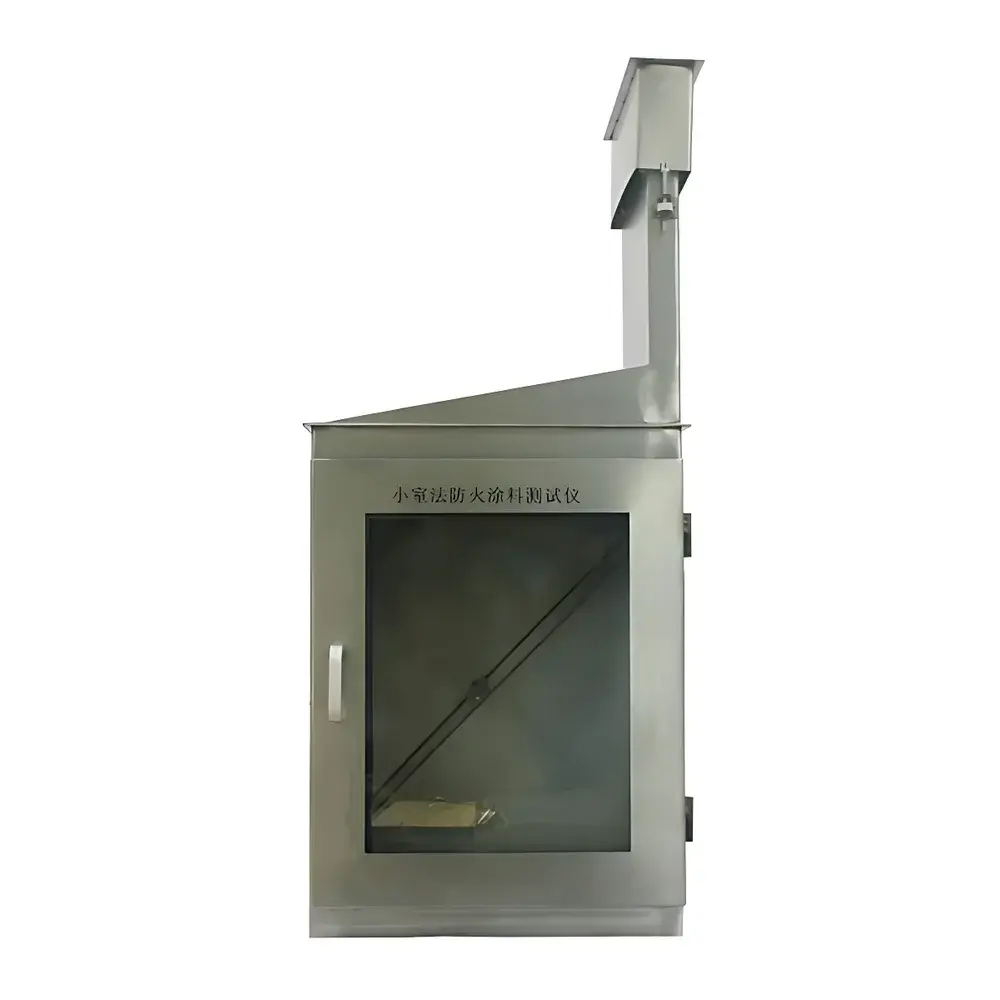
Jiubin Instruments JB/XSF-1 Fire Retardant Coating Tester (Small Chamber Method)
| Brand | Jiubin Instruments |
|---|---|
| Origin | Shanghai, China |
| Manufacturer Type | Authorized Distributor |
| Country of Origin | China |
| Model | JB/XSF-1 |
| Price Range | USD 1,400 – 7,000 |
| Application Domain | Intumescent and Flame-Retardant Coating Evaluation |
| Dimensions (L×W×H) | 340 mm × 230 mm × 794 mm |
| Specimen Holder Tilt Angle | 45° ± 2° |
| Copper Combustion Cup | OD 24.0 ± 0.1 mm, Wall Thickness 1.0 ± 0.06 mm, Height 17.0 ± 0.1 mm, Volume 6 mL |
| Fuel | Anhydrous Ethanol (Chemical Pure Grade) |
| Compliant Standard | GB 12441–2005 “Classification and Test Methods for Fire Performance of Surface-Type Fire-Retardant Coatings — Small Chamber Method” |
Overview
The Jiubin Instruments JB/XSF-1 Fire Retardant Coating Tester (Small Chamber Method) is a precision-engineered benchtop combustion test apparatus designed to quantitatively evaluate the flame-retardant efficacy of intumescent and non-intumescent coatings applied to flat substrates under controlled laboratory conditions. It implements the standardized small chamber method defined in GB 12441–2005, which measures two primary fire performance indicators: mass loss during controlled flaming exposure and char volume expansion after combustion cessation. These metrics provide objective, repeatable data for comparative assessment of coating formulations, batch consistency, and compliance verification—particularly for architectural, timber, and steel structural protection applications where regulatory documentation and third-party certification are required.
Key Features
- Compact, self-contained design with footprint under 0.1 m²—optimized for integration into QC laboratories and R&D facilities with space constraints.
- Adjustable specimen holder mounted on precision-machined pivot mechanism, enabling consistent 45° ± 2° tilt angle per GB 12441–2005 requirements to simulate real-world orientation effects on flame spread and charring behavior.
- High-purity copper combustion cup fabricated to strict dimensional tolerances (OD: 24.0 ± 0.1 mm; wall thickness: 1.0 ± 0.06 mm; height: 17.0 ± 0.1 mm; nominal volume: 6 mL), ensuring thermal uniformity and reproducible heat flux distribution during ethanol-fueled ignition.
- Chemical pure-grade anhydrous ethanol fuel delivery system with calibrated wick assembly, minimizing variability from moisture content or impurity-induced flame instability.
- Stainless steel housing with heat-resistant insulation layer and integrated ventilation port for safe exhaust routing—designed for operation within standard fume hoods or dedicated combustion testing enclosures.
- No embedded electronics or automated data logging; engineered for manual operator-controlled timing and post-test gravimetric/ volumetric measurement—aligning with the hands-on procedural rigor mandated by GB 12441–2005.
Sample Compatibility & Compliance
The JB/XSF-1 accommodates flat, rigid substrate specimens (e.g., wood, gypsum board, steel sheet) coated with liquid-applied or film-forming fire-retardant systems. Sample dimensions must conform to GB 12441–2005 specifications (typically 150 mm × 150 mm × (6–12) mm thick). The instrument does not support curved, porous, or thermally unstable substrates without prior conditioning or mechanical reinforcement. While GB 12441–2005 is its primary reference standard, test protocols may be adapted—under documented deviation—for internal screening against ASTM E84 (Surface Burning Characteristics) or ISO 5660-1 (Cone Calorimeter correlation studies), provided calibration traceability and operator training are maintained. The device itself carries no CE, UKCA, or UL certification; users are responsible for validating operational safety per local occupational health and fire codes (e.g., NFPA 1, OSHA 1910.120).
Software & Data Management
The JB/XSF-1 operates as a manual, analog test platform with no onboard software, firmware, or digital interface. All measurements—including pre-test mass (±0.001 g recommended balance), post-combustion mass, and char volume determination via displacement or geometric approximation—are recorded externally. Laboratories implementing GLP or GMP workflows commonly integrate this instrument into validated paper-based or LIMS-linked electronic notebooks, with audit trails documenting operator identity, ambient temperature/humidity, fuel lot number, and calibration status of ancillary equipment (e.g., analytical balance, calipers). While not compliant with FDA 21 CFR Part 11 out-of-the-box, full electronic record integrity can be achieved when paired with compliant documentation systems and SOPs governing data transcription, review, and retention.
Applications
- Quality control release testing of commercial intumescent coatings prior to shipment.
- Formulation development support for R&D teams optimizing char yield, expansion ratio, and afterflame duration.
- Batch-to-batch consistency verification for manufacturers supplying certified fire-rated assemblies.
- Technical due diligence during supplier qualification audits for construction material procurement.
- Educational use in fire science and materials engineering curricula demonstrating fundamental flame inhibition mechanisms.
FAQ
Does the JB/XSF-1 comply with international standards such as ASTM or ISO?
It is specifically engineered for GB 12441–2005. While test principles align conceptually with ASTM E162 (Radiant Panel) or ISO 5657 (Ignitability), direct equivalency requires protocol harmonization and interlaboratory validation.
Is the copper combustion cup replaceable, and where can spare cups be sourced?
Yes—cups are field-replaceable consumables. Jiubin Instruments supplies certified replacement cups with dimensional certificates; third-party cups require metrological verification prior to use.
Can the instrument be used with fuels other than anhydrous ethanol?
No. GB 12441–2005 mandates chemical pure-grade anhydrous ethanol. Substitution invalidates compliance and introduces uncontrolled variables in flame temperature and sooting behavior.
What maintenance is required to ensure long-term measurement stability?
Monthly visual inspection of cup integrity, cleaning of residue with acetone and lint-free cloth, and annual verification of tilt angle using calibrated digital inclinometer.
Is technical support available in English for overseas users?
Yes—Jiubin Instruments provides English-language documentation, remote troubleshooting, and application guidance via authorized regional distributors.



