
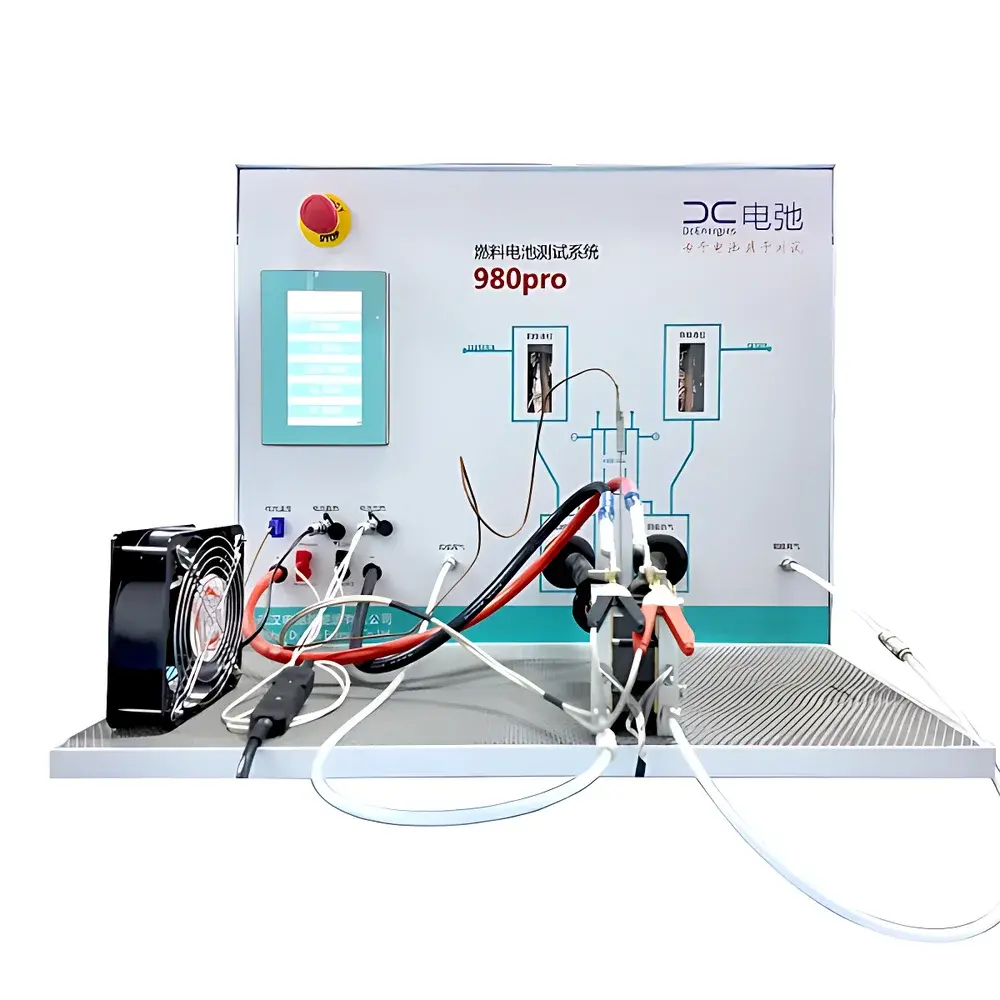
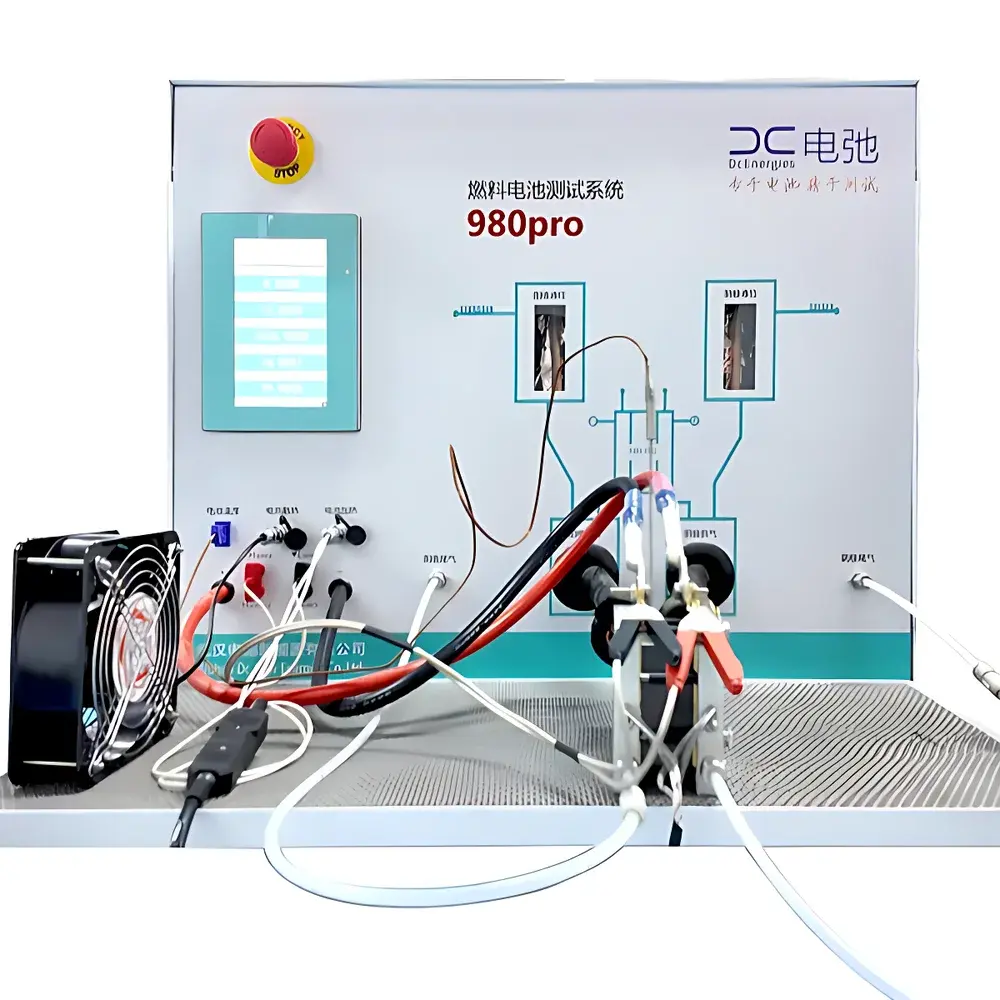
DC980 PEM Fuel Cell Testing System (Manual Backpressure) – dc-energies
| Brand | dc-energies |
|---|---|
| Origin | Hubei, China |
| Model | DC980 Manual Backpressure |
| Gas Flow Control (Anode) | 0–5 SLPM |
| Gas Flow Control (Cathode) | 0–10 SLPM |
| Humidification | Bubble-type, 20–90 °C, up to 100% RH |
| Temperature Sensing | T-type thermocouple |
| Max Power Load | 800 W (10 V/120 A) |
| Voltage Range | –0.7–2 V / –3.3–10 V |
| Voltage Resolution | 0.05 mV / 0.25 mV |
| Current Range | 0–24 A / 0–120 A (customizable) |
| Current Resolution | 0.4–4 mA |
| Data Acquisition Rate | 5 Hz |
| Safety | Integrated H₂ sensor (configurable alarm threshold: 1,000–40,000 ppm), dual-mode emergency shutdown (hardware/software), N₂ purge automation, PID-controlled humidifier & thermal management |
| Dimensions | 700 mm (H) × 700 mm (W) × 465 mm (D) |
| Weight | 55 kg |
| Volume | < 0.5 m³ |
Overview
The DC980 PEM Fuel Cell Testing System is a compact, research-grade electrochemical platform engineered for rigorous characterization of proton exchange membrane (PEM) fuel cells at the single-cell and short-stack level. Designed and manufactured by dc-energies (Wuhan, China), the system implements fundamental electrochemical measurement principles—including galvanostatic, potentiostatic, and power-controlled load protocols—alongside precise gas stoichiometry management, dynamic humidification control, and real-time thermal regulation. Its architecture adheres to core requirements for laboratory-scale PEMFC R&D: high-resolution current/voltage sourcing and sensing (±0.025% F.S. voltage accuracy, 5 Hz sampling), bubble-type humidification with PID-regulated temperature (20–90 °C), and integrated safety interlocks compliant with ISO 14687:2019 (hydrogen quality) and IEC 62282-2 (fuel cell safety). The system supports both dry and wet operating modes, enabling comparative studies of membrane hydration effects on ohmic resistance, mass transport losses, and catalyst layer kinetics—critical for MEA development, degradation mechanism analysis, and accelerated stress testing (AST).
Key Features
- Modular hardware design with standardized I/O interfaces, enabling integration with external climate chambers or auxiliary sensors (e.g., dew point analyzers, in-situ pressure transducers)
- Dual-channel mass flow control (MFC) with 0.01–100% full-scale range: anode (0–5 SLPM), cathode (0–10 SLPM), calibrated per ISO 6145-7 for traceable gas delivery
- Integrated bubble humidifiers (300 W each) with independent T-type thermocouple feedback and closed-loop PID temperature regulation
- Automatic N₂ purging sequence triggered by user command, safety event, or scheduled shutdown—ensuring inert atmosphere during idle or fault conditions
- Dual-mode operation: fully automated test sequences (scripted via software) and manual override with real-time parameter adjustment via front-panel controls
- Hardware-enforced safety layer including hydrogen leakage detection (electrochemical sensor, configurable 1,000–40,000 ppm threshold), emergency stop button, overcurrent/overvoltage cutoff, and fail-safe load disengagement
- Thermal management subsystem with active insulation zones for anode/cathode gas lines and cell fixture, minimizing thermal gradients across the MEA
- Front-panel dual-display interface showing real-time polarization data, humidifier status, gas pressures, and safety flag states
Sample Compatibility & Compliance
The DC980 accommodates standard PEMFC membrane electrode assemblies (MEAs) with active areas from 5 cm² to 100 cm², supporting both serpentine and parallel flow-field configurations. Fixture compatibility includes gasketed stainless-steel compression plates with uniform clamping force (adjustable 0.5–2.0 MPa) and integrated thermocouple ports adjacent to the catalyst layer. All wetted components are constructed from PTFE, EPDM, and 316L stainless steel to ensure chemical resistance against humidified H₂, O₂, and trace contaminants. The system meets functional safety requirements aligned with IEC 61508 (SIL 2) for embedded control logic and supports audit-ready operation under GLP-compliant workflows. Software-generated test reports include timestamped metadata, operator ID, calibration certificate references, and raw data checksums—facilitating traceability per ISO/IEC 17025 and FDA 21 CFR Part 11 (when deployed with validated electronic signature module).
Software & Data Management
dc-energies’ proprietary FCControl Suite provides a Windows-based GUI with hierarchical access levels (operator, engineer, administrator). Core capabilities include customizable test sequencing (via drag-and-drop workflow builder), real-time visualization of up to 16 synchronized channels (voltage, current, temperature, pressure, humidity), and automatic generation of polarization curves, EIS-ready datasets, and durability metrics (e.g., voltage decay rate, H₂ crossover increase). All acquired data are stored in HDF5 format with embedded schema definitions, ensuring long-term readability and interoperability with MATLAB, Python (h5py), and LabVIEW. Offline analysis tools support derivative-based identification of mass transport inflection points and Tafel slope extraction. The software architecture supports remote monitoring via secure HTTPS API and optional OPC UA server integration for enterprise-level SCADA connectivity.
Applications
- MEA screening and optimization: catalyst loading variation, ionomer equivalent weight assessment, substrate porosity impact on water management
- Accelerated stress testing (AST): relative humidity cycling, load cycling, open-circuit voltage hold, and start-stop protocol validation per DOE AST protocols
- Fuel impurity tolerance evaluation: CO, SO₂, NH₃, and NOₓ poisoning kinetics under controlled gas composition
- Dynamic response characterization: current ramping, step-load transient analysis, and impedance spectroscopy (EIS) across 0.1 Hz–10 kHz
- System-level integration studies: coupling with DC-DC converters, thermal management loops, or balance-of-plant (BOP) component emulation
- Teaching laboratories: hands-on instruction in electrochemical thermodynamics, reaction kinetics, and fuel cell system engineering principles
FAQ
What safety certifications does the DC980 system hold?
The DC980 complies with CE marking requirements for electromagnetic compatibility (EMC Directive 2014/30/EU) and low-voltage safety (LVD Directive 2014/35/EU). While not UL-listed as a standalone unit, its subsystems—including the hydrogen sensor, power supply, and programmable load—carry individual UL/CSA certifications. Full-system validation per UL 2261 is available upon request for OEM integration.
Can the system perform electrochemical impedance spectroscopy (EIS)?
Yes—the DC980’s 5 Hz data acquisition rate and <0.25 mV voltage resolution support low-frequency EIS measurements when paired with optional frequency response analyzer (FRA) firmware extension. Standard polarization testing includes built-in current perturbation capability for single-frequency impedance estimation.
Is remote operation supported?
Remote monitoring and control are enabled via Ethernet-connected FCControl Suite using TLS-encrypted WebSocket communication. Full script execution, real-time dashboard viewing, and alarm notification (email/SMS via SMTP gateway) are supported without local GUI interaction.
What customization options are available for non-standard MEA sizes or flow fields?
dc-energies offers mechanical redesign of the cell fixture, custom gasket tooling, and modified gas distribution manifolds. Electrical interface expansion (e.g., additional reference electrode inputs, auxiliary thermocouple channels) is supported through the system’s modular backplane architecture.
Does the software support automated compliance reporting for regulatory submissions?
Yes—test reports generated by FCControl Suite include mandatory elements for regulatory filings: instrument identification, calibration history, environmental conditions, raw data integrity hashes, and electronic signatures compliant with 21 CFR Part 11 when configured with time-stamped PKI authentication.






