
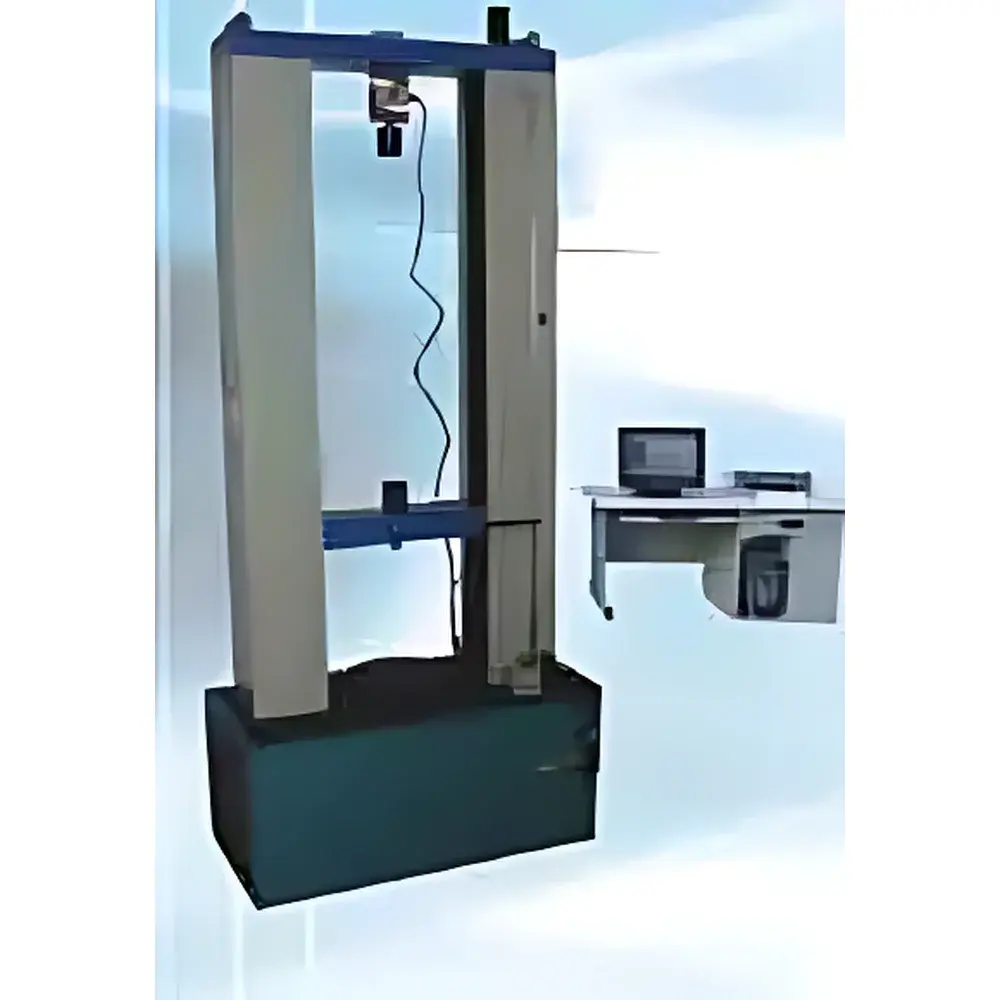
Jiubin JB-118 Universal Testing Machine
| Brand | Jiubin |
|---|---|
| Model | JB-118 |
| Capacity Range | 0–5 kN (user-selectable) |
| Load Cell | High-precision U.S.-made load cell |
| Load Accuracy | ±0.5% of full scale |
| Effective Test Width | 380 mm |
| Max. Tensile Span | 1000 mm |
| Drive System | Servo motor (Japan-made) + AC motor (Taiwan-made) |
| Mechanical Transmission | Precision ball screw (Taiwan-made) + High-strength backlash-free screw (Korea-made) |
| Test Speed Range | 0.001–500 mm/min (infinitely variable, dual-range selection) |
| Displacement Accuracy | ±0.005% of reading |
| Resolution | 1/200,000 |
| Safety Features | Upper/lower mechanical limits, emergency stop button |
| Display | Dual-mode — PC-based interface + embedded microcomputer display |
| Unit Options | g, kg, N, kN, lbf, lb |
| Power Supply | 220 V / 380 V, 50 Hz |
| Net Weight | 1080–1180 kg |
| Dimensions (W×D×H) | 1280 × 950 × 1800 mm |
| Fixture | Custom-configurable per specimen geometry and standard requirement |
| Optional Accessories | PC workstation, desktop printer, extensometer (two-point), proprietary test software |
Overview
The Jiubin JB-118 Universal Testing Machine is an electromechanical static materials tester engineered for precision mechanical property evaluation under tension, compression, flexure, and shear loading conditions. It operates on the principle of controlled displacement or load application via a servo-driven crosshead system, coupled with high-fidelity force transduction using a calibrated U.S.-manufactured load cell. Designed to meet fundamental requirements of ISO 6892-1 (tensile testing of metallic materials), ASTM E4 (load verification), ASTM E8/E8M (tensile testing of metals), and ISO 7500-1 (static uniaxial testing machines—verification of force measurement systems), the JB-118 delivers traceable, repeatable, and compliant test data across R&D laboratories, QC departments, and third-party certification facilities. Its dual-range speed capability (0.001–500 mm/min), combined with sub-0.005% displacement fidelity and ±0.5% load accuracy, supports both quasi-static ductility characterization and high-speed failure analysis in compliance with GLP and pre-audit-ready documentation workflows.
Key Features
- Modular drive architecture integrating Japan-sourced servo motors and Taiwan-sourced AC motors for optimal torque-speed response across low- and high-force regimes
- Dual-screw mechanical transmission system: precision-ground Taiwan ball screw for fine positioning; Korean high-rigidity backlash-free lead screw for structural stability during high-load compression tests
- High-resolution data acquisition: 1/200,000 internal resolution with real-time synchronization between load, displacement, and time axes
- Dual-display operation mode: standalone microcomputer controller for rapid setup and pass/fail checks; full-featured PC interface supporting customizable test protocols, curve overlay, and export to CSV/PDF/Excel formats
- Comprehensive safety interlock suite: dual mechanical end-stop limit switches, redundant emergency stop circuitry, and programmable software-defined load/displacement thresholds
- Configurable test space: 380 mm effective width and 1000 mm maximum tensile span accommodate ASTM-standard coupons, ISO-compliant specimens, and custom geometries up to Ø120 mm diameter or 80 mm thickness
Sample Compatibility & Compliance
The JB-118 accommodates a broad spectrum of solid material forms—including metallic rods, polymer sheets, composite laminates, elastomeric strips, ceramic tiles, and biomedical implants—via user-selected fixtures (e.g., wedge-action grips, pneumatic clamps, bend supports, shear adapters). All mechanical configurations conform to dimensional tolerances specified in ISO 527-2 (plastics), ASTM D638 (tensile plastics), ASTM D3039 (composite tensile), and EN 10002-1 (metals). Force calibration certificates are provided with NIST-traceable documentation, and the system supports periodic verification per ISO 7500-1 Class 1 requirements. Optional extensometer integration enables strain-controlled testing compliant with ASTM E83 (extensometer verification) and ISO 9513 (strain measurement accuracy).
Software & Data Management
The proprietary Jiubin TestSuite v3.2 software provides ISO 17025-aligned data governance: full audit trail logging (user ID, timestamp, parameter changes), electronic signature support, and version-controlled test method templates. Raw data files retain native resolution and metadata (test standard, specimen ID, environmental notes), and comply with FDA 21 CFR Part 11 requirements when deployed with Windows domain authentication and encrypted local storage. Export modules generate reports formatted for internal QA review or external submission to regulatory bodies—including automatic calculation of yield strength (Rp0.2), ultimate tensile strength (UTS), modulus of elasticity, elongation at break, and compressive yield stress.
Applications
- Tensile characterization of aerospace aluminum alloys (e.g., 7075-T6) per AMS 4027 and MIL-HDBK-5H
- Compression testing of pharmaceutical tablet hardness and friability per USP and Ph. Eur. 2.9.8
- Three-point flexural analysis of fiber-reinforced polymer beams per ASTM D7264
- Shear strength evaluation of adhesive joints in automotive bonding applications (SAE J1832)
- Creep and relaxation profiling under constant load (with optional load-hold function)
- Quality conformance verification for ISO 9001-certified manufacturing lines
FAQ
What standards does the JB-118 support out-of-the-box?
It natively implements test sequences aligned with ASTM E4, ISO 7500-1, ISO 6892-1, and ASTM D638—configurable via preloaded method templates.
Can the system be integrated into a LIMS or MES environment?
Yes—via TCP/IP or RS-232 serial communication, with structured XML/JSON output for automated ingestion into LabVantage, Thermo Fisher SampleManager, or Siemens Opcenter.
Is calibration documentation included with shipment?
Each unit ships with a factory calibration certificate referencing NIST-traceable standards, valid for 12 months from date of commissioning.
What is the recommended maintenance interval?
Preventive maintenance—including load cell zero drift check, screw lubrication, and encoder alignment—is advised every 500 operational hours or biannually, whichever occurs first.
Does the JB-118 support closed-loop strain control?
Strain control requires optional two-point extensometer hardware and corresponding firmware license; standard configuration operates in load- or displacement-control mode only.



