
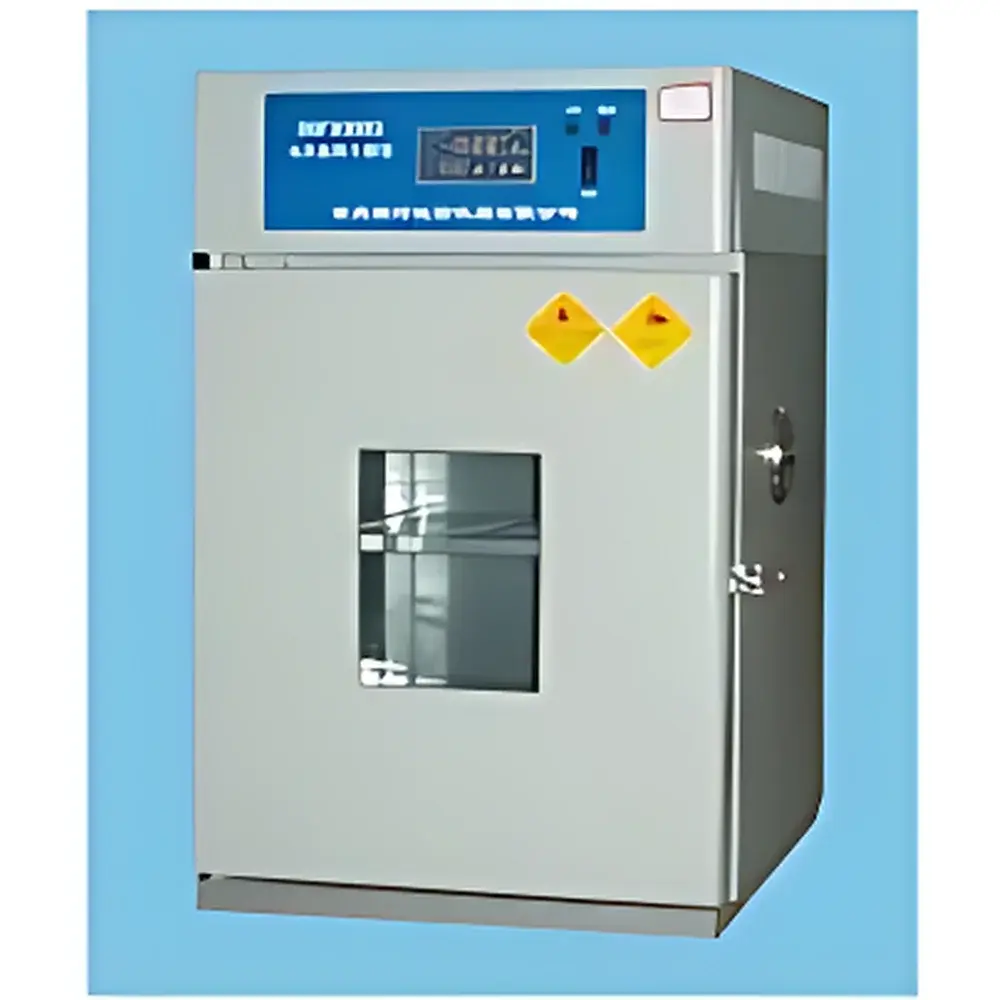
Jiubin JB-228 Steam Aging Test Chamber
| Brand | Jiubin |
|---|---|
| Origin | Taiwan |
| Model | JB-228 |
| Internal Dimensions (W×H×D) | 500 × 400 × 170 mm |
| Chamber Material | SUS304 Stainless Steel Interior & Exterior |
| Insulation | Polyurethane (PU) Foam |
| Heating Medium | Saturated Steam |
| Operating Temperature | 97 °C (±0.5 °C stability) |
| Temperature Sensor | PT-100 Platinum Resistance Thermometer |
| Control System | PID + SSR with Digital LED Display |
| Temperature Resolution | 0.1 °C |
| Timer Range | 1–999 min with End-of-Cycle Alarm and Automatic Power Cut-off |
| Water Level Management | Auto-refill Reservoir System |
| Power Supply | 220 V AC, 50/60 Hz |
| Ramp Time to Setpoint | Approx. 40 min |
| Safety Features | Dual-limit overtemperature protection, dry-run prevention, and fail-safe circuit interruption |
Overview
The Jiubin JB-228 Steam Aging Test Chamber is a precision-engineered environmental test system designed for accelerated thermal aging of electronic components under saturated steam conditions at a controlled temperature of 97 °C. Unlike conventional hot-air ovens, this chamber employs direct steam saturation to replicate high-humidity, elevated-temperature stress environments—critical for evaluating surface oxidation kinetics, solderability degradation, and intermetallic compound (IMC) growth at metal terminations. Its operational principle relies on maintaining a stable, condensate-saturated vapor phase within a thermally insulated stainless-steel chamber, enabling uniform thermal transfer and reproducible aging kinetics per IPC-TM-650 2.6.25 and JIS C 5023-3 standards. The unit is purpose-built for reliability validation in semiconductor packaging, passive component manufacturing, and PCB assembly process qualification.
Key Features
- Stainless steel construction (SUS304) for both internal and external chambers ensures corrosion resistance against prolonged steam exposure and facilitates cleaning under cleanroom-compatible protocols.
- Polyurethane (PU) foam insulation provides thermal retention efficiency exceeding 92%, minimizing energy consumption while maintaining ±0.5 °C temperature stability at setpoint.
- Digital PID + SSR temperature control system with PT-100 sensor feedback delivers 0.1 °C resolution and eliminates overshoot during ramp and soak phases.
- Integrated auto-refill water reservoir with level detection prevents dry-boil operation and supports unattended testing up to 999 minutes.
- Programmable timer with audible alarm and automatic main power disconnection upon cycle completion complies with IEC 61000-4-11 transient immunity requirements for lab equipment safety.
- Dual-stage overtemperature protection includes independent mechanical limit switch and electronic cut-off—certified to UL 61010-1 and EN 61010-1 functional safety criteria.
Sample Compatibility & Compliance
The JB-228 accommodates standard JEDEC trays (up to 300 mm × 200 mm footprint), QFP, SOIC, and chip-scale packages without modification. Its uniform steam distribution design meets the spatial temperature uniformity requirement of ±1.5 °C across the working volume (per ASTM E145-22 Class B specifications). The chamber supports compliance-driven test protocols including MIL-STD-202G Method 108 (moisture resistance), JESD22-A101 (steady-state humidity bias), and IPC-9701 (solder joint reliability assessment). All control logic and data logging functions are structured to support GLP/GMP audit trails when integrated with external validation software.
Software & Data Management
While the JB-228 operates as a standalone analog-digital hybrid instrument, its PID controller output signals (4–20 mA or 0–10 V) are compatible with third-party SCADA systems (e.g., LabVIEW, Ignition, or Siemens SIMATIC WinCC) for centralized monitoring and long-term trend analysis. Optional RS-485 Modbus RTU interface enables remote parameter setting, real-time temperature logging, and event-triggered data capture—including timer expiration, water-level alerts, and overtemperature faults. Data records conform to FDA 21 CFR Part 11 requirements when paired with validated electronic signature modules and audit-trail-enabled host software.
Applications
- Accelerated aging of leadframes, solder terminations, and wire-bond pads to assess Sn-Pb or Pb-free solder wetting performance prior to wave soldering.
- Oxidation rate quantification of Cu, Ag, and Ni surface finishes on discrete passives (resistors, capacitors, inductors) per IPC-J-STD-002D.
- Preconditioning of BGA and CSP packages before thermal cycling or drop testing per JEDEC JESD22-A104.
- Qualification of conformal coating adhesion under steam-saturated thermal stress (IPC-CC-830B Annex B).
- Reliability screening of automotive-grade connectors exposed to under-hood humidity-temperature profiles (SAE J2238).
FAQ
What is the maximum sample load capacity for uniform steam exposure?
The chamber’s effective working volume (500 × 400 × 170 mm) supports up to 12 standard JEDEC trays (240 × 180 mm) stacked on adjustable shelves—provided airflow and steam penetration paths remain unobstructed.
Does the unit meet ISO/IEC 17025 calibration traceability requirements?
Yes; the PT-100 sensor is factory-calibrated against NIST-traceable standards, and calibration certificates (including uncertainty budgets) are available upon request for laboratory accreditation purposes.
Can the JB-228 be used for IPC-J-STD-002D solderability testing?
It satisfies the steam aging preconditioning step (Section 4.2.2) at 97 °C for durations between 4 and 168 hours, provided external humidity verification (via calibrated hygrometer) confirms ≥98% RH within the chamber cavity.
Is steam generation internal or external to the chamber?
Steam is generated externally via an integrated electric boiler and delivered through a dedicated stainless-steel manifold—eliminating internal heating element contamination and ensuring consistent vapor quality.
What maintenance intervals are recommended for sustained accuracy?
Water reservoir and steam line descaling every 150 operating hours; PT-100 verification annually or after 500 cycles; door gasket inspection quarterly per preventive maintenance checklist (included in user manual).



