
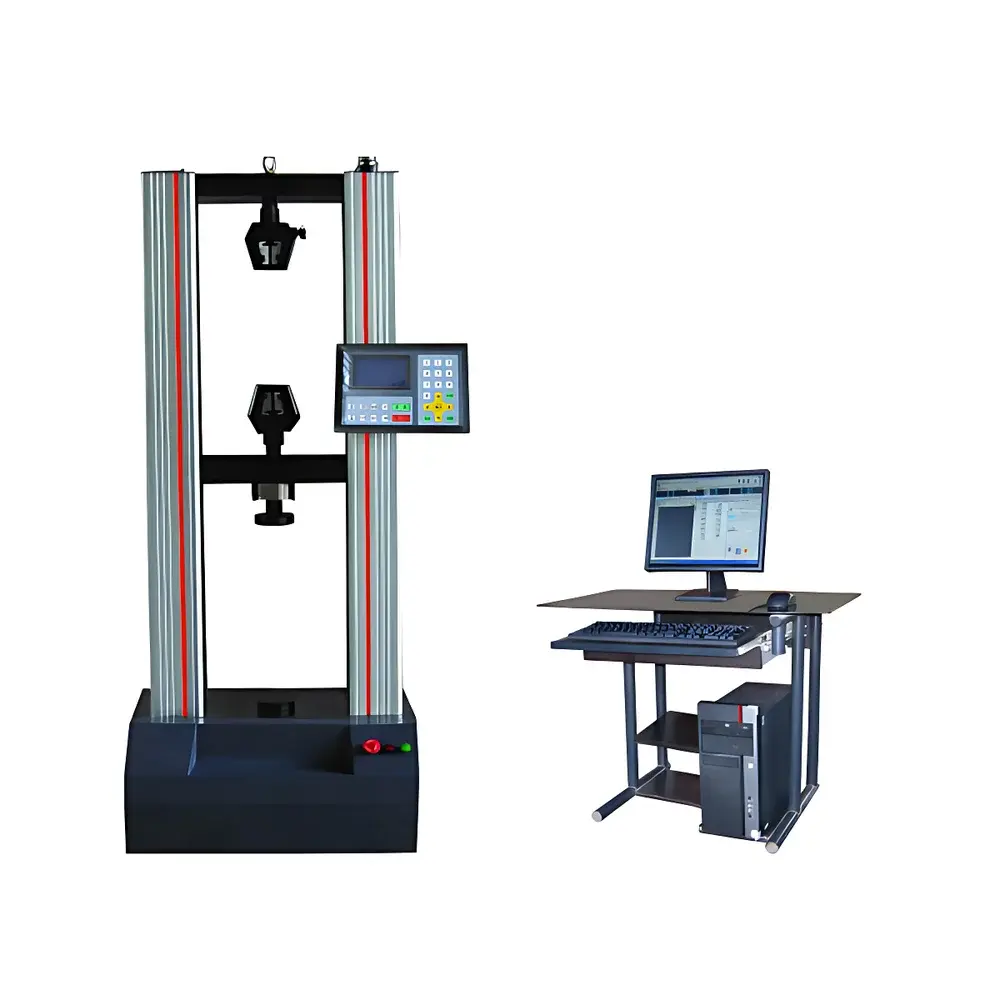
JB-117A Universal Testing Machine by Jiubin Instruments
| Key | Brand: Jiubin Instruments |
|---|---|
| Model | JB-117A |
| Max Test Load | 20 kN |
| Accuracy Class | ISO 7500-1 Class 0.5 |
| Load Resolution | 0.001 N |
| Speed Range | 0.01–500 mm/min |
| Effective Stroke | ~900 mm |
| Displacement Accuracy | ±0.005% |
| Load Cell Accuracy | ±0.05% |
| Control System | Full-digital triple-closed-loop (force, displacement, strain) |
| Drive Motor | Panasonic AC servo motor |
| Lead Screw | Precision ground ball screw (Taiwan-made) |
| Software | Windows-based, bilingual (EN/CN), ASTM/ISO-compliant data processing |
| Compliance | Meets ISO 6892-1, ASTM E4, ASTM E8, ASTM D638, ASTM D790, ISO 527, ISO 178, GLP audit trail capable |
| Weight | 270 kg |
| Dimensions (W×D×H) | 900 × 400 × 1600 mm |
| Power Supply | 220 V AC |
Overview
The JB-117A Universal Testing Machine by Jiubin Instruments is a high-precision electromechanical system engineered for static mechanical property characterization of metallic and non-metallic materials under uniaxial loading conditions. It operates on the principle of controlled force application via a servo-driven ball screw actuator, with real-time feedback from calibrated load cells, rotary encoders, and extensometer-compatible displacement sensors. Designed in strict accordance with ISO 7500-1:2018 (static calibration of force-proving instruments) and ISO 7500-2:2018 (verification of hardness testing machines), the JB-117A delivers Class 0.5 accuracy per international metrological standards. Its modular architecture supports seamless integration of optional extensometers, environmental chambers, and video extensometry systems—enabling full compliance with ASTM E8/E8M (tension testing of metallic materials), ASTM D638 (plastics tensile properties), ASTM D790 (flexural properties), ISO 527 (polymer tensile testing), and ISO 178 (flexural testing of plastics). The machine’s落地式 (floor-standing) structural design ensures torsional rigidity and minimal frame deflection during high-load compression or bending tests up to 20 kN.
Key Features
- Triple-closed-loop digital control system based on adaptive neuron PID algorithm, enabling simultaneous and independent regulation of force, displacement, and strain—without overshoot or mode-switching discontinuity.
- High-fidelity data acquisition: 1/300,000 internal resolution, 0.001 N force display resolution, and ±0.05% full-scale load accuracy verified per ISO 376.
- Panasonic AC servo motor coupled with Taiwan-sourced precision ground ball screw assembly, delivering smooth motion across the full speed range of 0.01–500 mm/min (±0.1% speed accuracy).
- Dual-display interface: Independent operation via embedded touchscreen controller and Windows-based PC software—both supporting identical test protocols and parameter sets.
- Comprehensive safety architecture: Dual-limit mechanical travel stops, overload emergency shutdown, leakage current protection, automatic break-point return, and configurable software-defined safety thresholds.
- Bilingual (English/Chinese) software with audit-ready data logging—including timestamped operator ID, parameter changes, calibration events, and raw channel data—fully compliant with FDA 21 CFR Part 11 requirements for electronic records and signatures.
- Extensible hardware interface: All peripheral ports conform to standard USB 2.0 specifications; no proprietary connectors required for accessories such as pneumatic grips, hydraulic wedge clamps, or high-temperature furnaces.
Sample Compatibility & Compliance
The JB-117A accommodates specimens ranging from ultra-thin polymer films (≥10 µm thick) to structural steel coupons (up to 20 mm thickness), provided within its 900 mm effective stroke and standard 400 mm × 400 mm test zone. Standard configurations include wedge-action tensile grips, compression platens, three-point bend fixtures, and peel test fixtures—all machined to ISO 2041 tolerances. Optional accessories include pneumatic vise grips (for high-throughput QA labs), video extensometers (for non-contact strain measurement per ISO 9513), and environmental chambers (−70 °C to +300 °C) for temperature-dependent mechanical analysis. All test methods executed on this platform are traceable to national metrology institutes (NIM, China NMI) and internationally recognized reference standards including NIST SRM 2241 (tensile calibration standards) and BAM Reference Materials for polymer modulus verification.
Software & Data Management
The bundled JiubinTest™ software (v5.3+) runs natively on Windows 10/11 and provides full GLP/GMP-aligned data governance. Core capabilities include automated calculation of yield strength (Rp0.2, Rp0.1), ultimate tensile strength (UTS), Young’s modulus, elongation at break, fracture toughness proxies (e.g., J-integral estimation), peel adhesion energy (J/m²), and shear strength (ASTM D1002). Raw data streams are saved in HDF5 format with embedded metadata (test method ID, operator, calibration certificate number, environmental conditions). Export options include CSV, XML, PDF reports with embedded stress–strain curves, and direct integration with LIMS via ODBC drivers. All user actions—including test initiation, parameter modification, and report generation—are logged with SHA-256 hashed timestamps and linked to authenticated operator accounts.
Applications
This system serves routine quality control and R&D applications across multiple sectors: tensile/compression testing of aerospace-grade aluminum alloys (per AMS 4027); peel strength validation of medical device adhesive laminates (ISO 10993-16); flexural modulus determination of biodegradable PLA filaments (ASTM D790); puncture resistance of protective textile membranes (EN 388); and creep compliance profiling of thermoplastic elastomers (ISO 899-1). In academic settings, it supports fundamental studies in viscoelastic constitutive modeling, damage evolution in fiber-reinforced composites, and size-effect scaling in nanomaterial thin films—when paired with optional digital image correlation (DIC) modules.
FAQ
What international standards does the JB-117A comply with for force calibration?
It conforms to ISO 7500-1:2018 Class 0.5, with factory calibration traceable to NIM (National Institute of Metrology, China) and optionally certifiable to UKAS or DAkkS upon request.
Can the system perform cyclic loading or fatigue tests?
No—the JB-117A is designed exclusively for quasi-static monotonic and ramp-hold testing. For dynamic or high-cycle fatigue, consider the JB-FAT series with electrodynamic actuation.
Is third-party software integration supported (e.g., MATLAB, LabVIEW)?
Yes—DLL-based API and TCP/IP protocol support enable bidirectional communication for custom automation scripts and real-time data streaming.
What is the maximum specimen height allowable under the crosshead?
With standard platens installed, usable vertical clearance is 900 mm; extended columns increase this to 1200 mm (optional configuration).
Does the software meet FDA 21 CFR Part 11 requirements for regulated industries?
Yes—full electronic signature workflow, role-based access control, immutable audit trails, and electronic record archiving are implemented and validated per IQ/OQ protocols.



