
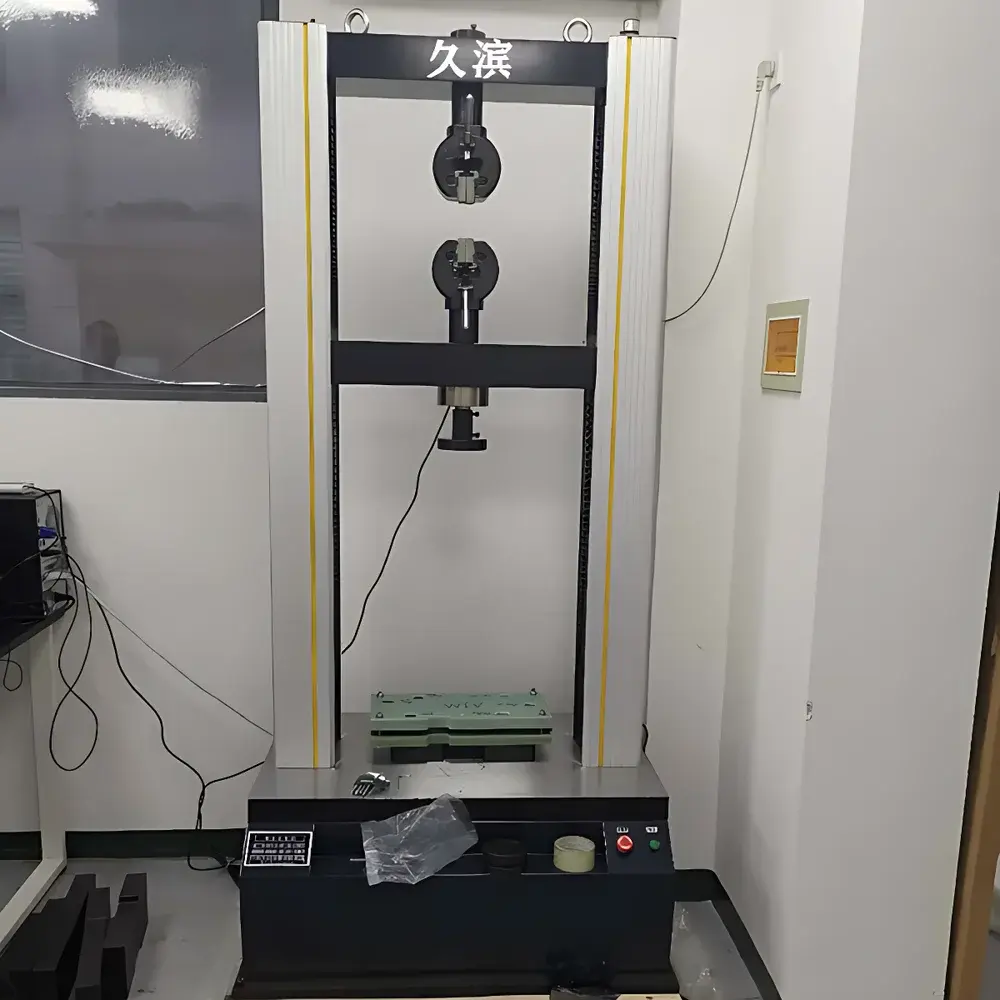
Jiubin JB-117A Automotive Seat Belt Tensile Testing Machine
| Brand | Jiubin Instruments |
|---|---|
| Origin | Taiwan |
| Model | JB-117A |
| Instrument Type | Electronic Universal Testing Machine |
| Compliance Standards | GB/T 16491–1996, GB/T 228.1–2010, GB/T 16825.1–2008, ASTM E8M–2013a, GB/T 7124–2008, GB/T 1040.1–2018, GB/T 9341–2008 |
Overview
The Jiubin JB-117A Automotive Seat Belt Tensile Testing Machine is an electronically actuated universal testing system engineered for high-reproducibility mechanical characterization of safety-critical restraint components. It operates on the principle of controlled axial force application via a precision ball-screw-driven crosshead, with load measurement performed by a calibrated S-type or inline load cell (typically 5 kN or 10 kN capacity, configurable per user specification). The machine implements closed-loop servo control to maintain constant strain rate, constant crosshead speed, or constant load rate—essential for compliance with standardized tensile protocols such as ISO 527, ASTM D638, and GB/T 228.1. Designed specifically for automotive seat belt webbing, pretensioners, retractor assemblies, and anchorage hardware, the JB-117A delivers traceable, repeatable force-displacement data under ambient laboratory conditions (23 ± 5 °C, 40–60% RH), supporting both R&D validation and in-line QC release testing.
Key Features
- Microprocessor-controlled digital display console with intuitive menu navigation and real-time load/extension readout
- High-rigidity dual-column frame with reinforced base plate and precision-ground guide rails for minimal deflection during high-load testing
- Adjustable crosshead travel range (up to 1000 mm standard) accommodating extended gage lengths required for seat belt elongation assessment
- Interchangeable grip systems: pneumatic wedge grips for woven polyester webbing, serrated vise grips for metal D-rings and anchor plates, and peel fixtures compliant with ASTM D903 (180° peel) and ASTM D1876 (T-peel)
- Overload protection circuitry and emergency stop button meeting IEC 60204-1 safety requirements
- Calibration traceable to national metrology institutes (NML/Taiwan or CNAS-accredited labs) with documented uncertainty budgets per ISO/IEC 17025
Sample Compatibility & Compliance
The JB-117A accommodates specimens ranging from narrow-width textile webbing (25–50 mm width, up to 3 m length) to stamped steel anchor brackets and injection-molded plastic buckles. Its modular fixture interface supports standardized test configurations including: axial tensile loading per FMVSS 209 / ECE R16 Annex 4; static strength evaluation of retractor locking mechanisms; and dynamic pre-load simulation for inertia reel testing (when paired with optional drop-weight accessories). All mechanical test procedures align with regulatory frameworks governing automotive passive safety systems—including UN Regulation No. 16, ISO 6487:2012 (data channel definition), and SAE J1592 (seat belt assembly performance criteria). The system satisfies GLP documentation requirements through audit-ready test log generation and operator ID tagging.
Software & Data Management
While the base JB-117A operates via standalone LCD controller, optional PC-based software (Jiubin TestSuite v3.x) enables advanced data acquisition at up to 100 Hz sampling rate, automated calculation of yield strength, ultimate tensile strength (UTS), elongation at break, modulus of elasticity, and energy absorption (area under stress–strain curve). Raw data exports to CSV or XML formats ensure compatibility with LIMS platforms and statistical process control (SPC) tools. Software modules include password-protected user roles, electronic signature capability, and full 21 CFR Part 11 compliance features—audit trail logging, data integrity checks, and immutable record archiving. Calibration history and maintenance logs are embedded within each test report.
Applications
- Verification of seat belt webbing tensile strength and elongation per FMVSS 209 Clause 4.2 and ECE R16 Paragraph 6.2.1
- Static load testing of tongue-and-buckle interfaces under 13.3 kN minimum requirement (ECE R16 Annex 4)
- Compression testing of energy-absorbing pretensioner housings per ISO 13232-3
- Peel strength assessment of adhesive-bonded webbing end terminations (GB/T 7124–2008)
- Flexural rigidity evaluation of retractable spool assemblies using three-point bending fixtures
- Quality conformance screening of incoming raw materials (polyester filament yarns, stainless steel wire ropes, die-cast zinc alloy components)
FAQ
What standards does the JB-117A support for automotive seat belt certification?
It fully supports FMVSS 209, ECE R16, ISO 13232, and GB/T 228.1–2010, with fixture configurations validated against each standard’s dimensional and procedural requirements.
Can the system perform cyclic fatigue testing?
The base configuration is optimized for static and quasi-static tests; optional servo-hydraulic add-ons or third-party waveform generators may extend functionality to low-cycle fatigue (LCF) per ISO 1099, though not natively supported.
Is calibration documentation provided with delivery?
Yes—each unit ships with a factory calibration certificate referencing NML/Taiwan standards, including load cell linearity error (< ±0.5% FS), displacement resolution (0.01 mm), and repeatability data (≤0.2% RSD at 80% FS).
What is the maximum specimen thickness accommodated by standard grips?
Standard wedge grips accept specimens up to 15 mm thick; custom jaw inserts are available for thicker metallic anchors or composite laminates.
Does the system meet ISO/IEC 17025 requirements for accredited testing labs?
When operated with certified calibration records, validated fixtures, and documented SOPs, the JB-117A serves as a compliant platform for ISO/IEC 17025 scope accreditation—subject to lab-specific validation per clause 7.7.



